Instant images, climate, earthquakes, and more, found on new mobile app
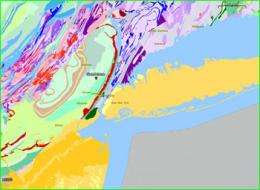
A new mobile application provides users with simplified access to vast libraries of images and information that up until now were tapped mainly by earth and environmental scientists. The EarthObserver App, for the iPhone, iPad or iPod Touch, displays natural features and forces on land, undersea and in the air. Created at Columbia University’s Lamont-Doherty Earth Observatory, it works on an intuitive level with touches of the fingers, drawing on dozens of frequently updated databases from institutions throughout the world. For a limited time, it may be downloaded free at the education section of the Apple app store. The app will eventually retail for a small fee.
With EarthObserver, users can zoom into and explore meandering Pacific deep-sea canyons, or ripple marks in New York harbor; visualize earth’s tectonic plates and their rates of movement; call up histories of earthquakes, volcanoes and other hazards in specific places; view plankton productivity at river mouths; see Arctic ice cover during different months of the year, or temperatures past and present across the world; plot human populations and indexes of their well-being; or access maps of cloud cover, permafrost or rock types. The application comes with overlays of political boundaries, and includes charts of U.S. offshore waters and lakes, as well as topographical maps of the United States suitable for planning hikes. Many datasets are updated monthly as new information comes in from satellites, research ships and other sources.
“This exposes the public to far richer data than has ever been available, in a form that has enormous potential beyond the flat screen of a computer,” said William B. Ryan, a marine geologist at Lamont who directed the project. Ryan sees benefits for students, educators and scientists, along with the general public. The ability to pan, zoom, and call up the names of features, their elevations and other information with the fingers “gives you a tactile experience of touching the earth that results in a real retention of information,” he said. “It takes what traditionally has been in a big atlas with a complex legend and allows you to just tap your way in.”
Among other databases feeding EarthObserver, Lamont’s own Marine Geoscience Data System supplies the oceanography. Scientists have already been accessing this data on conventional computers via the observatory’s GeoMapApp and 3-D Virtual Ocean; but while free to the public, those research-oriented tools are complex to manipulate. GeoMapApp, for instance, currently has only about 4,000 users, mostly scientists. “This completely simplifies it and makes it easy to use,” said Ryan.
Other features of EarthObserver:
--Digital elevations for the entire planet’s lands and ocean beds
--Overlays of thematic content on the base map, with adjustable opacity
--Text and numerical values for many themes, revealed at location by finger taps
--For the first time, the true colors of the sub-seafloor, based on 10,000 sediment cores from the world’s oceans warehoused at Lamont.
“This gives consumers a look at the world in a way they’ve never seen it before,” said Calvin Chu, a senior licensing officer for Columbia Technology Ventures, which licensed the app. “It’s the first of its kind that encapsulates this much information.”
The U.S. National Science Foundation has supported compilation of EarthObserver’s base map, with its detailed land elevations and seabed depths. Ryan emphasized that ongoing synthesis of other data has come from thousands of scientists, technicians and crew members aboard research ships and on land, and government agencies that have been making all kinds of charts since the 1930s, along with data now coming in from satellites run by NASA and related institutions.
Provided by Columbia University


