Better indoor air starts with minerals
January 5, 2011

Better indoor air starts with minerals

Enlarge

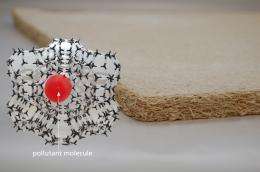
The structural model of a mineral with the dispersed pollutant molecule. When it is introduced into particleboards, the mineral reduces formaldehyde emissions from the wood material. Credit: Fraunhofer ISC

One of the sources of emission for pollutants in living spaces are particleboards glued with adhesives that contain formaldehyde. There is a new method that will now provide another way to reduce these vapors. The trick can be found in special minerals that equip wood materials with properties for cleaning air in living spaces.

Since the 50s, has been the basic material for many artificial resins and glues used in particleboards and plywood boards. Estimates indicate that more than 85 percent of all wood materials have containing formaldehyde. This substance escapes from the materials and, along with other sources, pollutes . This is why numerous ways have been developed to reduce emissions, and the International Agency for Research on Cancer (IARC) of the World Health Organization WHO has even classified formaldehyde as carcinogenic for humans. Thereupon both the existing threshold value of 0.1 ppm issued by Germany’s then-Federal Health Office in 1977 and WHO’s standard value of 100 micrograms per cubic meter have been confirmed.

Researchers at the Fraunhofer Institute for Wood Research, Wilhelm-Klauditz-Institut WKI in Braunschweig, Germany, and the Fraunhofer Institute for Silicate Research ISC in Würzburg, Germany, have found a new method to reduce formaldehyde emissions from particleboard: modified zeolites. These are aluminosilicates that function as a molecular sieve due to their extremely large inner surface and porous structure so that they can absorb formaldehyde particularly well. Dr. Katrin Bokelmann ought to know because she is the project manager at the Fraunhofer Institute for Silicate Research who, along with her team, is in charge of manufacturing compounds. As she puts it: “Zeolites are already used as a filling material in particleboards, but it’s an entirely new idea to use them for adsorbing pollutants in wood materials.”

The researchers were not able to achieve sufficiently high rates of adsorption in their tests of various commercially available or natural minerals. The best adsorption properties of these aluminosilicates were measured in synthetic zeolite Y, which the experts modified and improved with amino groups. Dr. Jan Gunschera is the project manager at the Fraunhofer Institute for Wood Research and this is how he sees it: “We noticed a 70 percent boost in the adsorption rate after we added formaldehyde to the processed material in our measuring chambers and then we put five percent by weight of the zeolite powder directly into our sample particleboards made of spruce roundwood. The result was that formaldehyde emissions from the board dropped 40 percent – both short-term and long-term tests of one month confirm these findings. In other words, the air in living spaces should be measurably improved. Our tests indicate that this technology can even reduce indoor air pollutant levels.” The properties of the wood materials did not undergo any negative influence from the zeolites, it was reported.

The researchers have applied for a patent for the new technique and think that modified zeolites – worked into furniture or ceiling panels – could conceivably reduce not only formaldehyde but also other aldehyde levels in indoor air. Scientists are currently looking for partners from the wood materials industry to mass-produce particleboards. A sample panel is on display at the Bau fair in Munich, Germany, from January 17 to 22 at Fraunhofer’s joint stand.

Provided by Fraunhofer-Gesellschaft search and more info website


Rank 3 /5 (2 votes)
Relevant PhysicsForums posts
  • Schwartz reagent-- NMR/MS/IR
    created4 hours ago
  • Inversion temp
    created9 hours ago
  • High school chemistry EEI
    created16 hours ago
  • oxidation of I- by KMnO4
    createdMay 25, 2012
  • Invesion temp
    createdMay 25, 2012
  • Hybridization of SnCl3 -
    createdMay 25, 2012
  • More from Physics Forums - Chemistry

More news stories

High-speed method to aid search for solar energy storage catalysts

Eons ago, nature solved the problem of converting solar energy to fuels by inventing the process of photosynthesis.

Chemistry / Materials Science

created 22 hours ago | popularity 5 / 5 (3) | comments 3 | with audio podcast

From lemons to lemonade: Reaction uses carbon dioxide to make carbon-based semiconductor

(Phys.org) -- A materials scientist at Michigan Technological University has discovered a chemical reaction that not only eats up the greenhouse gas carbon dioxide, it also creates something useful. And, by ...

Chemistry / Materials Science

created May 21, 2012 | popularity 4.7 / 5 (88) | comments 28 | with audio podcast

Researchers demonstrate possible primitive mechanism of chemical info self-replication

(Phys.org) -- When scientists think about the replication of information in chemistry, they usually have in mind something akin to what happens in living organisms when DNA gets copied: a double-stranded molecule ...

Chemistry / Materials Science

created May 25, 2012 | popularity 5 / 5 (4) | comments 2 | with audio podcast

New CO2-removing catalyst can take the heat

(Phys.org) -- The current method of removing the greenhouse gas carbon dioxide (CO2) from the flues of coal-fired power plants uses so much energy that no one bothers to use it. So says Roger Aines, principal ...

Chemistry / Materials Science

created May 24, 2012 | popularity 5 / 5 (7) | comments 7 | with audio podcast

Castor oil: Action mechanism of one of the oldest drugs known to man elucidated

Castor oil is known primarily as an effective laxative; however, it was also used in ancient times with pregnant women to induce labour. Only now have scientists at the Max Planck Institute for Heart and Lung ...

Chemistry / Biochemistry

created May 21, 2012 | popularity 3 / 5 (2) | comments 3 | with audio podcast


SpotterRF debuts Radar Backpack Kit (w/ Video)

(Phys.org) -- SpotterRF has announced a special radar backpack kit designed to enhance situational awareness for soldiers on the ground. The company says its special radar is designed for warfighters as part ...

Australia hails surprise super-telescope decision

Australia has hailed a surprise decision giving it a role in a radio telescope project aimed at revolutionising astronomy, vowing to draw on its decades of experience in space science.

Astronomers seize last chance in lifetime for Venus Transit

Astronomers are gearing for one the rarest events in the Solar System: an alignment of Earth, Venus and the Sun that will not be seen for another 105 years.

SpaceX capsule has 'new car' smell, astronauts say

SpaceX's Dragon cargo vessel smells like a new car, said astronauts at the International Space Station after opening the hatches Saturday following the spacecraft's landmark mission to the orbiting lab.

Family history of Alzheimer's affects functional connectivity

(HealthDay) -- Cognitively normal individuals with a family history of late-onset Alzheimer's disease (AD) may display lower resting state functional connectivity in the default mode network (DMN) of the brain, ...

Thousands of shellfish found dead in Peru

Thousands of crustaceans were found dead off the coast of Lima following the mystery mass death of dolphins and pelicans, the Peruvian Navy said Friday.