Image: Holes in the Sun's corona
Jan 12, 2011
Credit: NASA/SDO/AIA

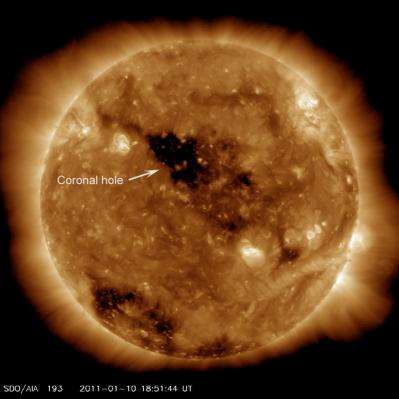
This Solar Dynamics Observatory image of the Sun taken on January 10 in extreme ultraviolet light captures a dark coronal hole just about at sun center.

Coronal holes are areas of the Sun's surface that are the source of open that head way out into space.

They are also the source regions of the fast solar wind, which is characterized by a relatively steady speed of approximately 800 km/s (about 1.8 million mph).

As the continues to rotate, the high speed solar wind particles blowing from this hole will likely reach in a few days and may spark some auroral activity.

The timelapse video below shows the coronal hole moving into full view.

This video is not supported by your browser at this time.
This timelapse video shows a coronal hole, as captured in ultraviolet light by NASA's Solar Dynamics Observatory on Jan. 10, 2011. Coronal holes are areas of the sun's surface that are the source of open magnetic field lines that head way out into space. They are also the source regions of the fast solar wind, which "blows" at a relatively steady clip of 1.8 million mph.


Explore further: NASA head views progress on asteroid lasso mission

add to favorites email to friend print save as pdf

Related Stories

SECCHI team obtains images of the solar wind at Earth

Dec 07, 2007

Using the Sun Earth Connection Coronal and Heliospheric Investigation (SECCHI) instruments on board NASA’s Solar Terrestrial Relations Observatory (STEREO) spacecraft, a consortium of scientists has seen, for the first ...

Scientists Explore the Mystery of Active Region Outflows

Jun 25, 2010

(PhysOrg.com) -- The Japanese Hinode spacecraft that launched in September 2006 contains the Extreme-ultraviolet Imaging Spectrometer (EIS), which provides measurements of properties of the solar corona such ...

3D Sun for the iPhone

Feb 17, 2010

Imagine holding the entire sun in the palm of your hand. Now you can. A new iPhone app developed by NASA-supported programmers delivers a live global view of the sun directly to your cell phone. Users can ...

The Sun's X-file under the Spotlight

Sep 03, 2004

One of the Sun's greatest mysteries is about to be unravelled by UK solar astrophysicists hosting a major international workshop at the University of St Andrews from September 6-9th 2004. For years scientists have been baffled ...

The Sun Loses its Spots

Jul 24, 2007

While sidewalks crackle in the summer heat, NASA scientists are keeping a close eye on the sun. It is almost spotless, a sign that the Sun may have reached solar minimum. Scientists are now watching for the ...

Recommended for you

Dark, massive asteroid to fly by Earth on May 31

10 hours ago

It's 1.7 miles long. Its surface is covered in a sticky black substance similar to the gunk at the bottom of a barbecue. If it impacted Earth it would probably result in global extinction. Good thing it is ...

Research team explains 'Lazarus' comets

13 hours ago

Astronomers from the University of Antioquia have discovered a graveyard of comets. These once-dormant comets, dubbed by astronomers as "The Lazarus comets," are now rejuvenated.

NASA ships sensors for seafaring satellite to France

14 hours ago

(Phys.org) —Three NASA-built instruments that are integral components of the next in a series of U.S./European ocean altimetry satellites have arrived in France for integration with their spacecraft in ...

Trip into space with DiCaprio costs $1.55m

14 hours ago

Leonardo DiCaprio is going to get closer to stars of a different kind as he heads into space aboard the Virgin Galactic, and a well-heeled bidder at the Cannes Film Festival has paid 1.2 million euros (1.5 million) to be ...

User comments : 0

More news stories

Galaxies fed by funnels of fuel

(Phys.org) —Computer simulations of galaxies growing over billions of years have revealed a likely scenario for how they feed: a cosmic version of swirly straws.

Dark, massive asteroid to fly by Earth on May 31

It's 1.7 miles long. Its surface is covered in a sticky black substance similar to the gunk at the bottom of a barbecue. If it impacted Earth it would probably result in global extinction. Good thing it is ...

Source of life running out: water scientists

The majority of people on Earth people will face severe water shortages within a generation or two if pollution and waste continues unabated, scientists warned at a conference in Bonn Friday.

Google eyes emerging markets networks

Google has become deeply involved in a series of projects to build and operate wireless networks in emerging markets including sub-Saharan Africa and Southeast Asia, a report said Friday.