Human embryonic stem cells in culture created
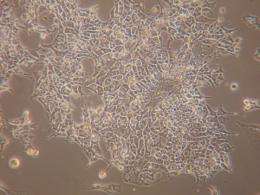
(PhysOrg.com) -- In regenerative medicine, large supplies of safe and reliable human embryonic stem (hES) cells are needed for implantation into patients, but the field has faced challenges in developing cultures that can consistently grow and maintain clinical-grade stem cells.
Standard culture systems use mouse "feeder" cells and media containing bovine sera to cultivate and maintain hES cells, but such animal product–based media can contaminate the cells. And because of difficulties in precise quality control, each batch of the medium can introduce new and unwanted variations.
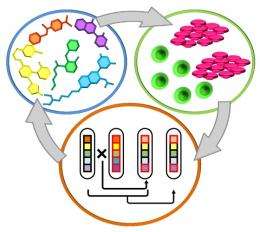
Now, a team of stem cell biologists and engineers from UCLA has identified an optimal combination and concentration of small-molecule inhibitors to support the long-term quality and maintenance of hES cells in feeder-free and serum-free conditions. The researchers used a feedback system control (FSC) scheme to innovatively and efficiently select the small-molecule inhibitors from a very large pool of possibilities.
The research findings, published today in the journal Nature Communications, represent a major advance in the quest to broadly transition regenerative medicine from the benchtop to the clinic.
"What is significant about this work is that we've been able to very rapidly develop a chemically defined culture medium to replace serum and feeders for cultivating clinical-grade hES cells, thereby removing a major roadblock in the area of regenerative medicine," said Chih-Ming Ho, the Ben Rich–Lockheed Martin Professor at the UCLA Henry Samueli School of Engineering and Applied Science and a member of the National Academy of Engineering.
Unlike current animal product–based media, the new medium is a "defined" culture medium — one in which every component is known and traceable. This is important for clinical applications and as drugs or cells enter the world of regulatory affairs, including good manufacturing practice compliance and Food and Drug Administration supervision.
"It is also the first defined medium to allow for long term single-cell passage," said the paper's senior author, Hong Wu, the David Geffen Professor of Molecular and Medical Pharmacology at the David Geffen School of Medicine at UCLA and a researcher with UCLA's Eli and Edythe Broad Center of Regenerative Medicine and Stem Cell Research.
Single-cell passaging — a process in which hES cells are dissociated into single cells and subcultured through single-cell–derived colonies — is important in overcoming the massive cell death associated with hES cell dissociation during routine passage, and it allows for genetic manipulation at the clonal level.
"Although other studies have demonstrated growth of hES cells under defined media formulations and/or on defined surfaces, to the best of our knowledge, this is the first study that combines defined cultures with routine single-cell passaging, which plays an important role in supplying a large mass of clinically applicable cells," said Hideaki Tsutsui, a UCLA postdoctoral scholar and lead author of the study. "Thus, our hES cell culture system, guided by the FSC technique, will bring hES cells one step closer to clinical therapies."
Initially, the very large number of small molecules in the culture medium and their unknown synergistic effects made it difficult for researchers to assess the proper concentration of each for achieving long-term expansion of hES cells. The major challenge was to find the best way to sort out those molecules and rapidly determine the best combinatorial concentrations.
The breakthrough, ultimately, was the product of a close interdisciplinary collaboration.
Tsutsui, then a UCLA Engineering graduate student, and Bahram Valamehr, then a graduate student at the Geffen School of Medicine, started working on the project two years ago. Armed with biological readouts and analyses of stem cells mastered in Hong Wu's laboratory through the lab's extensive accomplishments in stem cell research, Tsutsui and Valamehr used the FSC scheme — developed previously by Ho's group to search for optimal drug combinations for viral infection inhibition and cancer eradication — to facilitate the rapid screening of a very large number of possibilities.
Working together, the team was able to discover a unique combination of three small-molecule inhibitors that supports long-term maintenance of hES cell cultures through routine single-cell passaging.
"There are certain research projects biologists can dream about, and we know we can eventually get there, but we don't have the capacity to achieve them in a timely manner, especially in a study like this," Wu said. "It would have taken 10 graduate students another 10 years to test all the possible combinations of molecules. Having an opportunity to collaborate with the engineering school has been invaluable in making this dream a reality."
"This is the best example of demonstrating the strength and potential of interdisciplinary collaborations," said Ho, who is also director of the Center for Cell Control at UCLA Engineering and a senior author of the paper. "Engineers and biologists working side by side can accomplish a mission impossible."
Other authors of the study included Antreas Hindoyan, Rong Qiao, Xianting Ding, Shuling Guo, Owen N. Witte and Xin Liu.
Provided by University of California Los Angeles


