A greener path for the production of a vital chemical
January 14, 2011

A greener path for the production of a vital chemical

Enlarge

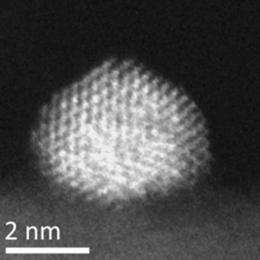
A high angle annular dark field electron micrograph of a gold-palladium nanoparticle on a titanium oxide support.

(PhysOrg.com) -- Nanoparticles of gold and palladium (Au-Pd) could lead to a more efficient and environmentally friendly way of producing benzyl benzoate, a chemical compound used widely in the food, pharmaceutical and chemical industries whose applications include a fixative for fragrances, a food additive and a solvent for chemical reactions.

The most common method of producing benzyl benzoate is to react benzoic acid with benzyl alcohol. It can also be generated from benzaldehyde. All three starting materials are derived from toluene, a component of . The manufacture of benzyl alcohol and benzaldehyde requires the use of halogens and acidic solvents, whereas benzoic acid is produced via a more environmentally friendly liquid phase cobalt-catalyzed reaction.

A research team led by Graham Hutchings, professor of chemistry at Cardiff University in Wales in the United Kingdom, and Christopher Kiely, professor of materials science and engineering at Lehigh, has found a way of producing benzyl benzoate directly from toluene in a solvent-free, single-step process using Au-Pd nanoparticles to catalyze the reaction.

“By optimizing the Au-Pd ratio in the nanoparticle, as well as the reaction conditions, we were able to achieve conversion rates of over 95 percent with no conversion to carbon dioxide,” says Hutchings.
A greener path for the production of a vital chemical
Enlarge

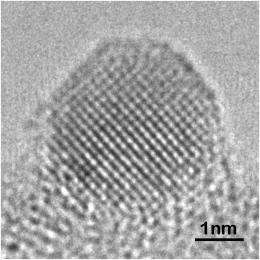
A high resolution electron micrograph of a gold-palladium nanoparticle on a titanium oxide support.

Shining a light on particle size and catalytic activity

The researchers reported their finding Jan. 14 in Science magazine in an article titled “Solvent-Free Oxidation of Primary Carbon-Hydrogen Bonds in Toluene Using Au-Pd Alloy .” The article was coauthored by Hutchings and Kiely and 10 other researchers, including Ramchandra Tiruvalam, a Lehigh Ph.D. candidate working with Kiely.

Rather than making the catalysts by conventional support impregnation techniques, the researchers chose a preparation route that involved the sol-immobilization of Au-Pd colloids using amorphous carbon and titanium oxide supports. This technique offers much greater control over particle size and composition than do conventional methods.

Transmission electron microscopy (TEM) studies carried out by Tiruvalam revealed that the average particle sizes were very similar, 3.3 nanometers on carbon and 3.5nm on titanium oxide.

“Despite having a very similar particle-size distribution, the Au-Pd/carbon samples were found to have approximately double the catalytic activity of the Au-Pd/titanium oxide samples,” says Kiely, who directs the Nanocharacterization Laboratory in Lehigh’s Center for Advanced Materials and Nanotechnology.

“This suggests that simple metal surface area considerations are not dominating the catalytic activity.”

Achieving stability and reusability

Using Lehigh’s aberration-corrected TEM, Tiruvalam was able to show that the particles were indeed Au-Pd alloy particles, that those on the titanium oxide were highly faceted and tended to form a flat interface with the support, and that those on the carbon were much more rounded.

“The difference in catalytic activity may be related to differences in the number of low coordination number edge and corner sites available,” explains Kiely. “The more rounded ‘rougher’ particles on the carbon support have significantly more of these sites than the flatter particles on the support.”

In a final set of experiments, the researchers were able to demonstrate that the Au-Pd/carbon catalysts showed no loss of activity after use and that there was little change in particle shape and size after extended reaction periods.

“It is clear that these highly active catalysts are both stable and reusable,” says Kiely.

More information: http://www.science … 5.full?rss=1

Provided by Lehigh University search and more info website

Filter


Move the slider to adjust rank threshold, so that you can hide some of the comments.


Display comments: newest first

Nartoon
Jan 15, 2011

Rank: not rated yet
This was supposed to happen years ago, with consumers making their own hydrogen from Natural Gas. What goes round...
Rank 5 /5 (3 votes)
Relevant PhysicsForums posts
  • Steam in My Espresso Machine
    created4 hours ago
  • Density question
    createdMay 24, 2012
  • Mass transport originating from a point source at a solid gas interface
    createdMay 22, 2012
  • Ammonia dispersion in Air
    createdMay 22, 2012
  • Multi Choice Help
    createdMay 21, 2012
  • index of refraction and thickness of materials
    createdMay 18, 2012
  • More from Physics Forums - Materials & Chemical Engineering

More news stories

Dopant gives graphene solar cells highest efficiency yet

(Phys.org) -- By taking advantage of graphene’s favorable electrical and optical properties, and then adding an organic dopant, researchers have achieved the highest power conversion efficiency yet for ...

Nanotechnology / Nanophysics

created May 21, 2012 | popularity 5 / 5 (10) | comments 14 | with audio podcast feature

Nanomedicine: Quantum dots appear safe in pioneering study on primates

A pioneering study to gauge the toxicity of quantum dots in primates has found the tiny crystals to be safe over a one-year period, a hopeful outcome for doctors and scientists seeking new ways to battle diseases ...

Nanotechnology / Bio & Medicine

created May 20, 2012 | popularity 4.3 / 5 (3) | comments 8 | with audio podcast

In nanorod crystal growth, nanoparticles seen as artificial atoms

In the growth of crystals, do nanoparticles act as "artificial atoms" forming molecular-type building blocks that can assemble into complex structures? This is the contention of a major but controversial theory ...

Nanotechnology / Nanophysics

created May 24, 2012 | popularity 4.8 / 5 (6) | comments 0 | with audio podcast

Synthetic nano-waste does not disappear

(Phys.org) -- Tiny particles of cerium oxide do not burn or change in the heat of a waste incineration plant. They remain intact on combustion residues or in the incineration system, as a new study by Swiss ...

Nanotechnology / Bio & Medicine

created May 25, 2012 | popularity 5 / 5 (2) | comments 1 | with audio podcast

First direct observation of oriented attachment in nanocrystal growth

Berkeley Lab researchers have reported the first direct observation of nanoparticles undergoing oriented attachment, the critical step in biomineralization and the growth of nanocrystals. A better understanding ...

Nanotechnology / Nanophysics

created May 24, 2012 | popularity 4.7 / 5 (3) | comments 0 | with audio podcast


SpotterRF debuts Radar Backpack Kit (w/ Video)

(Phys.org) -- SpotterRF has announced a special radar backpack kit designed to enhance situational awareness for soldiers on the ground. The company says its special radar is designed for warfighters as part ...

Australia hails surprise super-telescope decision

Australia has hailed a surprise decision giving it a role in a radio telescope project aimed at revolutionising astronomy, vowing to draw on its decades of experience in space science.

Astronomers seize last chance in lifetime for Venus Transit

Astronomers are gearing for one the rarest events in the Solar System: an alignment of Earth, Venus and the Sun that will not be seen for another 105 years.

SpaceX capsule has 'new car' smell, astronauts say

SpaceX's Dragon cargo vessel smells like a new car, said astronauts at the International Space Station after opening the hatches Saturday following the spacecraft's landmark mission to the orbiting lab.

Family history of Alzheimer's affects functional connectivity

(HealthDay) -- Cognitively normal individuals with a family history of late-onset Alzheimer's disease (AD) may display lower resting state functional connectivity in the default mode network (DMN) of the brain, ...

Thousands of shellfish found dead in Peru

Thousands of crustaceans were found dead off the coast of Lima following the mystery mass death of dolphins and pelicans, the Peruvian Navy said Friday.