New 'frozen smoke' material: One ounce could carpet three football fields
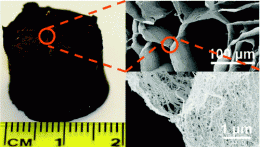
Image credit: ACS / DOI:10.1021/nn102246a
Scientists are reporting the development of a new, ultra-light form of "frozen smoke" -- renowned as the world's lightest solid material -- with amazing strength and an incredibly large surface area.
The new so-called "multiwalled carbon nanotube (MCNT) aerogel" could be used in sensors to detect pollutants and toxic substances, chemical reactors, and electronics components. A report about the material appears in ACS Nano.
Lei Zhai and colleagues explain that aerogels made from silicon dioxide (the main ingredient in sand) and other material already are used as thermal insulation in windows and buildings, tennis rackets, sponges to clean up oil spills, and other products.
Aerogels are solid but so light that they have been compared to frozen smoke. However, only a few scientists have succeeded in making aerogels from carbon nanotubes, wisps of carbon so small that almost 50,000 would fit across the width of a human hair.
The report describes a process for making MCNT aerogels and tests to determine their properties. MCNT aerogels infused with a plastic material are flexible, for instance, like a spring that can be stretched thousands of times. If the nanotubes in a one-ounce cube were unraveled and placed side-to-side and end-to-end, they would carpet three football fields.
The MCNT aerogels also are excellent conductors of electricity, making them ideal for sensing applications, such as sensing as little as 0.003527 ounce of a material resting in the palm of one hand, the report indicates.
More information: "Ultralight Multiwalled Carbon Nanotube Aerogel", ACS Nano. DOI: 10.1021/nn102246a
Provided by
American Chemical Society
-
From lemons to lemonade: Reaction uses carbon dioxide to make carbon-based semiconductor,
28 comments
-
Thioridazine kills cancer stem cells in human while avoiding toxic side-effects of conventional cancer treatments,
3 comments
-
SpaceX private rocket blasts off for space station (Update),
41 comments
-
Climate scientists say they have solved riddle of rising sea,
30 comments
-
Scotland passes turbine test to harness tidal power,
40 comments
-
Steam in My Espresso Machine
3 hours ago
-
Density question
May 24, 2012
-
Mass transport originating from a point source at a solid gas interface
May 22, 2012
-
Ammonia dispersion in Air
May 22, 2012
-
Multi Choice Help
May 21, 2012
-
index of refraction and thickness of materials
May 18, 2012
- More from Physics Forums - Materials & Chemical Engineering
More news stories
Dopant gives graphene solar cells highest efficiency yet
(Phys.org) -- By taking advantage of graphenes favorable electrical and optical properties, and then adding an organic dopant, researchers have achieved the highest power conversion efficiency yet for ...
Nanomedicine: Quantum dots appear safe in pioneering study on primates
A pioneering study to gauge the toxicity of quantum dots in primates has found the tiny crystals to be safe over a one-year period, a hopeful outcome for doctors and scientists seeking new ways to battle diseases ...
Nanotechnology / Bio & Medicine
May 20, 2012 |
4.3 / 5 (3) |
8
|
In nanorod crystal growth, nanoparticles seen as artificial atoms
In the growth of crystals, do nanoparticles act as "artificial atoms" forming molecular-type building blocks that can assemble into complex structures? This is the contention of a major but controversial theory ...
May 24, 2012 |
4.8 / 5 (6) |
0
|
Synthetic nano-waste does not disappear
(Phys.org) -- Tiny particles of cerium oxide do not burn or change in the heat of a waste incineration plant. They remain intact on combustion residues or in the incineration system, as a new study by Swiss ...
Nanotechnology / Bio & Medicine
May 25, 2012 |
5 / 5 (2) |
1
|
First direct observation of oriented attachment in nanocrystal growth
Berkeley Lab researchers have reported the first direct observation of nanoparticles undergoing oriented attachment, the critical step in biomineralization and the growth of nanocrystals. A better understanding ...
May 24, 2012 |
4.7 / 5 (3) |
0
|
SpotterRF debuts Radar Backpack Kit (w/ Video)
(Phys.org) -- SpotterRF has announced a special radar backpack kit designed to enhance situational awareness for soldiers on the ground. The company says its special radar is designed for warfighters as part ...
Australia hails surprise super-telescope decision
Australia has hailed a surprise decision giving it a role in a radio telescope project aimed at revolutionising astronomy, vowing to draw on its decades of experience in space science.
Astronomers seize last chance in lifetime for Venus Transit
Astronomers are gearing for one the rarest events in the Solar System: an alignment of Earth, Venus and the Sun that will not be seen for another 105 years.
SpaceX capsule has 'new car' smell, astronauts say
SpaceX's Dragon cargo vessel smells like a new car, said astronauts at the International Space Station after opening the hatches Saturday following the spacecraft's landmark mission to the orbiting lab.
Family history of Alzheimer's affects functional connectivity
(HealthDay) -- Cognitively normal individuals with a family history of late-onset Alzheimer's disease (AD) may display lower resting state functional connectivity in the default mode network (DMN) of the brain, ...
Thousands of shellfish found dead in Peru
Thousands of crustaceans were found dead off the coast of Lima following the mystery mass death of dolphins and pelicans, the Peruvian Navy said Friday.
Jan 12, 2011
Rank: 4.6 / 5 (5)
Jan 12, 2011
Rank: 1 / 5 (3)
Jan 12, 2011
Rank: 4.5 / 5 (15)
Jan 12, 2011
Rank: 4.7 / 5 (3)
Jan 12, 2011
Rank: 5 / 5 (1)
Jan 12, 2011
Rank: 5 / 5 (1)
I think the significance is that it has a large surface area.
Jan 12, 2011
Rank: 4.3 / 5 (3)
Jan 12, 2011
Rank: 4.3 / 5 (7)
What safety reasons? The Hindenburg used Hydrogen and it........ yeah, Helium's cool I guess.
Jan 13, 2011
Rank: 4.5 / 5 (4)
Hydrogen is still better,if only because it is the lightest gas.There would be no sparks to ignite it in a pedal powered aircraft,and anyway,only small amounts of H2 would leak out..
Jan 13, 2011
Rank: 5 / 5 (3)
Unless you build up a static charge from the atmosphere or get struck by lightning.
Jan 13, 2011
Rank: 5 / 5 (3)
But no: while aerogels are pretty strong for their weight they are not strong enough to add much structural integrity to a wing. Today's glider wings are almost hollow already. If you wanted added buoyancy then you could fill these with helium/hydrogen today. Since the volume is rather low the added effect would be negligible (i.e.: it isn't worth it)
Jan 13, 2011
Rank: 5 / 5 (2)
just search "Helium Shortage"
From "The Independent" 8/2010
-----
...The experts warn that the world could run out of helium within 25 to 30 years...the world's most commonly used inert gas is being depleted at an astonishing rate because of a law passed in the United States in 1996 which has effectively made helium too cheap to recycle.
The law stipulates that the US National Helium Reserve, which is kept in a disused underground gas field near Amarillo, Texas – by far the biggest store of helium in the world – must all be sold off by 2015, irrespective of the market price.
------
Sad to think that we're wasting it so fast, but maybe it will be the reason we return to space...if we can without the technologies that need Liquid He.
Jan 13, 2011
Rank: not rated yet
Jan 13, 2011
Rank: 4.8 / 5 (5)
The anti-hydrogen phobia is silly when you consider that you pump gasoline into your car every week.
Jan 13, 2011
Rank: 4.8 / 5 (5)
Google(pictures): hydrogen, gasoline, puncture
and look at the first set of pictures
Hydrogen looks _a lot_ safer*
* Though I have to admit that hydrogen is flammable over a wider range of mixtures than gasoline. But on the plus side: it doesn't pool at the site of the accident.
Jan 13, 2011
Rank: 5 / 5 (2)
Secondly, you could probably make the buoyant wing with these cnt aerogels, but it would cost an arm and a leg (and maybe even a kidney). The problem with the old generation of aerogels was that they were very brittle, and would crush easy. These CNT aerogels seem to have to have that solved. However even the old aerogels cost a couple hundred dollars for a square inch of material. These are probably significantly more expensive due to the CNTs.
Jan 13, 2011
Rank: not rated yet
Jan 13, 2011
Rank: not rated yet
Does anyone else get irritated by the random folksy definitions? - i mean the interjected "flexible - like a spring that can be streched back and forth many times"?
do non-technical (or simply dim) readers really get this far into the site, and if so, will they continue reading because they spotted something they understand?
- its plain wrong as well in this case, the property described is called "toughness" not flexibility, which is simply the Youngs modulus.
Jan 13, 2011
Rank: not rated yet
Jan 13, 2011
Rank: not rated yet
Never mid the armories .... Tom Brady would love it.
Jan 13, 2011
Rank: not rated yet
But the gasoline isn't that flammable in liquid state. Hydrogen gas wrapped in a bubble, millimeters from a nearly inexhaustible source of oxygen is bad.
Jan 13, 2011
Rank: not rated yet
Right, should have thought about that more before firing off that reply. Aerogel won't provide any advantage in a wing which is the point I was trying to make.
Jan 13, 2011
Rank: not rated yet
Jan 15, 2011
Rank: not rated yet
Thanks for that alq ..... I wonder how many other things we are running out of but no one realizes.
Jan 15, 2011
Rank: not rated yet
Jan 16, 2011
Rank: not rated yet
Note that lead acid batteries use relativity to achieve most of their power (2011-01-car-batteries-powered-relativity from physorg)
A lead - carbon hybrid would probably not support the aircraft mentioned above, but could it provide a new super-efficient battery technology?
Jan 16, 2011
Rank: not rated yet
Come on guys, the Hindenburg fire was fueled by a coating of rocket fuel on the skin, not by the hydrogen, which quickly escaped into the atmosphere. The Hindenburg video clearly shows the skin burning after the hydrogen has long-since left the scene.
Jan 16, 2011
Rank: not rated yet
Jan 16, 2011
Rank: not rated yet
Lightning... Zappp! Boom!
Jan 17, 2011
Rank: not rated yet
Jan 17, 2011
Rank: not rated yet
Jan 17, 2011
Rank: not rated yet
Jan 19, 2011
Rank: not rated yet
could you make a house out of this?
Jan 19, 2011
Rank: not rated yet
I think you need to take into account the difference between strength by weight and strength by volume.
Feb 27, 2011
Rank: not rated yet