Farm reform, biotech are key to feeding world by 2050: study
Jan 12, 2011 by Richard Ingham
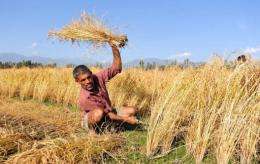
A Kashmiri man cut and gathers rice stalks into a bundle in a field on the outskirts of Srinagar in September 2010. Massive changes in farming practices, eating habits and consumption will be needed to feed Earth's population sustainably when it hits nine billion in 2050, French scientists warned on Wednesday.

Massive changes in farming practices, eating habits and consumption will be needed to feed Earth's population sustainably when it hits nine billion in 2050, French scientists warned on Wednesday.

In under 40 years, the world will have to make farming more productive but less dependent on , curb food losses and waste, protect the environment and reduce agriculture's exposure to disastrous price swings, they said.

Their study, called Agrimonde (Agriworld in French), is co-authored by specialists at France's National Institute for Agricultural Research (INRA) and the International Cooperative Centre for Agronomical Research for Development (CIRAD).

"This exercise is undertaken at a very specific human history, at a time when the population today is seven billion," CIRAD president Gerard Matheron said at a press conference. "World faces a major challenge."

Last week, the UN's Food and Agriculture Organisation (FAO) reported that had hit their highest level ever and World Bank President Robert Zoellick warned that rising prices for staples "are re-emerging as a threat to global growth and social stability."

Riots in Algeria, meanwhile, left five people dead, hundreds wounded and about 1,000 in jail, prompting the authorities to promise to cut food prices.

The Agrimonde study said that North Africa and the Middle East, Asia and sub-Saharan Africa, all with fast-growing populations today, will be heavily dependent on imported food in 2050.

It puts forward two scenarios -- both relatively optimistic -- by which the planet's expected nine billion humans are fed by 2050.

Under a business-as-usual scenario, all regions in the world would enjoy strong economic growth, invest heavily in research, innovation, education, health and infrastructure.

But, under this scenario, there is not a high priority to the environment, with resulting damage to ecosystems.

Under the second scenario, environmental integrity is a key factor.
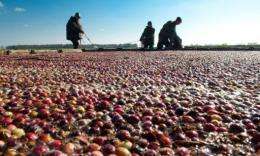
Belarussians harvest cranberries on a lake near the village of Selishche, some 300 kms outside Minsk, in October 2010. Massive changes in farming practices, eating habits and consumption will be needed to feed Earth's population sustainably when it hits nine billion in 2050, French scientists warned on Wednesday.

To achieve this goal in sustainability, rich countries in particular would have to reduce excessive consumption that leads to obesity and tackle loss and waste in food distribution and use that today runs at around 25 percent of production.

Agriculture everywhere would have to be more economical in fossil fuels and make less use of chemicals.

"However, this would not be a return to archaic agriculture, but instead require innovation and social change," said CIRAD researcher Bruno Dorin, who co-authored the study.

Genetic manipulation of plants to boost yields would be necessary. However, smarter ways of traditional cross-breeding are emerging as good alternatives to genetic engineering, which is a hot political issue in many countries, he said.

At the same time, there would have to be changes in trade rules so that the supply line to importing countries becomes stronger and more resilient, thus easing the price shocks that hit producer or customer.

"The necessary and foreseeable growth of agricultural exchanges coming from OECD (Organisation for Economic Cooperation and Development) countries, the ex-Soviet block and Latin America, and going towards Africa, Asia and the Middle East needs to be stabilised and regulated," says the paper.

Explore further: Strong resistance to making people think green

add to favorites email to friend print save as pdf

Related Stories

Global experts: Warming could double food prices

Dec 01, 2010

(AP) -- Even if we stopped spewing global warming gases today, the world would face a steady rise in food prices this century. But on our current emissions path, climate change becomes the "threat multiplier" ...

Three billion Asians face food crisis threat: research

Oct 28, 2008

(PhysOrg.com) -- The escalating cost of rice and other foodstuffs across Asia could cause the reversal of policy reforms, social unrest and deepening poverty for over 3 billion Asians – according to new ...

Future of food policy should start at home

Jan 10, 2011

Long accustomed to plentiful and affordable meat, fish, fruit and vegetables, Australians may have to get used to higher prices as the soaring cost of agricultural staples suggests an era of cheap food is coming to an end.

Dangerous wheat disease jumps Red Sea

Jan 16, 2007

A new form of stem rust, a virulent wheat disease, has jumped from eastern Africa and is now infecting wheat in Yemen in the Arabian Peninsula.

Asia faces food shortage by 2050 without water reform

Aug 17, 2009

A comprehensive new study of irrigation in Asia warns that, without major reforms and innovations in the way water is used for agriculture, many developing nations face the politically risky prospect of having ...

Recommended for you

Chinese, Indian airlines face EU pollution fines

1 hour ago

Eight Chinese and two Indian airlines face fines of up to several million euros for not paying for their greenhouse gas emissions during flights within the bloc, the European Commission said on Friday.

Fracking risks to ground water assessed

22 hours ago

(Phys.org) —Extraction of "unconventional" gas from sedimentary rocks such as shale could provide a clean energy source and help some regions to become energy independent, but concerns have been raised ...

Caribbean talks conservation on Branson's island

23 hours ago

(AP)—Surrounded by a turquoise sea and a menagerie of exotic animals on a billionaire's private island, political and business leaders gathered Friday to back an initiative aimed at expanding protection ...

User comments : 0

More news stories

Chinese, Indian airlines face EU pollution fines

Eight Chinese and two Indian airlines face fines of up to several million euros for not paying for their greenhouse gas emissions during flights within the bloc, the European Commission said on Friday.

Alaska volcano shoots ash 15,000 feet into the air

(AP)—One of Alaska's most restless volcanoes has shot an ash cloud 15,000 feet into the air in an ongoing eruption that has drawn attention from a nearby community but isn't expected to threaten air traffic.

Fracking risks to ground water assessed

(Phys.org) —Extraction of "unconventional" gas from sedimentary rocks such as shale could provide a clean energy source and help some regions to become energy independent, but concerns have been raised ...

Bright explosion on the Moon

For the past 8 years, NASA astronomers have been monitoring the Moon for signs of explosions caused by meteoroids hitting the lunar surface. "Lunar meteor showers" have turned out to be more common than anyone ...

US seizes Bitcoin operator accounts

US authorities seized the accounts of a Bitcoin digital currency exchange operator, claiming it was functioning as an "unlicensed money service business," court documents showed Friday.