Researchers identify 'Facebook neurons'
January 10, 2011

Carnegie Mellon researchers identify 'Facebook neurons'

Enlarge

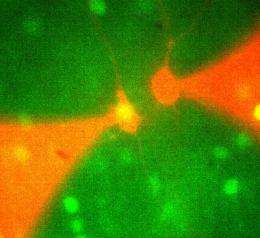
Paired cell recording from the cerebral cortex of the fosGFP transgenic mouse. Credit: Carnegie Mellon University

Carnegie Mellon University researchers have found that within the brain's neocortex lies a subnetwork of highly active neurons that behave much like people in social networks. Like Facebook, these neuronal networks have a small population of highly active members who give and receive more information than the majority of other members, says Alison Barth, associate professor of biological sciences at Carnegie Mellon and a member of the Center for the Neural Basis of Cognition (CNBC). By identifying these neurons, scientists will now be able to study them further and increase their understanding of the neocortex, which is thought to be the brain's center of higher learning.

Up to trillions of neurons make up the neocortex, the part of the that is responsible for a number of important functions, including sensory perception, motor function, spatial reasoning, conscious thought and language. Although neuroscientists have been studying the neocortex for 40 years, technologies had only allowed them to look broadly at general areas of the brain, but not at the high-resolution of individual neurons. While they believed only a small proportion of neurons were doing most of the work in the neocortex, they couldn't see if this was indeed the case.

In the current study, published in the journal Neuron, the researchers used a specialized developed by Barth to overcome these challenges and clearly see which neocortical neurons were the most active. The model links (GFP) with the activity-dependent gene fos, causing the neuron to light up when it is activated. The researchers, including former Carnegie Mellon and CNBC postdoctoral student Lina Yassin, who is now at the Ludwig-Maximillians-Universtat Munich, took recordings from both fos-labeled and unlabeled neurons and found that the most active neurons were expressing the fos gene. The researchers were then able to isolate the active neurons using imaging techniques and take electrophysiological recordings from the neurons, allowing the researchers to begin to understand the mechanisms underlying the increased activity.

Barth and colleagues were able to see that the fos-expressing neurons weren't more active because they were intrinsically more excitable; in fact, the neurons seemed to be calmer or more suppressed than their neighboring, inactive neurons. What made them more active was their input.

According to Barth, it seems that this active network of neurons in the acts like a social network. There is a small, but significant, population of neurons that are more connected than other neurons. These neurons do most of the heavy lifting, giving and receiving more information than the rest of the neurons in their network.

"It's like Facebook. Most of your friends don't post much — if at all. But, there is a small percentage of your friends on Facebook who update their status and page often. Those people are more likely to be connected to more friends, so while they're sharing more information, they're also receiving more information from their expanded network, which includes other more active participants," Barth said.

The findings stand to have a dramatic impact on neuroscience. Now that researchers are able to identify and visualize these active cells they can begin to determine why they are more active and how stable the activity is. The Carnegie Mellon researchers plan to study these neurons to see what, if any, role these neurons play in learning.

The results also will help to further computational neuroscience, specifically in the area of sparse coding. In sparse coding, scientists hope to study how the brain recruits a small population of neurons to encode information. This research will for the first time allow for the study of the electrophysiological properties of strongly responsive but sparsely populated cells.

More information: Paper online: doi:10.1016/j.neuron.2010.11.029

Provided by Carnegie Mellon University search and more info website

Filter


Move the slider to adjust rank threshold, so that you can hide some of the comments.


Display comments: newest first

zslewis91
Jan 10, 2011

Rank: 5 / 5 (1)
"facebook neurons" jesus christ these people need to pull their heads out of their butts, what are we 12?
Rank 5 /5 (3 votes)
Relevant PhysicsForums posts
  • Potential Breakthrough in Seizure Control
    created8 hours ago
  • Popping/Cracked sternum.
    created13 hours ago
  • Which Mental Illness Encompasses This Problem?
    created13 hours ago
  • A question about drug tolerance
    createdMay 23, 2012
  • Poor nutrition leading to overeating?
    createdMay 23, 2012
  • Math and dyslexia?
    createdMay 21, 2012
  • More from Physics Forums - Medical Sciences

More news stories

Family history of Alzheimer's affects functional connectivity

(HealthDay) -- Cognitively normal individuals with a family history of late-onset Alzheimer's disease (AD) may display lower resting state functional connectivity in the default mode network (DMN) of the brain, ...

Medicine & Health / Alzheimer's disease & dementia

created 3 hours ago | popularity not rated yet | comments 0

Transvaginal mesh op restores pelvic organ prolapse at price

(HealthDay) -- Transvaginal mesh (TVM) procedures are effective for anatomical restoration of pelvic organ prolapse (POP), but patients report a worsening of sexual function following surgery, according to ...

Medicine & Health / Other

created 3 hours ago | popularity not rated yet | comments 0

Travel to high altitudes tied to Crohn's, colitis flare-ups

(HealthDay) -- People with inflammatory bowel disease, which includes Crohn's disease and colitis, may be at increased risk for flare-ups when they fly or travel to high altitudes for skiing or mountain climbing, ...

Medicine & Health / Inflammatory disorders

created 4 hours ago | popularity not rated yet | comments 1 | with audio podcast

Skp2 activates cancer-promoting, glucose-processing Akt

HER2 and its epidermal growth factor receptor cousins mobilize a specialized protein to activate a major player in cancer development and sugar metabolism, scientists report in the May 25 issue of Cell.

Medicine & Health / Cancer

created 21 hours ago | popularity not rated yet | comments 0 | with audio podcast

Tongue analysis software uses ancient Chinese medicine to warn of disease

For 5,000 years, the Chinese have used a system of medicine based on the flow and balance of positive and negative energies in the body. In this system, the appearance of the tongue is one of the measures used to classify ...

Medicine & Health / Other

created 19 hours ago | popularity 1 / 5 (1) | comments 0 | with audio podcast


SpotterRF debuts Radar Backpack Kit (w/ Video)

(Phys.org) -- SpotterRF has announced a special radar backpack kit designed to enhance situational awareness for soldiers on the ground. The company says its special radar is designed for warfighters as part ...

Australia hails surprise super-telescope decision

Australia has hailed a surprise decision giving it a role in a radio telescope project aimed at revolutionising astronomy, vowing to draw on its decades of experience in space science.

Astronomers seize last chance in lifetime for Venus Transit

Astronomers are gearing for one the rarest events in the Solar System: an alignment of Earth, Venus and the Sun that will not be seen for another 105 years.

SpaceX capsule has 'new car' smell, astronauts say

SpaceX's Dragon cargo vessel smells like a new car, said astronauts at the International Space Station after opening the hatches Saturday following the spacecraft's landmark mission to the orbiting lab.

Thousands of shellfish found dead in Peru

Thousands of crustaceans were found dead off the coast of Lima following the mystery mass death of dolphins and pelicans, the Peruvian Navy said Friday.

Astronauts enter world's 1st private supply ship

(AP) -- Space station astronauts floated into the Dragon on Saturday, a day after its heralded arrival as the world's first commercial supply ship.