Fabrication of mosaic nanofilters for molecular transport, separation of macromolecules
January 10, 2011

Enlarge

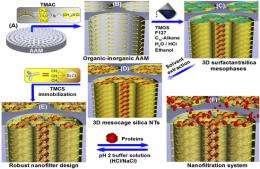
Fig. 1 Robust, simple synthesis process for nanofilter AAM membranes in 3D mosaic cage silica NTs for molecular orientation and size cut-off of proteins. Note: The abbreviations used are N-trimethoxysilylpropyl-N,N,N-trimethylammonium chloride (TMAC), tetramethylorthosilicate (TMOS), and trymethylchlorosilane (TMCS).

A team led by Dr. Sherif El-Safty, Exploratory Materials Research Laboratory for Energy and Environment, National Institute for Materials Science (NIMS; Japan), fabricated tight mosaic cage silica nanotubes (NTs) inside anodic alumina membranes (AAM) as a promising candidate nanofilter for high-speed (within several seconds) size-exclusion separation of high concentration macromolecules.

To date, separation of proteins into relatively homogeneous groups and sizes has been very important in biopharmaceuticals and medicines. From the practical viewpoint, the requirements for these applications include easy scaling-up, fast separation, suitability for high production volumes, and low cost. Technically, the design of extremely robust filter membranes without formation of air gaps among membrane nanochannels is a remaining challenge, as pore gaps not only reduce the potential of size-exclusion nanofiltration systems, but also limit the long-term storage stability of NTs, making storage difficult even for a month.

For practical control of mosaic nanofilter membranes, a general approach based on densely engineered three-dimensional (3D) mesocage structures inside NTs was adopted. In this design, multifunctional of the pore channels of the AAM facilitated production of extremely robust constructed sequences of membranes as “real nanofilters” without “detachment pores” (air gaps) between the fabricated nanotubes inside the AAM. The approach used by the NIMS team is ideal for constructing tubular-structured architectures inside membranes with vertical alignment, open surfaces of top-bottom ends, multidirectional (3D) pore connectivity, and stability, which are promising for application to nanofilter systems.

The key to this development was the fact that the nanofilter system efficiently separates such as proteins of various sizes over a wide, adjustable range of concentrations. Although conventional processes require as much as 12 hours or more, this technique provides a rapid filtration process that achieves filtration in seconds, despite the blocking effect of the proteins during the filtration process.

The intrinsic properties of the NIMS design (shelf-life or long-term stability, separation efficiency, reusability) are important advantages in comparison with the conventional protein nanofilter techniques used to date. Such advantages will be key to the development of a fabrication approach with the potential to become the optimal method for the design of nanofilters for filtration and molecular transport of multiple species.

The results of this research demonstrated that the NIMS approach offers a time- and cost-efficient alternative tool to current macromolecule analysis methods. This development also offers new insights into control design of devices in the fields of electronics, sensors, and other nanotechnologies.

Provided by National Institute for Materials Science


Rank 5 /5 (1 vote)
Relevant PhysicsForums posts
  • Steam in My Espresso Machine
    created2 hours ago
  • Density question
    createdMay 24, 2012
  • Mass transport originating from a point source at a solid gas interface
    createdMay 22, 2012
  • Ammonia dispersion in Air
    createdMay 22, 2012
  • Multi Choice Help
    createdMay 21, 2012
  • index of refraction and thickness of materials
    createdMay 18, 2012
  • More from Physics Forums - Materials & Chemical Engineering

More news stories

Dopant gives graphene solar cells highest efficiency yet

(Phys.org) -- By taking advantage of graphene’s favorable electrical and optical properties, and then adding an organic dopant, researchers have achieved the highest power conversion efficiency yet for ...

Nanotechnology / Nanophysics

created May 21, 2012 | popularity 5 / 5 (10) | comments 14 | with audio podcast feature

Nanomedicine: Quantum dots appear safe in pioneering study on primates

A pioneering study to gauge the toxicity of quantum dots in primates has found the tiny crystals to be safe over a one-year period, a hopeful outcome for doctors and scientists seeking new ways to battle diseases ...

Nanotechnology / Bio & Medicine

created May 20, 2012 | popularity 4.3 / 5 (3) | comments 8 | with audio podcast

In nanorod crystal growth, nanoparticles seen as artificial atoms

In the growth of crystals, do nanoparticles act as "artificial atoms" forming molecular-type building blocks that can assemble into complex structures? This is the contention of a major but controversial theory ...

Nanotechnology / Nanophysics

created May 24, 2012 | popularity 4.8 / 5 (6) | comments 0 | with audio podcast

Synthetic nano-waste does not disappear

(Phys.org) -- Tiny particles of cerium oxide do not burn or change in the heat of a waste incineration plant. They remain intact on combustion residues or in the incineration system, as a new study by Swiss ...

Nanotechnology / Bio & Medicine

created May 25, 2012 | popularity 5 / 5 (2) | comments 1 | with audio podcast

First direct observation of oriented attachment in nanocrystal growth

Berkeley Lab researchers have reported the first direct observation of nanoparticles undergoing oriented attachment, the critical step in biomineralization and the growth of nanocrystals. A better understanding ...

Nanotechnology / Nanophysics

created May 24, 2012 | popularity 4.7 / 5 (3) | comments 0 | with audio podcast


SpotterRF debuts Radar Backpack Kit (w/ Video)

(Phys.org) -- SpotterRF has announced a special radar backpack kit designed to enhance situational awareness for soldiers on the ground. The company says its special radar is designed for warfighters as part ...

Australia hails surprise super-telescope decision

Australia has hailed a surprise decision giving it a role in a radio telescope project aimed at revolutionising astronomy, vowing to draw on its decades of experience in space science.

Astronomers seize last chance in lifetime for Venus Transit

Astronomers are gearing for one the rarest events in the Solar System: an alignment of Earth, Venus and the Sun that will not be seen for another 105 years.

SpaceX capsule has 'new car' smell, astronauts say

SpaceX's Dragon cargo vessel smells like a new car, said astronauts at the International Space Station after opening the hatches Saturday following the spacecraft's landmark mission to the orbiting lab.

Family history of Alzheimer's affects functional connectivity

(HealthDay) -- Cognitively normal individuals with a family history of late-onset Alzheimer's disease (AD) may display lower resting state functional connectivity in the default mode network (DMN) of the brain, ...

Thousands of shellfish found dead in Peru

Thousands of crustaceans were found dead off the coast of Lima following the mystery mass death of dolphins and pelicans, the Peruvian Navy said Friday.