Detecting esophageal cancer with light
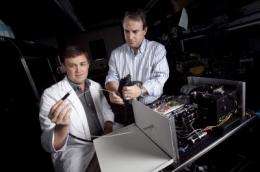
This is Neil Terry, left, and Adam Wax with a prototype of the new device. Credit: Duke University Photography
A tiny light source and sensors at the end of an endoscope may provide a more accurate way to identify pre-cancerous cells in the lining of the esophagus.
Developed by biomedical engineers at Duke University and successfully tested on patients during a clinical trial at the University of North Carolina at Chapel Hill, the device holds the promise of being a less invasive method for testing patients suspected of having Barrett's esophagus, a change in the lining of the esophagus due to acid reflux. Acid reflux occurs when stomach acid splashes, or refluxes, up into the esophagus.
This video is not supported by your browser at this time.
Long periods of acid reflux can change the cells that line the esophagus, making them appear more like intestinal cells than esophageal cells. These cellular changes can also be a precursor to cancer. As in most cancers, early identification of these pre-cancerous cells often leads to better outcomes for patients. Barrett's esophagus afflicts more than one percent of the U.S. population, with most patients above the age of 50.Using an endoscope to reach the esophagus via the nose, physicians shine short bursts of this light at locations of suspected disease and sensors capture and analyze the light as it is reflected back. In particular, they are trying to spot characteristic changes within the layer of cells known as the epithelium, which line cavities and surfaces throughout the body.
"By interpreting the way the light scatters after we shine it at a location on the tissue surface, we can the spot the tell-tales signs of cells that are changing from their healthy, normal state to those that may become cancerous," said Neil Terry, a Ph.D. student working in the laboratory of Adam Wax, associate professor of biomedical engineering at Duke's Pratt School of Engineering, who developed the device.
The team published their findings online in the January issue of the journal Gastroenterology.
"Specifically, the nuclei of pre-cancerous cells are larger than typical cell nuclei, and the light scatters back from them in a characteristic manner," Terry continued. "When we compared the findings from our system with an actual review by pathologists, we found they correlated in 86 percent of the samples."
UNC gastroenterologist Nicholas Shaheen, M.D., conducted the preliminary clinical trial of the device on 46 patients with Barrett's esophagus.
"Currently, we take many random tissue samples from areas we where we think abnormal cells may be located," Shaheen said. "This new system may make our biopsies smarter and more targeted. Early detection is crucial, because the cure rate for esophageal cancer that is caught early is quite high, while the cure rate for advanced disease is dismal, with a 15 percent survival rate after five years."
The technology that Wax and his team developed for cancer detection is known as angle-resolved low coherence interferometry (a/LCI). The technique is able to separate the unique patterns of the nucleus from the other parts of the cell and provide representations of its changes in shape in real time.
"This optical approach of sampling allows us to cover more tissue sites in less time and has the potential to significantly improve our ability to spot and monitor these pre-cancerous cells," Wax said. "This type of approach could be used to improve and perhaps one day supplant the physical biopsies currently being used."
Wax pointed out that since approximately 85 percent of all cancers begin within the layers of the epithelium in various parts of the body, he believes that the new system could also work in such cancers as those of the colon, trachea, cervix or bladder.
Provided by
Duke University
-
From lemons to lemonade: Reaction uses carbon dioxide to make carbon-based semiconductor,
28 comments
-
Thioridazine kills cancer stem cells in human while avoiding toxic side-effects of conventional cancer treatments,
3 comments
-
SpaceX private rocket blasts off for space station (Update),
41 comments
-
Climate scientists say they have solved riddle of rising sea,
30 comments
-
Scotland passes turbine test to harness tidal power,
40 comments
-
Potential Breakthrough in Seizure Control
8 hours ago
-
Popping/Cracked sternum.
12 hours ago
-
Which Mental Illness Encompasses This Problem?
13 hours ago
-
A question about drug tolerance
May 23, 2012
-
Poor nutrition leading to overeating?
May 23, 2012
-
Math and dyslexia?
May 21, 2012
- More from Physics Forums - Medical Sciences
More news stories
Family history of Alzheimer's affects functional connectivity
(HealthDay) -- Cognitively normal individuals with a family history of late-onset Alzheimer's disease (AD) may display lower resting state functional connectivity in the default mode network (DMN) of the brain, ...
Medicine & Health / Alzheimer's disease & dementia
3 hours ago |
not rated yet |
0
Transvaginal mesh op restores pelvic organ prolapse at price
(HealthDay) -- Transvaginal mesh (TVM) procedures are effective for anatomical restoration of pelvic organ prolapse (POP), but patients report a worsening of sexual function following surgery, according to ...
3 hours ago |
not rated yet |
0
Travel to high altitudes tied to Crohn's, colitis flare-ups
(HealthDay) -- People with inflammatory bowel disease, which includes Crohn's disease and colitis, may be at increased risk for flare-ups when they fly or travel to high altitudes for skiing or mountain climbing, ...
Medicine & Health / Inflammatory disorders
4 hours ago |
not rated yet |
1
|
Skp2 activates cancer-promoting, glucose-processing Akt
HER2 and its epidermal growth factor receptor cousins mobilize a specialized protein to activate a major player in cancer development and sugar metabolism, scientists report in the May 25 issue of Cell.
21 hours ago |
not rated yet |
0
|
Tongue analysis software uses ancient Chinese medicine to warn of disease
For 5,000 years, the Chinese have used a system of medicine based on the flow and balance of positive and negative energies in the body. In this system, the appearance of the tongue is one of the measures used to classify ...
19 hours ago |
1 / 5 (1) |
0
|
SpotterRF debuts Radar Backpack Kit (w/ Video)
(Phys.org) -- SpotterRF has announced a special radar backpack kit designed to enhance situational awareness for soldiers on the ground. The company says its special radar is designed for warfighters as part ...
Australia hails surprise super-telescope decision
Australia has hailed a surprise decision giving it a role in a radio telescope project aimed at revolutionising astronomy, vowing to draw on its decades of experience in space science.
Astronomers seize last chance in lifetime for Venus Transit
Astronomers are gearing for one the rarest events in the Solar System: an alignment of Earth, Venus and the Sun that will not be seen for another 105 years.
SpaceX capsule has 'new car' smell, astronauts say
SpaceX's Dragon cargo vessel smells like a new car, said astronauts at the International Space Station after opening the hatches Saturday following the spacecraft's landmark mission to the orbiting lab.
Thousands of shellfish found dead in Peru
Thousands of crustaceans were found dead off the coast of Lima following the mystery mass death of dolphins and pelicans, the Peruvian Navy said Friday.
Astronauts enter world's 1st private supply ship
(AP) -- Space station astronauts floated into the Dragon on Saturday, a day after its heralded arrival as the world's first commercial supply ship.