Dying young did not cause Neanderthals' demise
Jan 10, 2011
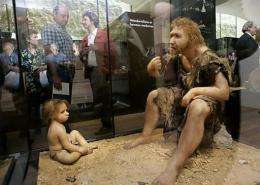
A Neanderthal man ancestor's reconstruction. Dying young was not likely the reason Neanderthals went extinct, said a study out Monday that suggests early modern humans had about the same life expectancy as their hairier, ancient cousins.

Dying young was not likely the reason Neanderthals went extinct, said a study out Monday that suggests early modern humans had about the same life expectancy as their hairier, ancient cousins.

Scientists have puzzled over why the Neanderthals disappeared just as modern humans were making huge gains and moving into new parts of Africa and Europe, and some have speculated that a difference in longevity may have been to blame.

If anything, higher fertility rates and lower infant mortality gave modern humans an advantage over the Neanderthals, who died off about 30,000 years ago, said the study in the .

Scientist Erik Trinkaus of Washington University studied fossil records to get an idea of the of Neanderthals and early modern humans, who co-existed in different parts of the world for about 150,000 years.

He found about the same number of 20-40 year old adults in both populations, an indication that would reflect "similar patterns of adult mortality," said the study.

"All the samples have a dearth of older individuals, which should reflect a complex combination of low for adults, demographic instability, and the demands of mobility," he said.

"If indeed there was a demographic advantage for early modern humans, at least during transitional phases of Late Pleistocene , it must have been the result of increased fertility and/or reduced immature mortality."

The squat, low-browed lived in parts of Europe, Central Asia and the Middle East. Their last known refuge was Gibraltar.

Explore further: Actor Johnny Depp immortalized in ancient fossil find

add to favorites email to friend print save as pdf

Related Stories

Study finds Neanderthals ate their veggies

Dec 27, 2010

A US study on Monday found that Neanderthals, prehistoric cousins of humans, ate grains and vegetables as well as meat, cooking them over fire in the same way homo sapiens did.

New ancestor? Scientists ponder DNA from Siberia

Mar 24, 2010

(PhysOrg.com) -- An international team of scientists from the Max Planck Institute for Evolutionary Anthropology in Leipzig has sequenced ancient mitochondrial DNA from a finger bone found in southern Siberia. ...

Scientists redate Neanderthal fossils

Jan 05, 2006

Scientists say two Neanderthal fossils excavated from Vindija Cave in Croatia in 1998 may be 3,000-4,000 years older than originally thought.

Handsome by Chance

Aug 02, 2007

Chance, not natural selection, best explains why the modern human skull looks so different from that of its Neanderthal relative, according to a new study led by Tim Weaver, assistant professor of anthropology at UC Davis.

Recommended for you

The eloquence of the otoliths

May 16, 2013

Fish fossils that are about 23 million years old give unprecedented insight into the evolutionary history of the gobioid order, one of the most species-rich groups among the modern bony fishes.

Light cast on lifestyle and diet of first New Zealanders

May 16, 2013

(Phys.org) —A University of Otago-led multidisciplinary team of scientists have shed new light on the diet, lifestyles and movements of the first New Zealanders by analysing isotopes from their bones and teeth.

mtDNA study shows Minoans came from Europe not Africa

May 15, 2013

(Phys.org) —A new study conducted by a team of American and Greek researchers has found that the people of the ancient Minoan civilization living on the island of Crete most likely came from Europe. In ...

User comments : 6

Adjust slider to filter visible comments by rank

Display comments: newest first

ubavontuba
3 / 5 (8) Jan 10, 2011
What evidence is there that Neanderthals were hairier? Seriously, who writes this stuff?
StillWind
4.2 / 5 (5) Jan 10, 2011
Yeah, these guys survived at least 600,000 years of some of the most extreme climate change the planet has ever seen, and some people still want to make them out to be inferior to us.
All the more ironinc when we consider that many today think that a 4 degree rise will wipe "us" out.
Jez_Ball
5 / 5 (2) Jan 10, 2011
I thought Neanderthals died out because they typically lived in groups of 10-20, whereas competing Homo Sapiens easily overwhelmed them with their groups of 50-100 individuals.
ubavontuba
1 / 5 (1) Jan 10, 2011
I thought Neanderthals died out because they typically lived in groups of 10-20, whereas competing Homo Sapiens easily overwhelmed them with their groups of 50-100 individuals.
That's the latest sociological hypothesis, anyway. It makes a lot of sense.

The comparison has been likened to chimpanzees and bonobos (humans being more like the sociable bonobos). Competition for limited resources in a harsh environment, combined with smaller groups, infighting, warfare with homosapiens, low birth rates, high infant mortality, and diseases spread by contact with homosapiens, makes extinction for them seem inevitable.

You can also compare it to the European invasion of America. The Europeans tended to congregate in larger groups, secure more resources, and so on... with all too nearly similar results.
RobertKarlStonjek
not rated yet Jan 10, 2011
Pathogens have come close to wiping out whole populations in modern times eg when 'moderns' meet 'primitive' populations. Pathogens are far more effective than a few hostile encounters; most of the land was unpopulated, so out breeding is hardly a convincing story.
Polestar
not rated yet Jan 16, 2011
Neanderthal's brains were larger than ours. Maybe when they saw us come along they said, "Oh Brother, there goes the neighborhood".

More news stories

Evolution of lying

(Phys.org) —Ultimately, our ability to convincingly lie to each other may have evolved as a direct result of our cooperative nature.

Morocco to harness the wind in energy hunt

Morocco is ploughing ahead with a programme to boost wind energy production, particularly in the southern Tarfaya region, where Africa's largest wind farm is set to open in 2014.

US seizes Bitcoin operator accounts

US authorities seized the accounts of a Bitcoin digital currency exchange operator, claiming it was functioning as an "unlicensed money service business," court documents showed Friday.