Discovery of 'probiotic transporters' unlocks secrets of infection-preventive bifidobacteria
January 26, 2011

Discovery of 'probiotic transporters' unlocks secrets of infection-preventive bifidobacteria

Enlarge

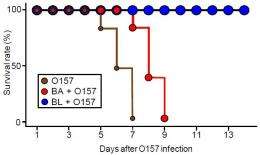
Survival rate of germ-free mice, preventive B. longum (BL)- and non-preventive B. adolescentis (BA)-associated mice after O157 infection (n = 10).

Japanese researchers at RIKEN, Yokohama City University and the University of Tokyo have uncovered how gut bifidobacteria protect the body against lethal infection by enhancing the defenses of colonic epithelium. Published in this week’s issue of Nature, the finding provides first-ever clues on the mechanisms underlying the beneficial effects of gut microbiota, promising more effective probiotic therapies for a variety of disorders and diseases.

In recent years, new metagenomics techniques have enabled scientists to delve ever-deeper into the world of gut microbiota, revealing the strong influence that intestinal exert on our health. Bifidobacteria, one of the most numerous such bacteria, confer to their hosts a range of beneficial health effects, aiding in digestion, boosting the immune system and even reducing cancer risk. The mechanism underlying these effects, however, has remained a mystery.

With their study, the research team set out to unravel this mystery using a combination of techniques from genetics, transcriptomics and metabolomics. Initial experiments on so-called germ-free (GF) mice, whose guts are uncolonized by bacteria, revealed stark differences between bifidobacteria strains. The researchers found that mice colonized by one bifidobacterium subspecies, B. longum, were able to survive when fed the pathogenic bacteria E. coli O157, while GF mice without the bacteria died of infection within 7 days. Another strain named B. adolescentis, in contrast, had no such effect.
Discovery of 'probiotic transporters' unlocks secrets of infection-preventive bifidobacteria
Enlarge

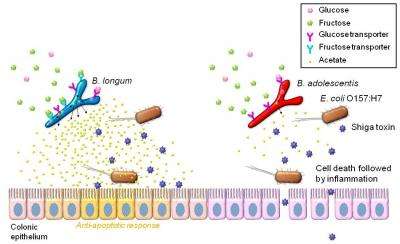
Schematic representation of the mechanisms of O157 lethal infection and prevention by bifidobacteria. Both B. longum (BL) and B. adrescentis (BA) possess glucose transporter(s) and can produce acetate from glucose in the proximal colon, where glucose is thought to be present; this acetate exerts an anti-apoptotic effect on colonic epithelium. In the distal colon, in contrast, only fructose is available, and thus only BL, with its fructose transporters, is able to produce acetate there. BA lacks the fructose transporters, and thus fails to produce enough acetate to prevent epithelial apoptosis by O157. This results in translocation of Shiga toxin into the blood stream, leading to death of the mice.

By analyzing fecal metabolic profiles, the researchers succeeded in pinpointing the source of this difference in the production of acetate, which they showed enhances intestinal epithelial defense and protects against infection from O157. The key actor in this mechanism is a carbohydrate transporter encoded by genes present in certain strains of bifidobacteria such as B. longum, which enables these bacteria to utilize fructose to produce acetate in the distal colon.

As a demonstration of the power of multi “omics” technologies, the identification of these “probiotic transporters” constitutes a milestone in the study of gut microbiota. The finding also demonstrates the power of multi “omics” technologies for analyzing the gut ecosystem, promising advancements in the development of cutting-edge probiotic therapies.

More information: Shinji Fukuda, Hidehiro Toh, Koji Hase, Kenshiro Oshima, Yumiko Nakanishi, Kazutoshi Yoshimura, Toru Tobe, Julie M. Clarke, David L. Topping, Tohru Suzuki, Todd D. Taylor, Kikuji Itoh, Jun Kikuchi, Hidetoshi Morita, Masahira Hattori and Hiroshi Ohno. Bifidobacteria protect host from enteropathogenic infection through production of acetate. Nature (2010). DOI: 10.1038/nature09646

Provided by RIKEN search and more info website


Rank 5 /5 (1 vote)
Relevant PhysicsForums posts

More news stories

Thousands of shellfish found dead in Peru

Thousands of crustaceans were found dead off the coast of Lima following the mystery mass death of dolphins and pelicans, the Peruvian Navy said Friday.

Biology / Ecology

created 3 hours ago | popularity 5 / 5 (1) | comments 0

Researchers solve structure of human protein critical for silencing genes

In a study published in the journal Cell on May 24, Cold Spring Harbor Laboratory (CSHL) scientists describe the three-dimensional atomic structure of a human protein bound to a piece of RNA that "guides" the pr ...

Biology / Cell & Microbiology

created 19 hours ago | popularity 4.7 / 5 (7) | comments 0 | with audio podcast

It's in the genes: Research pinpoints how plants know when to flower

Scientists believe they've pinpointed the last crucial piece of the 80-year-old puzzle of how plants "know" when to flower.

Biology / Biotechnology

created 18 hours ago | popularity 3.9 / 5 (8) | comments 1 | with audio podcast

More plant species responding to global warming than previously thought

(Phys.org) -- Far more wild plant species may be responding to global warming than previous large-scale estimates have suggested.

Biology / Ecology

created May 22, 2012 | popularity 4.7 / 5 (13) | comments 16 | with audio podcast

Totally rad: Scientists create rewritable digital data storage in DNA

(Phys.org) -- Scientists from Stanford's Department of Bioengineering have devised a method for repeatedly encoding, storing and erasing digital data within the DNA of living cells.

Biology / Biotechnology

created May 21, 2012 | popularity 4.9 / 5 (15) | comments 11 | with audio podcast


SpotterRF debuts Radar Backpack Kit (w/ Video)

(Phys.org) -- SpotterRF has announced a special radar backpack kit designed to enhance situational awareness for soldiers on the ground. The company says its special radar is designed for warfighters as part ...

Family history of Alzheimer's affects functional connectivity

(HealthDay) -- Cognitively normal individuals with a family history of late-onset Alzheimer's disease (AD) may display lower resting state functional connectivity in the default mode network (DMN) of the brain, ...

Transvaginal mesh op restores pelvic organ prolapse at price

(HealthDay) -- Transvaginal mesh (TVM) procedures are effective for anatomical restoration of pelvic organ prolapse (POP), but patients report a worsening of sexual function following surgery, according to ...

Travel to high altitudes tied to Crohn's, colitis flare-ups

(HealthDay) -- People with inflammatory bowel disease, which includes Crohn's disease and colitis, may be at increased risk for flare-ups when they fly or travel to high altitudes for skiing or mountain climbing, ...

Astronomers seize last chance in lifetime for Venus Transit

Astronomers are gearing for one the rarest events in the Solar System: an alignment of Earth, Venus and the Sun that will not be seen for another 105 years.

Australia hails surprise super-telescope decision

Australia has hailed a surprise decision giving it a role in a radio telescope project aimed at revolutionising astronomy, vowing to draw on its decades of experience in space science.