Hunt for dark matter closes in at Large Hadron Collider
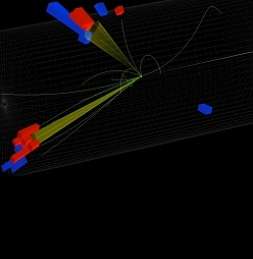
One of the earliest CMS events found showing evidence of two jets. The blue and red columns represent energy deposited in the detector, while the yellow curved lines are measured tracks of particles.
(PhysOrg.com) -- Physicists are closer than ever to finding the source of the Universe's mysterious dark matter, following a better than expected year of research at the Compact Muon Solenoid (CMS) particle detector, part of the Large Hadron Collider (LHC) at CERN in Geneva.
The scientists have now carried out the first full run of experiments that smash protons together at almost the speed of light. When these sub-atomic particles collide at the heart of the CMS detector, the resultant energies and densities are similar to those that were present in the first instants of the Universe, immediately after the Big Bang some 13.7 billion years ago. The unique conditions created by these collisions can lead to the production of new particles that would have existed in those early instants and have since disappeared.
The researchers say they are well on their way to being able to either confirm or rule out one of the primary theories that could solve many of the outstanding questions of particle physics, known as Supersymmetry (SUSY). Many hope it could be a valid extension for the Standard Model of particle physics, which describes the interactions of known subatomic particles with astonishing precision but fails to incorporate general relativity, dark matter and dark energy.
Dark matter is an invisible substance that we cannot detect directly but whose presence is inferred from the rotation of galaxies. Physicists believe that it makes up about a quarter of the mass of the Universe whilst the ordinary and visible matter only makes up about 5% of the mass of the Universe. Its composition is a mystery, leading to intriguing possibilities of hitherto undiscovered physics.
Professor Geoff Hall from the Department of Physics at Imperial College London, who works on the CMS experiment, said: "We have made an important step forward in the hunt for dark matter, although no discovery has yet been made. These results have come faster than we expected because the LHC and CMS ran better last year than we dared hope and we are now very optimistic about the prospects of pinning down Supersymmetry in the next few years."
The energy released in proton-proton collisions in CMS manifests itself as particles that fly away in all directions. Most collisions produce known particles but, on rare occasions, new ones may be produced, including those predicted by SUSY known as supersymmetric particles, or 'sparticles'. The lightest sparticle is a natural candidate for dark matter as it is stable and CMS would only 'see' these objects through an absence of their signal in the detector, leading to an imbalance of energy and momentum.
In order to search for sparticles, CMS looks for collisions that produce two or more high-energy 'jets' (bunches of particles travelling in approximately the same direction) and significant missing energy.
Dr Oliver Buchmueller, also from the Department of Physics at Imperial College London, but who is based at CERN, explained: "We need a good understanding of the ordinary collisions so that we can recognise the unusual ones when they happen. Such collisions are rare but can be produced by known physics. We examined some 3 trillion proton-proton collisions and found 13 'SUSY-like' ones, around the number that we expected. Although no evidence for sparticles was found, this measurement narrows down the area for the search for dark matter significantly."
The physicists are now looking forward to the 2011 run of the LHC and CMS, which is expected to bring in data that could confirm Supersymmetry as an explanation for dark matter.
The CMS experiment is one of two general purpose experiments designed to collect data from the LHC, along with ATLAS (A Toroidal LHC ApparatuS). Imperials High Energy Physics Group has played a major role in the design and construction of CMS and now many of the members are working on the mission to find new particles, including the elusive Higgs boson particle (if it exists), and solve some of the mysteries of nature, such as where mass comes from, why there is no anti-matter in our Universe and whether there are more than three spatial dimensions.
More information: http://cms.web.cer … s/index.html
Provided by
Imperial College London
-
From lemons to lemonade: Reaction uses carbon dioxide to make carbon-based semiconductor,
28 comments
-
Thioridazine kills cancer stem cells in human while avoiding toxic side-effects of conventional cancer treatments,
3 comments
-
SpaceX private rocket blasts off for space station (Update),
41 comments
-
Climate scientists say they have solved riddle of rising sea,
30 comments
-
Scotland passes turbine test to harness tidal power,
40 comments
-
How can squinting be used by both a myopic & hyperopic eye?
3 hours ago
-
The need for practical electronic and mechanical skills for aspiring experimentalists
8 hours ago
-
Refraction and splitting of a photon
10 hours ago
-
Total pressure load on a chain...
11 hours ago
-
Water under pressure and temperature effects
14 hours ago
-
Flow, different liquid, pressure
14 hours ago
- More from Physics Forums - General Physics
More news stories
Landmark calculation clears the way to answering how matter is formed
(Phys.org) -- An international collaboration of scientists, including Thomas Blum, associate professor of physics, is reporting in landmark detail the decay process of a subatomic particle called a kaon ...
May 25, 2012 |
4.8 / 5 (13) |
40
|
Is a classical electrodynamics law incompatible with special relativity?
(Phys.org) -- The laws of classical electromagnetism that were developed in the 19th century are the same laws that scientists use today. They include Maxwell’s four equations along with the Lorentz la ...
Lying in wait for WIMPs: Researchers seek to dramatically increase sensitivity of Large Underground Xenon detector
Although it's invisible, dark matter accounts for at least 80 percent of the matter in the universe. No one knows what it is, but most scientists would bet on weakly interacting massive particles, or WIMPs.
May 23, 2012 |
4 / 5 (5) |
14
|
Hall effect at the speed of light: How can you demonstrate relativistic effects with your mobile phone?
The relativistic Hall effect describing objects rotating at speeds comparable with the speed of light has been reported.
May 21, 2012 |
4.3 / 5 (3) |
8
Cloak of invisibility: Engineers use plasmonics to create an invisible photodetector
A team of engineers at Stanford and the University of Pennsylvania has for the first time used "plasmonic cloaking" to create a device that can see without being seen - an invisible machine that detects light. It is the first ...
May 21, 2012 |
4.8 / 5 (16) |
7
|
SpotterRF debuts Radar Backpack Kit (w/ Video)
(Phys.org) -- SpotterRF has announced a special radar backpack kit designed to enhance situational awareness for soldiers on the ground. The company says its special radar is designed for warfighters as part ...
Family history of Alzheimer's affects functional connectivity
(HealthDay) -- Cognitively normal individuals with a family history of late-onset Alzheimer's disease (AD) may display lower resting state functional connectivity in the default mode network (DMN) of the brain, ...
Transvaginal mesh op restores pelvic organ prolapse at price
(HealthDay) -- Transvaginal mesh (TVM) procedures are effective for anatomical restoration of pelvic organ prolapse (POP), but patients report a worsening of sexual function following surgery, according to ...
Travel to high altitudes tied to Crohn's, colitis flare-ups
(HealthDay) -- People with inflammatory bowel disease, which includes Crohn's disease and colitis, may be at increased risk for flare-ups when they fly or travel to high altitudes for skiing or mountain climbing, ...
Thousands of shellfish found dead in Peru
Thousands of crustaceans were found dead off the coast of Lima following the mystery mass death of dolphins and pelicans, the Peruvian Navy said Friday.
Astronomers seize last chance in lifetime for Venus Transit
Astronomers are gearing for one the rarest events in the Solar System: an alignment of Earth, Venus and the Sun that will not be seen for another 105 years.
Jan 26, 2011
Rank: 2.2 / 5 (26)
...and I have just had a brain wave about writing a best-seller novel. Would anyone like to buy it?
Seriously, wtf?
Jan 26, 2011
Rank: 2 / 5 (21)
Whatever pays the rent, I guess...
Jan 26, 2011
Rank: 4.8 / 5 (26)
They're searching at different energies. At a particular energy, they'll find what they're looking for (maybe) for each energy they don't find it at, they solve a version of the equation, allowing for fewer other equations resulting in each failure leading to total success.
Jan 26, 2011
Rank: 1.7 / 5 (34)
Try instead "each failure leading to total failure". Works just as well and far more likely to be true.
Really hard to find what you make up because you don't like what you see. The lengths we will go to sustain theories which do not reflect reality is amazing.
Jan 26, 2011
Rank: 4.4 / 5 (23)
Jan 26, 2011
Rank: 2.4 / 5 (30)
Because we are so enamored with our theories, we have failed to recognize that they have failed. Instead, we create an imaginary substance which cannot be detected but which has the single characteristic that it interacts gravitationally. This substance is always found in the precise quantity and in the precise position to account for any gravitational anomalies.
When you have to create an imaginary substance to prop up your theories and when you have to constantly "find" the precise amount of that substance in precisely the positions necessary to account for the anomalies, you are no longer following any scientific method. You are acting more like a shaman than a scientist.
Jan 26, 2011
Rank: 4.4 / 5 (18)
The thing is, current theory works so well and has yet to be disproved. So before we go scrapping it because we can't figure out this dark matter puzzle, let's see if the Higgs exists (which it does, in theory) and see if it can account for this missing mass.
Why would you object to this line of reasoning? I'm not trying to be a jerk, I'm genuinely curious.
Jan 26, 2011
Rank: 1.6 / 5 (20)
Do you not see the impossibility of an invisible, undetectable particle [or whatever] which is always found in the precise amount necessary to account for gravitational anomalies and is additionally distributed in the precise manner necessary to account for the observed motions?
You would think, wouldn't you, that among the billions of galaxies and galaxy clusters we can see, that at least one of them would have too much or too little of this substance or that at least one of them would have this substance distributed differently?
When you have to make it up and then you have to presume impossible odds on its distribution, you do not have a scientific theory. A scientific theory is based on observation and reasonable probabilities.
Jan 26, 2011
Rank: 4.4 / 5 (20)
If we define the missing mass from galaxies as dark matter, how can it be in anything but the correct amount to explain the gravitational anomolies?
Furthermore, it doesn't just appear in a perfect sphere enveloping each galaxy, or anything like that. It's distribution, as inferred from gravitational effects, is far from uniform.
Jan 26, 2011
Rank: 4.2 / 5 (6)
Well, your criticism might carry more impact if this was not, in fact, how most novels from well established authors are contracted. (The author has an idea, with maybe a few pages of outline written to express it - and of course they think it will be a best seller and promote it to their publisher as such, do you think they're stupid? - and the publisher pays for the idea. It's called an advance. And before you carry the analogy too far, are you going to seriously try to suggest that a Professor in Physics at Imperial College could not, in some way, be reasonably considered "well established"?)
Perhaps you might like to explain your critique more coherently?
Jan 26, 2011
Rank: 1.3 / 5 (16)
You make my point. It is not a uniform distribution, but a highly variable distribution which always is "just right" to account for the observed motions.
Jan 26, 2011
Rank: 1 / 5 (16)
Jan 26, 2011
Rank: 1 / 5 (14)
Jan 26, 2011
Rank: 4.7 / 5 (12)
I don't think you got T-Bohr's point. It is not a suspicious coincidence that the amount of DM is just right to account for observations,... rather it is that in order for a galaxy to rotate in such a way given exiting theory there would have to be x amount of mass by definition.
Jan 26, 2011
Rank: 4.5 / 5 (18)
By searching for the missing mass which theory says must exist, they ARE testing the theory. You can't just dump a theory that is so accurate locally,... because there IS the possibility that theory is TELLING YOU there is unobserved mass. This must be ruled out.
Jan 27, 2011
Rank: not rated yet
Well, I don't think our theories dictate the position of the universe, but rather the universe and distribution of this dark matter dictates what we observe. Either way, I do see your point and there isn't much sense with me arguing over this. I think we are more or less on the same page.
Jan 27, 2011
Rank: 1 / 5 (8)
There is no theory. All we have is mathematical equations that don't really work so we throw in a balancing factor. Quantum mechanics is in its infancy, in that there is no physical theory, only mathematical. I respect Feynman so much for saying "we don't know". All we have is a bunch of equations.
Jan 27, 2011
Rank: 1 / 5 (7)
Jan 27, 2011
Rank: 4.5 / 5 (15)
Except that the 'imaginary substance that cannot be detected" has been detected. There are whole sky maps of the stuff, detected by gravitational lensing. Large scale lensing occurs even though there is no luminous matter that can produce the effect. There can be little doubt that dark matter exists.
Jan 27, 2011
Rank: 4.6 / 5 (9)
Sorry, but that makes no sense. Care to expand?
That too.
Jan 27, 2011
Rank: 5 / 5 (10)
Jan 27, 2011
Rank: 4.9 / 5 (9)
Whether those shapes correspond to the "missing" galactic masses would, of course, depend on the material's density. So we're back to convenient assumptions on that point. Nevertheless, SOMETHING is bending light around galaxies, and an invisible mass actually seems like the simplest solution for the data. Got any better ideas?
I've thought that maybe the lensing is caused by non-gravity-based contours in spacetime, but I suspect there's some physics that renders that bogus...
Jan 27, 2011
Rank: 3.7 / 5 (9)
Jan 27, 2011
Rank: 5 / 5 (2)
Jan 27, 2011
Rank: 4.6 / 5 (13)
The notion of atoms has been around for millenia, though not as a mathematical prediction.
I think the classic example would be the prediction of the positron (though Dirac didn't quite call it that), which pops out of the Dirac equation (1928). The physical discovery occurred in 1932.
Jan 27, 2011
Rank: 5 / 5 (10)
Many modified gravitational theories have been proposed. None match observations. Scientists are quite willing to try anything that fits the data.
Jan 27, 2011
Rank: 1 / 5 (5)
Maybe the SM describes subatomic interactions with "astonishing precision" because the model is fed with constants to do just that...?
Jan 27, 2011
Rank: 4.6 / 5 (10)
Ethelred
Jan 27, 2011
Rank: 2.5 / 5 (8)
cmon this is not news, and I would like a refund on the 5 minutes I wasted on this when a proper headline of "dark matter confined to more narrow range". I feel cheated of my time.
Jan 27, 2011
Rank: 1 / 5 (7)
How do you know this? What are the upper bounds in terms of energetic frequency placed on light?
As well, how do you explain photographs of atoms? Wasn't one posted on physorg?
Jan 27, 2011
Rank: 3.5 / 5 (8)
More finely tuned constants than there are fundamental particles at this point.
Nevertheless, there is no unexplainable deviation, and no significant deviation from the SM and observation.
LHC may produce one. Be patient.
If it continues to confirm the SM, will you continue to be as displeased?
Jan 27, 2011
Rank: 2.6 / 5 (5)
Which is equivalent to saying that every reaction observed so far at the LHC has confirmed the Standard Model.
Impressive, but entirely expected at this point.
Jan 27, 2011
Rank: 3.9 / 5 (11)
No one knows what the upper limit is on the frequency of light, but it is presumed that the shortest wavelength is less than the plank length.
Before you get to frequencies that high, your photons become indistinguishable from electron/positron pairs, so you lose the concept of photon (if there is one).
As for a photograph of an atom. Scanning/tunneling electron microscopes have been "photographing" atoms for some time. But then the "photographs" are just really visualizations of the field potential between the probe tip and the surface being scanned.
Light by itself can not be used to image an individual atom because imaging requires many photons and atoms only absorb photons at specific frequencies, and are altered by doing so.
Jan 27, 2011
Rank: 3 / 5 (6)
In the case of imaging often multiple "equivalent" particles are measured and the individual measurements are processed to produce a visualization that is claimed to be that of a single particle.
These things are obvious to a professional, but not at all clear in most articles targeded at the lay person.
Jan 27, 2011
Rank: 5 / 5 (11)
Why are you such an anti-science nutjob? Are you jsut upset because reality is more complex than you can grasp?
Jan 27, 2011
Rank: 2.8 / 5 (11)
After this recognition, science would get a more accurate view of the natural micro and macro world.
Jan 27, 2011
Rank: 1.6 / 5 (14)
1) Note that stars and galaxies move too fast to stay in their galaxy/galaxy groups.
2) Imagine mass with gravitational properties but otherwise no observable properties.
3) Imagine the distribution of this imaginary substance in such a manner that the anomalies in our gravity formulas go away.
4) Declare that we have found our imaginary mass because our theories now work as long as we continue to imagine that our imaginary mass is where we have imagined it to be.
It is sad that you don't recognize the flaw in your reasoning.
Jan 27, 2011
Rank: 1.7 / 5 (11)
Jan 27, 2011
Rank: 4.4 / 5 (9)
Then maybe you should learn how science makes progress. Sometimes theories TELL us something. Several people above have explained this and have given you excellent examples in history where a theory predicted the existence or non-existence of things that where not known of, or that were thought to exist.
[I must have been wrong when I got the impression that Vendicar was a kid a while ago]
Jan 27, 2011
Rank: 4.9 / 5 (14)
What does that have to do with the upper bounds of human eyesight? We don't see gamma rays. Or X-rays. The key word was VISIBLE. Which means by EYE. I will accept the lens aided eye because the eye is still the receptor(and I can't see past my elbow without lenses). The eye simply can't receive X-raysThere aren't any. No. PHOTO is LIGHT. There are false color images taken from scanning tunneling microscopes and another tool with a name that escapes me at the moment. But they aren't done with light. The images are created in computers. We see something a computer created from data.
Yes I am being a bit pedantic but only a very tiny bit. So tiny it can't be seen with visible light.
Ethelred
Jan 27, 2011
Rank: 1.6 / 5 (13)
I am sorry that you cannot understand that circular reasoning is flawed reasoning.
We create an imaginary substance to normalize our models. Now that our models are normalized, we declare that the imaginary substance must exist because it normalized our models.
This is not science. It is not even logical. It is flawed reasoning.
There may actually be "dark matter" and it may even be where we want it to be in the amounts we want it to be [not likely], but one thing is absolutely certain, it has not been "found" because we normalized our math with it.
Jan 27, 2011
Rank: 5 / 5 (6)
Those produce a characteristic gamma ray frequency that has been detected.
httpDELETEME://en.wikipedia.org/wiki/Electron-positron_annihilation
Ethelred
Jan 27, 2011
Rank: 3.6 / 5 (5)
Ethelred
Jan 27, 2011
Rank: 4.6 / 5 (9)
Jan 27, 2011
Rank: 5 / 5 (14)
One path can be wrong. Two paths of evidence are much less likely to be wrong.
Ethelred
Jan 27, 2011
Rank: 1.2 / 5 (19)
Jan 27, 2011
Rank: 1.6 / 5 (7)
Centrifugal force is an effect.
Gravity is a force that is comparable to the electric and the magnetic force, you just need to understand the nature of gravity.
Jan 27, 2011
Rank: 5 / 5 (12)
Jan 27, 2011
Rank: not rated yet
Jan 27, 2011
Rank: 5 / 5 (12)
Out of our asses. Definitely. All of us. As a matter of fact, I graduated from septic tank cleaning school. I normally have to deal with other kinds of particles. I'm scrubbing one down this very minute. As I type. On my iPod Shuffle. With my teeth. I keep an antenna out the hatch for reception.
Jan 27, 2011
Rank: not rated yet
Here are my predictions out of my ass. Mass doesn't come from a particle, no Higg's boson. There isn't any anti-matter because it was annihilated when the big bang occurred. There are only 3 dimensions. And dark matter isn't matter.
Gawad, you must be very familiar with dark matter.
Jan 27, 2011
Rank: 5 / 5 (10)
Jan 27, 2011
Rank: 4.2 / 5 (6)
According to GR gravity is not a force.
Jan 27, 2011
Rank: 4.8 / 5 (4)
Jan 27, 2011
Rank: 4.5 / 5 (8)
Dark energy,.. no, really. It could be vacuum energy (einsteins cosmological constant) or perhaps another source. TBD.
Jan 27, 2011
Rank: 5 / 5 (6)
Jan 27, 2011
Rank: 5 / 5 (11)
You seem to want to believe that you have some special insight into the subject because you 'realized' there is a logical loop. Do you really think that other physicists have not thought of this? Do you think you are smarter then the scientists who study this? If you have a better theory then please make it public but until then, it's better to pursue all possibilities.
If we didn't look for DM and it turned out to be the correct answer to the galactic gravitational problems then you would look like quite the fool now wouldn't you?
Jan 27, 2011
Rank: 1.3 / 5 (12)
Sorry you don't like it when reality is not congruent with your illogical expectations.
And I have never claimed any special insight. I do not have the answers. Nevertheless, circular reasoning does not magically make imaginary mass real nor can circular reasoning ever prove anything.
Jan 27, 2011
Rank: 5 / 5 (1)
This discovery would not surprise me in the least.
Jan 27, 2011
Rank: 5 / 5 (12)
Are you saying we should NOT be investigating these observations? If so, let me turn the tables real quick and ask that you tell me why that should be, in spite of the evidence we have accumulated so far?
Accusing me of not having a grasp on reality is an amateur move on your part, in light of everything you have said so far. By saying that you think that a scientific consensus on what sorts of things we should be investigating is wrong, you are in fact claiming special insight. If you have it let's hear it.
Jan 27, 2011
Rank: 4.7 / 5 (12)
You don't listen. There is no circular reasoning here. The theory is predicting there must be more mass than observed, otherwise the theory is incorrect as is. Looking for DM is a way of checking that prediction and validity of that theory. As I said if you don't find it you can rule it out,.. if you don't look for it you effectively rule it in.
Jan 27, 2011
Rank: 1 / 5 (3)
Great! Now we have a new word: sparticles
To seriously investigate Dark Matter, one has to know the CAUSE of such activity. What force would cause protons in Empty Space to collide continuously to produce a quantum foam/steam/mist? Nothing said about a cause of such activity.
P.S. Gravity bends light. DM does not hinder any object. Purely my opinion to date.
Jan 27, 2011
Rank: 1.4 / 5 (10)
Are you being intentionally obtuse or are you really incapable of understanding?
Of course we can look for dark matter (and any other thing we might want to look for), but DM is highly unlikely and saying we have discovered it when we are only restating the observations which prompted us to postulate it is disingenuous. It is either an intentional lie or it is an illogical conclusion based on circular reasoning.
Jan 27, 2011
Rank: 1 / 5 (11)
Let me try to restate this in a way which is more understandable. Let us note that suns are moving too fast to remain bound to their galaxies according to our models and according to our understanding of the mass involved. Therefore, we postulate unseen mass to normalize out models. When asked if DM exists, we say yes, it is evident in the movement of suns. We have made the mistake of saying our hypothesis proves our hypothesis.
Jan 27, 2011
Rank: 5 / 5 (9)
Forget it guys; we've been outed.
Jan 27, 2011
Rank: 5 / 5 (11)
@ dogbert it's been said already but apparently it needs to be said again. There is empirical, observational evidence of SOMETHING creating a gravity lensing effect. We call that thing 'Dark Matter' for now. There is SOMETHING causing it.
Your statement that 'DM is highly unlikely' is not based on any evidence that you have cared to share other then your logical opinion.
It's like trying to claim that 'ufo's are not real, but thinking that 'ufo' means alien spacecraft, when we all know it just means 'something in flight that we cannot identify'. Ufo's are patently real from the context of that definition. Alien spacecraft on the other hand, well, I won't get into that one :P
Jan 27, 2011
Rank: 5 / 5 (8)
You're flapping your arms and screeching that we've made it all up, yet you haven't read but a single page outside of what you hear on blogs from other posters.
Do you know what the "Bullet" cluster is?
Do you know what ZwCl0024+1652 is?
Ever heard of the QUaD telescope project?
Jan 27, 2011
Rank: 4.5 / 5 (8)
Geez guy, put some a$$ into it.
If a theory is making a prediction (MORE MASS THAN IS OBSERVED), don't you think that that prediction should be tested? It is not duck-tape onto the theory, it is a PREDICTION which is falsifiable.
The title of this article is..
"Hunt for dark matter closes in at Large Hadron Collider"
The title of this article is NOT,...
"By using our beloved theory we discovered Dark Matter, ...and oh ya, umm by the way, the new definition of 'discover' is that um,... if a theory says so, then ahh well, umm, it exists."
Jan 27, 2011
Rank: 5 / 5 (12)
Jan 27, 2011
Rank: 5 / 5 (9)
Why are you posting this message right now, rather than working in a soup kitchen? There are more urgent issues that need resolving than reading science articles on the internet!
Jan 27, 2011
Rank: 1 / 5 (3)
Jan 27, 2011
Rank: not rated yet
How is it that Dark Energy can be both energy and mass at the same time?
Jan 27, 2011
Rank: 4.3 / 5 (6)
E=mc^2.
Jan 27, 2011
Rank: not rated yet
Of course E=mc2 but isn''t Dark Energy both E and mc2 at the same time?
Jan 27, 2011
Rank: 1 / 5 (1)
Jan 27, 2011
Rank: 5 / 5 (6)
Everything is energy. Some of it has condensed into matter.
Jan 27, 2011
Rank: 1 / 5 (5)
You conveniently ignored the obvious possibility that the "Law" of gravity may be incomplete.
Because of the way average stellar velocity plateaus with distance from Galactic Nucleus, instead of falling off, the more logical thing to suggestis:
1) There may be some other force at work, whatever holds stars in orbit of galaxies appears to function approximately linearly, and not by the inverse square law.
or
2) The equation for gravity itself is somehow modified over distances larger than a few light years, becoming arbitrarily close to linear, instead of inverse square.
There is no rational reason whatever for "Dark Matter" being a superior explaination to these others...
Jan 27, 2011
Rank: 5 / 5 (7)
Jan 27, 2011
Rank: 1 / 5 (6)
Y = -(1/X^2) + 150,000m/s
Y being meter/second
X being distance from center.
More particularly, since this has an vertical assymptote with negative values of Y near the origin, this could even be seen as mathematically representing the singularity at the center of the galaxy, event horizon being where the curve intersects X axis. This is almost an exact parallel of the stellar curve found in a college physics text.
It probably doesn't work out exactly, but it demonstrates an equation that mimmicks the shap of the curve precisely, and mimicks a negative singularity at the origin...
Maybe the answer lies in somehow expressing gravity in a similar way.
*here come the flames*
Jan 27, 2011
Rank: 1 / 5 (6)
Only if you had linear gravity the entire time.
Put in more mathematical terms, I was saying gravity should have some sort of assymptote in the horizontal which it approaches over very long distances. See my post above, in which I found a nice fit, yet overly simplistic, within a few minutes of trying.
Jan 27, 2011
Rank: 1 / 5 (6)
So the idea is that even though space should straighten out in parallel to the inverse square law, it can't because it has been warped too much.
Like if you bend a rod too much it simply cannot straighten itself back out...
Jan 27, 2011
Rank: 1 / 5 (6)
Whether or not there is Dark Matter in and around individual galaxies, inter-galactic observatiosn still wouldn't make sense because galaxies are actually accelerating away from one another. They are not just drifting away at escape velocity.
So Dark Energy seems impossible to explain as anything other than an all new force.
While Dark Matter may be a gravitating particle, OR it may be an error in the formulation of the gravitational equations.
Jan 27, 2011
Rank: 4.5 / 5 (8)
Jan 27, 2011
Rank: 5 / 5 (7)
An excellent question.
You're either guilty of your own accusation or you don't understand what is being said to you. You keep ignoring the gravitational lensing evidence.
Just so you understand, this line of evidence has NOTHING to do with why stars in a galaxy don't fly off into inter-galactic space (to which you keep referring). These are TWO DIFFERENT lines of evidence in support of DM.
The grav lensing evidence came AFTER DM was proposed to solve the galactic rotation curve conundrum. Is that any clearer?
Jan 27, 2011
Rank: 5 / 5 (4)
Now it just sounds like semantics. I could say that even things we observe using visible light are not visible in the way you suggest, because all I actually perceive is patterns of neural activity within my own brain. Be honest and admit that when he said that things that were invisible have become visible, he meant that things that were undetected have been detected. Visible light, X-rays, neutron diffraction, etc., whatever, it's all just patterns of neural activity to me, and that's all it will ever be.
Jan 27, 2011
Rank: 2 / 5 (1)
Jan 27, 2011
Rank: 5 / 5 (8)
Jan 27, 2011
Rank: 1 / 5 (6)
Huh?
DM is simply the hypothesis that there is "missing matter" to fill in the "error" in gravitational equations.
So how is it any different, given evidences as they are, to say that rather the equation itself is somehow wrong, or that there is another unknown force?
Claim 1:
There is invisible matter.
Claim 2:
there is an unknown force.
Claim 3:
There is neither invisible matter nor an unknown force. There is an error in the existing equation...
Which of the three is more likely?
Jan 27, 2011
Rank: 5 / 5 (7)
Jan 27, 2011
Rank: 5 / 5 (9)
QC, please read some other posts in this thread. See my above post to dogbert for clarification - there are TWO lines of evidence, not just the one you and dogbert keep harping on about.
Jan 27, 2011
Rank: 1 / 5 (3)
How can you be sure? Linear gravity actually fits the data once you get 30,000ly from the CoG of the average galaxy.
I wasn't simply "forcing" an assymptote, the data suggests a horizontal assymptote near 150km/s or so.
As an example, I simply picked a curve which closely matched the majority of the data points.
Jan 27, 2011
Rank: 5 / 5 (7)
It's all made up.
Jan 27, 2011
Rank: not rated yet
The question you should ask yourself then include during your proposal is why? because that makes no sense.
Jan 27, 2011
Rank: 1 / 5 (5)
And they still haven't even considered one other possibility, which is this...
Maybe "Dark Matter" isn't Dark at all. Maybe it's right in front of your nose and you're making wrong assumptions about the masses of known objects, i.e. stars, planets, and nebula, etc.
Start with uniform disk of matter, being a special case of shell theorem.
At radius, r, gravity is the function of inverse squared of r.
Now in this special case of a uniform disk, whenever we double r, it turns out both the numerator and the denominator get multiplied by 4, because in a uniform disk, the mass contained in any given shell is determined by the area of the shell, while denominator increases as the square of distance from CoG.
Thus we have
A = GM/(r^2)
But in this special case of a uniform disk, M gets replaced by a function of density and the volume of a "flat" cylinder.
A = G* (d*h*pi*r^2)/(r^2)
Where d is density, h is height.
Jan 27, 2011
Rank: 1 / 5 (5)
That data came from a graph in a college text book I have here. Admittedly, its a few years old now, but it certainly wasn't made up...
===
Back on topic.
A = G* (d*h*pi*r^2)/(r^2)
Where d is density, h is height.
Then we can see that we end up with, since the r^2 cancels...
A = G*d*h*pi
Making gravity independent of distance for a uniform disk. Thus making stable orbital velocity in a uniform disk independent of distance.
Which closely matches the behavior of stars in the rims of galaxies.
Jan 27, 2011
Rank: 5 / 5 (4)
I'm sure many possibilities have been considered - that's what theorists are especially good at!
If it wasn't invisible, it wouldn't be termed Dark Matter.
Absolutely not. Masses can be accurately calculated, especially when bodies orbit one another.
You've lost me. How is any of that relevant?
Jan 27, 2011
Rank: 1 / 5 (4)
I have above derived a way to explain that graph without invoking ghost particles, or anything else for that matter.
The simple answer is this:
Galaxies are "close to uniform" when you are far away from the black hole.
You don't need "Dark Matter" or "Ghost particles" to explain that.
You just need better instruments to detect more dust, planets, comets, asteroids, and brown dwarfs, etc.
Jan 27, 2011
Rank: 1 / 5 (3)
Because the resulting curve exactly parallels the data of stellar motion with respect to galactic nucleus...
Wow...
Jan 27, 2011
Rank: 5 / 5 (5)
By a huge factor, there simply isn't enough unseen normal matter nor at the required concentrations to do the job. This is well established and another reason for supporting DM.
I don't understand your need to keep trying to invent far less plausible mechanisms to explain something which DM does so well already. Ironic really.
Jan 27, 2011
Rank: 1 / 5 (4)
Density = Kg/m^3
Average Density = 6.61309E-19 kg/m^3
NOw if we take:
A = G*d*h*pi
G = 6.67E-11M^3/KgS^2
d = 6.613090134E-19 kg/m^3
h = 9.4608E18 m
A = 1.31101605E-9m/s^2
or
A = 0.041344m/year
Now the big problem with this is galaxies aren't uniform disks, they are tapered out to near-zero thickness in the rims relative to the bulge in the center, so this doesn't work exactly either, but it's moving in the right direction, because most of the difference is offset by the bulge, and again, without invoking ghost particles.
Note that this doesn't work in practice, because astronomers are now reporting a galaxy's "mass" as being the "normal matter" plus the "dark matter", as thogh DM were already proven, so you can't even check the math for youself for real anyway.
Jan 27, 2011
Rank: 1 / 5 (6)
DM doesn't do anything well at all.
Conveniently, there is no DM in our solar system, even though it should make up 90% of the Solar systems' mass. It is supposedly 90% of galactic mass, and in spite of the fact the Sun is far enough away from the CoG that the Solar System SHOULD be smack in the middle of the Dark Matter, all of the matter in the SS can be explained without DM, as can the behaviour of the Sun, planets, and moons.
How is it that you don't see how contradictory this stuff is?
The DM must be distributed almost perfectly evenly to fit the stupid theory, but conveniently there is none in the solar system or anywhere nearby to perturb planetary orbits, lunar orbits, comets, asteroids, etc, or throw off mass calculations by 90%...
Use your fricken brain guys. That's ridiculous.
Jan 27, 2011
Rank: 1 / 5 (5)
So for example, if you take all the stars and planets, etc, within 20 ly, then the DM in that sphere SHOULD be 9 times more massive than the observable objects in that sphere.
But if this was the case, it would have been detected centuries ago through unexplainable gravitational perturbations between local stars.
"Perturbation" isn't even the right word. The DM gravitation would be the DOMINANT force, even across scales of a few light years...
If DM was 90% of galactic mass, Newton or Kepler would have detected that anomaly, even then.
Jan 27, 2011
Rank: 5 / 5 (8)
Who says it should? DM distribution is NOT uniform and doesn't clump at the solar system scale. The bulk of the DM is concentrated in galactic halos.
There are no contradictions. You just don't understand current knowledge and theory.
Again, sez you. See my above comment.
We are, but you don't seem to be. Try setting aside your preconceptions and read up on the current research objectively, then form a reasoned opinion. That's how people that use their fricking brains do it.
Jan 27, 2011
Rank: 5 / 5 (7)
The dark matter is presumed to be extremely weakly-interacting (probably even less than neutrinos.) Weakly-interacting particles will have no way of dissipating their energy, and so have no way of clumping. Thus, you end up with a uniform fog of them.
If the solar system is both filled with and surrounded by such a particle fog, then the observable objects in the system will not exhibit any gravitational effect: the fog will be pulling on them equally in all directions, resulting in no net force.
The disks of spiral galaxies are far from uniform in density (which is estimated by counting stars per unit volume.) The density is highest near the galactic center, and falls off toward the rim.
The dark matter would form a spherical halo rather than a disk (again, because it's so weakly-interacting), so its equivalent point-mass should grow as a cube of radius, even as gravity falls off as square of radius. This would make DM contribution (within the halo) linear with radius.
Jan 27, 2011
Rank: 1 / 5 (4)
By Newton's shell theorem, if the DM was farther away from the galactic hub than the stars it would have no net influence on the motion of the stars.
I think you need to go back to basics, because you are either a liar, or just flat out don't even know basic concepts of how gravity works.
Yet nobody has ever found them...
If the "bulk" of DM is in galactic halos, which are outside of galaxies, then it would not at ALL explain the stellar orbital velocity problem. Not in the least, because by shell theorem that DM would have no impact whatsoever on the behavior of objects closer to the hub...
wikipedia.org/wiki/File:GalacticRotation2.svg
That graphic is precisely why "Dark Matter" was invented in the first place.
Jan 27, 2011
Rank: 1 / 5 (4)
it wouldn't work.
If it is spherical it would behave exactly the same as planetary mass, which having even distribution would give exactly twice the gravity every time you double the radius.
volume of sphere:
v = (4/3)pi*r^3
mass = d * V
A = G*d*v/(r^2)
A = G*d*(4/3)pi*r
The problem with this is gravity actually increases with distance, but that would require the stars to move FASTER with distance, in order to keep a stable orbit, which they do not do.
They approach a limit and then move the same with distance...which is eactly what you'd expect for an "arbitrarily uniform disk", such as the Sombrero Galaxy in the other article...
Jan 27, 2011
Rank: 1 / 5 (4)
If you have same density, then doubling radius of a sphere increases mass by factor of 8. Divide by 4 (2^2), gives double the gravity. Because volume of sphere increases twice as fast as surface area as radius is doubled.
if you double the gravity, you must increase orbital velocity to maintain a stable orbit, else they would collapse.
So as we can see, the notion of a sphere of invisible, evenly distributed mass does not and cannot work under any circumstances.
In fact, only a near perfect DISK can explain it...
Jan 27, 2011
Rank: 1 / 5 (4)
At the planetary or stellar scale, gravitational collapse is prevented by the proximity of the atoms via electromagnetic force and nuclear force.
But at the galactic scale, the material would have to either collapse or escape since the particles are so far away that the electromagnetic and nuclear forces obviously have no bearing on them.
I hope you see why it is physically impossible to construct spherical clouds or objects of a galactic scale, uniform or otherwise...
Jan 27, 2011
Rank: 2.2 / 5 (41)
-I bet QC could get a job writing nonsense equations on blackboards in Sci Fi movies.
Jan 27, 2011
Rank: 2 / 5 (4)
In the rare case that the planes were perfectly symetrical, they would eventually merge and flatten out to a disk.
In the long term, all stable orbital systems collapse to disks, with any matter above or below the disk ending up either in the object at the CoG, or else escaping and flying off on a hyperbolic trajectory above or below the orbital plane...
This is why almost nothing of any significant mass orbits above or below the orbital plane in solar systems. There are still a few things, a stray comet or two, a slight tilt of pluto's orbit, etc, but literally 99.9999% of SS mass is on almost the exact same plane...no other configuration is stable within any laws of physics...
It's also why galaxies are tens or hundreds of times as wide as they are thick.
Jan 27, 2011
Rank: 5 / 5 (4)
Closer to the galactic center, matter density is very high, so it dominates gravitationally. Farther away, matter density drops off, while DM contribution grows. These two trends act in opposition to each other, thus "flattening out" the orbital velocity curve.
The actual density of DM is quite low. But there's a whole lot more of it (it forms a sphere, whereas matter forms a disk, and the DM sphere has much larger overall radius than the visible matter disk). So by total mass, there is ~9x more DM than normal matter.
ctd.
Jan 27, 2011
Rank: 5 / 5 (5)
And why would anything escape, when it's gravitationally bound and can't interact with anything else (i.e. can neither gain nor lose orbital speed, on average?)That can only happen for ordinary matter, because it can (1) collide inelastically, and (2) radiate away excess energy. The hypothetical DM can do neither, so it has no way of dissipating orbital energy or altering its orbital trajectory.
Jan 27, 2011
Rank: 1 / 5 (4)
I know what you're saying, but it doesn't work. I tried to explain why, but maybe I made bad choice of words.
The observed phenomenon with stars is that their orbital velocities plateaus and then remains steady with distance.
Even if we assume DM never coincides with regular matter, and only "fills in the voids" it won't work.
In that case, the velocity of stars would need to always double as radius doubles, and it isn't observed.
This was the whole point in previous several posts. Velocity with respect to distance from CoG in almost all galaxies reaches a plateau and stays stead.
Nevermind the paradox that a sphere of DM would collapse...the affect of such a sphere would be LINEAR gravity that always goes up by doubling as distance doubles.
In the DATA this doesn't happen either. In the DATA the stars reach a plateau (horizontal assymptote) in their velocity and stay there, invariant of distance...
Jan 27, 2011
Rank: 2.3 / 5 (43)
Jan 27, 2011
Rank: 1 / 5 (4)
That will not explain the stellar motions either. Let's pretend the DM behaves exactly like you said, and it never ever interacts with anything.
Well, that doesn't change the laws of physics regarding the normal matter. If the DM makes a uniform sphere the gravity for any given point in the sphere will still be:
A = G*d*(4/3)*pi*r
Where r is the distance from CoG.
This becomes a linear equation in r, which means that velocity of the stars would be linear with r.
The velocity of stars in real galaxies is not linear with r. The velocity plateaus around 25,000 to 30,000ly and stays always the same no matter how much farther out you go.
Sorry, but the 1000 character limit is ridiculously insufficent for threads like this.
Jan 27, 2011
Rank: 1 / 5 (3)
1) Globular clusters aren't galactic scale
2) Globular clusters can be explained in a manner consistent with what I have said, and without invoking ghost particles.
Let's say you have several orbital planes of stars as a galaxy forms. As these planes begin to converge to one another over time due to gravity; stars "above" or "below" a plane are attracted to that plane over time, just as they are attracted to everything else. Over time, as these objects approach one another, they still have the same relative angular momentum in every spin axis. So as their original orbital planes converged, these stars and nebulas converged, either falling into orbits around one another, or collding to form new stars which in turn were either ejected or orbitting or fell into another star. What is left in globular clusters is stars that were "lucky" and came in at just the perfect angle to not be ejected or fall into another star.
Jan 27, 2011
Rank: 5 / 5 (5)
Actually, it would be the linear growth in DM gravity with distance from CoG that would encourage matter to fall closer to the CoG initially, until the gravity gradient flattens out. In a mature galaxy, the flat gradient is exactly what you'd expect to see: it's a system that has achieved equilibrium.Nothing would collapse. Simply, orbital velocity of DM particles outside the galactic disk must increase as you get farther from CoG.
Jan 27, 2011
Rank: 1 / 5 (4)
A globular cluster could form anywhere along that axis as the motions converge, because the angular momentum is conserved, and again, along every spin axis. So some of the stars could become trapped by one another at this time, and as a system they would be "tugged" towards the average of the two planes.
The way you could explain the star's orbitting one another on different planes is a reflection of a slight difference in the approach vector as the cluster was forming, but much of what is going on requires collisions and ejections over time.
The clusters simply haven't been around long enough to flatten out.
Jan 27, 2011
Rank: 1 / 5 (4)
*sigh* you really don't get it...
Gravity is not subtractive, so you're wrong.
Adding any number makes the number bigger, not smaller or averaged...
Milky Way OM: 700billion suns
Milky Way DM: 6.3 trillion suns (allegedly)
No matter what formula you use to figure the shape, and therefore the influence of the DM, we have:
DM + OM = Total Mass.
total mass will always be greater than or equal what either one would be independently, and therefore total gravity will always be greater or equal what either would be independently.
A sphere doesn't even help explain the phenomenon, AT ALL.
In order to explain the phenomenon, you need Total gravity to exactly follow the uniform disk formula, starting around 25k to 30k LY...
Jan 27, 2011
Rank: 5 / 5 (3)
Don't miss my post right above yours, and also check this out:
en.wikipedia.org/wiki/MACS_J0025.4-1222
Direct observational evidence for DM as distinct from OM, and against modified gravity theories...
Jan 27, 2011
Rank: 5 / 5 (6)
Jan 27, 2011
Rank: 1 / 5 (3)
Dark Matter was invented to try to explain this phenomenon.
Newton's law explains this phenomenon IF AND ONLY IF Galaxies are arbitrarily close to uniform density disks.
A = G*d*h*pi
See above where I derived this special case of Newton's Law.
wikipedia.org/wiki/File:GalacticRotation2.svg
As we can see from this link, the DATA from actual observations fits that of a uniform disk, at least once you get up the initial curve.
"A" on that graphic is what we would expect if Galaxies behaved like "Big solar systems" with much/most of their mass in a point mass in the CoG.
"B" is the observed data, which suggests that, at least over all, Galaxies are approximately uniform disks...
The formula for "Dark Matter in a sphere" cannot produce this plateau. It would produce a line with positive slope.
Jan 27, 2011
Rank: 1 / 5 (3)
You're missing the pooooint. A sphere does not work. I don't care what type matter is. Dark, light, OM, black hole or white hole. Spherical distribution of matter doesn't explain the phenomenon.
Even if DM exist, it would be found as this:
TM = DM + OM
Gt = Gdm + Gom
Gdm = Gt - Gom
Gom is too complicated to calculate exactly by hand in the real world, because you need to figure out exactly how much OM mass is "really" inside any given shell in the galaxy, which is different for every galaxy.
No matter how much DM does or dos not exist, Gt is a function that has this as an assymptote:
A = G*d*h*pi
d = density
(where TM is given by formula for cylinder's volume Times density)
Jan 27, 2011
Rank: 5 / 5 (5)
Jan 28, 2011
Rank: 1 / 5 (3)
It's a half-decent approximation for planets orbiting the Sun, because almost all of the mass of the SS is in the sun.
But with Galaxies, most of the OM is NOT in the SMBH.
The alleged SMBH in the CoC of the Milkyway is only supposedly 4.31million solar masses, which means it only accounts for about:
SMBH = 6.15714E-7 of Milky way mass
Which is to say 0.0000615714% of the Milky Way's mass.
The SMBH barely even contribute's to the Milky Way's "ordinary matter" mass, which is 700 billion suns.
It is therefore my belief that the "DM" problem is actually doesn't exist at all.
Rather the interpretation of the gravitational situation of OM has been misunderstood.
The OM is already in a near-uniform disk, not a centralized mass, which already explains the phenomenon without DM.
Jan 28, 2011
Rank: 5 / 5 (5)
Let me try it this way:DM (sphere) + OM (disk) creates exactly such a uniform effective density distribution in the disk.
We wouldn't need to postulate DM if we actually observed uniform-density disks. But we don't. As a matter of fact we observe most of the matter clumped near the core.
That's exactly why we need DM -- dark matter, matter we can't see with telescopes -- to create the uniform flat gravity across the disk irrespective of distance from the core.
Jan 28, 2011
Rank: 1 / 5 (2)
Cheetose.
Jan 28, 2011
Rank: 5 / 5 (5)
We can easily count density of stars in other nearby spiral galaxies, and from this we can determine distribution of OM. It is NOT UNIFORM.
THAT is why the need for DM arises: precisely BECAUSE the stars orbit as if density in the disk were uniform, whereas in FACT it is NOT -- at least as far as we can SEE.
Jan 28, 2011
Rank: 1 / 5 (3)
Why? Because I can do math.
You still haven't even bothered to do anything.
Prove me wrong.
I already proved how to explain the phenomenon as an arbitrarily uniform disk of matter produces the observed effect, while no other geometric configuration can produce the observed effect.
Jan 28, 2011
Rank: 1 / 5 (2)
And I alrady explained to you that this does not work, because TOTAL MASS must be a UNIFORM disk.
90% of the mass cannot be in a sphere if TOTAL MASS is required by law of gravity to be in a uniform disk.
The stars makes sense if Total mass is mostly uniform DISK.
Total mass cannot be a uniform disk if 90% of total mass (DM) is in a sphere.
IF DARK MATTER EXIST, IT CANNOT BE IN A SPHERE. That would produce a linear increase in gravity.
The Data does not show linear increase. The data shows a plateua effect.
IF DARK MATTER EXIST, it MUST BE IN A GRADUATED DISK CONFIGURATION CAUSING TOTAL MASS TO APPROXIMATE A UNIFORM DISK. A dm Sphere will NOT accomplish this.
Jan 28, 2011
Rank: 5 / 5 (5)
Must...resist...
I, PE and others have repeatedly presented you with evidence and shown where your 'math' has gone off the rails.
Now for the inconvenient truth, which you chose to ignore. PE posted this earlier:
QC, I ask you directly - please explain how the above link is wrong (just add a www dot in front of the link).
If you choose to ignore this direct request or brush it off, we will all know that you prefer to keep your head buried in the sand. Can you respond?
Jan 28, 2011
Rank: 5 / 5 (5)
BTW, there's no need to shout.
Here's the basic math you're arguing over:
F(r) = F_1(r) + F_2(r)
Where F(r) is total gravitational force as a function of radius, F_1 and F_2 are its two components coming from DM and OM, respectively.
We've established that:
F_1(r) ~= ar
(where a is some constant)
Knowing that F(r) ~= c (where c is a constant), solve for F_2(r).
Then back-solve for density distribution of OM based on your result for F_2.
Compare with observed OM density distribution.
It just so happens that with the DM formula on the order of F_1 above, you get a very good match with observed vs. theoretical OM distribution.
Jan 28, 2011
Rank: 1 / 5 (3)
wikipedia.org/wiki/File:GalacticRotation2.svg
The data has a curve which increases early on, then levels off in a horizontal line which is parallel to the formula for a uniform disk.
Atm = G*d*h*pi
Gives orbital velocity that is invariant with distance. The real galaxy doesn't follow this perfectly, but if follows something that APPROACHES this as distance increases.
Now, you say DM should be in a sphere. I say that even if DM does exist, it should be in a disk, not a sphere. Here's why.
"Atm" is a flat line when plotted with respect to distance and is based on TOTAL MASS.
If Dark Matter was a sphere, it would give:
Adm = G*(4/3)*d*pi*r
gravitational Acceleration caused by a sphere of Dark Matter is a function of positive slope with respect to distance.
Since gravity in the same shell is not subtractive, there is NO function you can add to the sphere formula to get a horizontal line...
Jan 28, 2011
Rank: 1 / 5 (6)
Explain how Pink Elephant can add two functions, which always have a positive value and somehow end up with an flat line?
If dark matter is 90% of mass in galaxy, then DM = 9OM.
so let's just look at some pure math for a moment.
If DM is in a sphere, we already know it's formula has positive slope according to what I posted, which even PE admitted.
Because the gravity of regular matter is never "negative" there is no way to add a sphere of DM to co-located regular matter to obtain a flat line.
Regular matter's curve for graviatational acceleration has a horizontal assymptote at 0, and never becomes negative, thanks to the inverse squared law.
If you add any non-negative horizontal assymptote to a curve with a positive slope, you will still have a positive slope.
Try it:
Y1 = X... (DM in a sphere)
Y2 = (1/X^2)... (OM)
Y3 = Y1 + Y2 ... (TM)
Therefore, the DM, if it exists, must be in a DISK, not a sphere.
Jan 28, 2011
Rank: 5 / 5 (5)
y_1(x) = ax
y_2(x) = 100 - ax
Both are non-negative over the interval [0, 100/a], with a > 0
Then:
y = y_1 + y_2 = 100 (a constant)
over that same interval. Note that y_1 is a function of positive slope. y_2, however is not (it has negative slope.)
Now of course, this is oversimplified, since here y_2 does go negative rather than approaching 0 asymptotically as x tends toward infinity. But perhaps you get the point?
Jan 28, 2011
Rank: 1 / 5 (5)
I don't want to spend too much time on that article, because there is too much conjecture in it, and the scale is so large that it's laughable they try to study something on that scale when they arleady knwo they can't even explain the smaller, galactic scale.
This claim creates several paradoxes.
1) If particles can't interact then in space they would oscillate gravitationally, because they would pass right through one another, then they would again be slowed and fall back to one another again, with exactly the same result over and over, because the sum of kinetic and potential energy must be conserved.
Well, character limit again.
Jan 28, 2011
Rank: 1 / 5 (4)
Why have these effects never been observed before, if DM is 9 times more common than OM?
WE should see this everywhere almost all the time if there is 90% DM (or even 50%)...
Jan 28, 2011
Rank: 1 / 5 (4)
i.e. OM object has mass 2, DM particle has mass 1, and oscillating in the direction parallel to the system's motion.
To the observer, the OM would occasionally appear to slow down, and even move backwards, for no apparent reason, even though the system's net motion is unchanged.
This is not the same as a retrograde spin, or "retrograde" planetary motion.
This is a linear oscillation which "should" happen in particle (or object or cloud) pairs that can pass through one another without interacting...
If there is 90% DM, this should happen enough to observe local, not conjecture
Jan 28, 2011
Rank: 5 / 5 (6)
The problem with DM, is it can't clump into anything approaching the size of asteroids. It can't even clump into anything approaching the size of dust grains. It can't clump at all, because it doesn't interact.
Generally, you don't see big luminous masses of OM orbiting otherwise dark concentrations of DM, because OM has long since fallen down the DM gravity well. In fact, that's how galaxies and galactic clusters formed in the first place.
Jan 28, 2011
Rank: 1 / 5 (5)
No,no, no...
YOu just used circular reasoning to support an argument.
"Dark matter must exist because that's what formed the galaxies".
This discussion gets ever more ludicrous.
Matter which can form clumps can't form a galaxy, but DM which passes right through itself in a zero sum game can somehow form "gravity wells" and make galaxies?
Yeah...
I own 9 invisible BMWs too...you can just never, ever, see them. They definitely exists. They helped make the factory.
Jan 28, 2011
Rank: 5 / 5 (6)
This is where quantum foam and inflation come in. In the inflation epoch of the Big Bang, quantum foam was greatly amplified to generate cosmic-scale inhomogeneities. These caused density variations in the OM (and presumably DM) that eventually condensed from the quark-gluon plasma.
These primordial gravity wells acted as seeds to attract nearby OM and DM; this amplified the gravity wells, which attracted still more OM and DM, and so on until you got your cosmic web interspersed with great voids.
There are supercomputer models of all this. In fact, there isn't enough observable OM in the universe to make the models evolve into anything resembling modern universe. Only when DM is added into the models, do you get reasonable reproduction of large-scale cosmic structure.
Jan 28, 2011
Rank: 5 / 5 (4)
That's an excellent point and adds yet another element in support of DM. However, QC will simply dismiss it as "it's just a computer model", not reality. But when you put all the disparate lines of evidence together, it supports a very solid argument for the existence of DM.
Jan 28, 2011
Rank: 4.4 / 5 (5)
I prefer to remain skeptical until I see a particle physics table including DM particles.
Jan 28, 2011
Rank: 5 / 5 (4)
As you wish, but if the evidence was given in a court of law against the defendant, he would be convicted beyond reasonable doubt. :-)
I'm looking forward to more LHC results in the future, which may just give you the particle(s) on a table.
Jan 28, 2011
Rank: 4.3 / 5 (6)
Jan 28, 2011
Rank: 4 / 5 (1)
The ramifications for the standard model would be very interesting, indeed.
There is a remarkable bifurcation in the development path of general physics and astrophysics/cosmology. While both show a sound abundance of highly speculative hypotheses mainstream general physics is maintaining a conservative path as manifested by the standard model
whereas mainstream astrophysics has been overwhelmed in the last two decades by highly speculative thinking (inflation, DM, DE) which is not well or not at all connected to general physics.
Jan 28, 2011
Rank: 5 / 5 (4)
I somewhat agree, but of the three, DM has easily the most going for it, as already laid out in this thread, therefore I reject your characterization of it 'not being well or at all connected to general physics'.
If there is a speculative element in astrophysics it is because the universe is 'out there' and we're stuck on this rock, so direct experimentation is difficult. This is why further studies by the LHC will be so exciting.
I should also point out that DE wasn't invented on a whim, but came out of direct physical observations.
Jan 28, 2011
Rank: 1 / 5 (1)
Jan 28, 2011
Rank: 5 / 5 (7)
Jan 28, 2011
Rank: 5 / 5 (2)
Ethelred
Jan 28, 2011
Rank: 5 / 5 (1)
Dark Energy seems to mess up the energy balance sheet.
Does anyone know if I have that right? If I have it wrong how is the energy balance set to zero with Dark Energy?
Ethelred
Jan 28, 2011
Rank: 5 / 5 (2)
Ethelred
Jan 28, 2011
Rank: 5 / 5 (3)
Without an acceptance of an Objective Reality there can be no science.
Ethelred
Jan 28, 2011
Rank: 5 / 5 (1)
Jan 28, 2011
Rank: 5 / 5 (2)
That is all.
Jan 28, 2011
Rank: 5 / 5 (1)
Our perceptions are tuned to the Universe by evolution so I don't see a problem with our perceptions being built on electromagnetic forces.
The Universe IS mathematical. Why else it would it consistently be amenable to mathematical models? For instance the inverse square law makes sense mathematically in a universe with 3 dimensional space. Universes with 4D space don't work, if all 4 dimensions are equivalent, because orbits become unstable. 2D space has issues with life, at the very least eating and elimination must go through the same orifice, nasty that.
Ethelred
Jan 28, 2011
Rank: 1 / 5 (4)
Jan 28, 2011
Rank: 2 / 5 (1)
Jan 28, 2011
Rank: 2 / 5 (1)
Jan 28, 2011
Rank: 2.4 / 5 (46)
"Typical galaxies range from dwarfs with as few as ten million stars, up to giants with a hundred trillion stars..."
"Some globular clusters, like Omega Centauri in our Milky Way and G1 in M31, are extraordinarily massive, with several million solar masses and multiple stellar populations."
-And you fail to consider the orbits of globulars themselves which typically take them anywhere above the galactic plane.But globulars are some of the oldest formations in galaxies; and you would rather make something up than do a little research. My god youre stupid. Explain ellipticals jackass.
Jan 28, 2011
Rank: 5 / 5 (6)
httpDELME://en.wikipedia.org/wiki/Stress-energy_tensor
httpDELME://mathworld.wolfram.com/MinkowskiMetric.html
DE's negative pressure produces a warp that slightly overwhelms the gravitational attraction contributed from its DE's mass/energy density. Apparently it will accelerate a universe's expansion or contraction (depending on the initial conditions).
It goes without saying, this is still very speculative. An interesting article:
httpDELME://cerncourier.com/cws/article/cern/28917
Jan 28, 2011
Rank: 1 / 5 (4)
Ethelred:
Did you bother to read the thread, where I showed that since a galaxy is a disk of distributed matter, the inverse squared law contracts to a form which does not produce a horisontal assymptote at zero, but rather produces a horizontal assymptote at a fixed non-zero constant.
For like the tenth time, a uniform disk we have:
v = h*pi*r^2
d = density
M = d*v
A = GM/(r^2)
A = G*d*h*pi*r^2/(r^2)
A = G*d*h*pi
Stars far away from the center of a galaxy approach an assymptote dominated by this horizontal line. "d" and "h" will be different for each galaxy, being the density of the galaxy, and the height of the galaxy.
This works because a uniform disk's mass grows as the square of radius, and the inverse squared law cancels this growth to unity.
I HAVE PROPOSED NOTHING NEW. I have simply examined the case of gravitation in a Disk.
Jan 28, 2011
Rank: 1 / 5 (3)
I've been trying to make them realize this, but they seem incapable of admitting that gravity does not behave like a point source in a distributed disk.
The reason the point source model is "close enough" when studying a solar system, such as the Sun, or a planetary system such as Jupiter, is because almost all of the mass actually is in the object at the CoG, so it works.
But in a Galaxy, almost none of the mass is co-located in the CoG. The SMBH may be 4.6 million solar mass, but that's insignficant because the galaxy is 400 billion stars, or more.
Jan 28, 2011
Rank: 1 / 5 (3)
In a galaxy, MOST of the mass is NOT in the central "point source."
In the Solar system, 98% of the mass is in the Sun.
In the Jupiter system, 99% of mass is in the planet.
In galaxy, only 0.0006.57% of the OM is in the SMBH.
We see 99.999343% of OM is somewhere other than the object at the CoG.
Doesn't anyone else see how this already explains the phenomenon, WITHOUT DM?
The OM in a galaxy is FAR more like a disk than is a planetary system or solar system.
yes there is a bulge at first, and this explains the portion of the graph that climbs sharply, but after this there is a disk, for several ten thousands of light years....this already explains why the graph levels off and doesn't change.
Jan 28, 2011
Rank: 1 / 5 (3)
I showed above the two formulas for gravitational acceleration in a sphere and in a disk.
Disk:
A = G*d*h*pi
Sphere:
m = v*d
m = d*((4/3)pi*r^3)
A = G*d*((4/3)pi*r^3)/r^2
A = G*d*(4/3)Pi*r
If a disk and a sphere have the same mass and density, then the disk will have a higher radius because a disk's radius grows much faster with an increase in mass than does the radius of a sphere.
Let's use water for simplicity because unity of density.
If you have a sphere of radius 1, "R", it has volume:
v = (4/3)pi
Now if we want a thin DISK with the same volume, we pick an arbitrary thickness. For the milky way, the thickness is 1/50,000th of the radius.
Volume of disk:
H = 1/50,000R
R = 1
v = H*pi*r^2
v = (1/50,000)*pi*r^2
no plug in "v" above and solve for "r".
(4/3)pi = (1/50000)*pi*r^2
200000/3 = r^2
258.18 = r
cont...
Jan 28, 2011
Rank: 1 / 5 (3)
Well, now you say, "How is this relavent"...
Well, continuing the example above, let's say you have a point mass orbiting the CoG at a distance of 125.
With a spherical CoG, the object at 125units feels ALL of the gravitational mass, according to the familier:
A = G*M/r^2
With the mass having been (4/3)pi, we can even find the gravity (remember our units are meters here, so mass is with respect to cubic meters of water.)
It's in meters, but it's hard to tell because values cancelled out.
m = (4/3)*pi* 1000kg/m = 4188.79kg
So for object orbitting the sphere at distance 125, it obeys:
A = G(4188.79kg)/(125m^2)
A = 1.78811E-11m/s^2
Now let's see what acceleration would be at the same ditance in the above described disk...
cont...
Jan 28, 2011
Rank: 1 / 5 (3)
258.18 = R
Now our orbiting body is 125 units from CoG, so it doesn't even feels all the gravity. By Newton's shell theorem, it feels gravity ONLY of the inner disk of radius:
r = 125
So to find the fraction of mass that actually attracts the object, we take area of the little circle and divide by area of the big circle, and call this "n".
n = pi(125^2)/pi(258.18^2)
n = 0.234409297362
n = percent mass inside the small shell.
m = n*4188.79kg
m = 981.89kg = mass of inner shell of r = 125.
Now we have:
A = G*981.89kg/(125^2)
A = 4.9149E-12m/s^2
Now, same distance orbitter:
Sphere:
A = 1.78811E-11m/s^2
Disk:
A = 4.9149 E-12m/s^2
Ratio of 3.6379 At 125 distance...
I'm really hating the 1000 character limit, because I need to show at least one more data point for each scenario for the reader to see the effects.
Jan 28, 2011
Rank: 1 / 5 (3)
Above in "DISK" I transposed a 1 and 9.
DISK:
A = 4.19149 E-12m/s^2
===
Now, for a second data point, consider the object orbitting at 258.18 (same as edge of the disk)
In the spherical scenario, the mass of the shell has not changed, since it's all in the CoG anyway, so we can just do this:
A = G*4188.79/(258.18^2)
A = 4.191497669E-12m/s^2
Additionally, at this distance, both scenarios are equvialent.
You'll notice that the consequence of this is that paradoxically, the rate of acceleration in the DISK is about the same, even after more than doubling the distance...
This "scale model" precisely agrees with the data...
wikipedia.org/wiki/File:GalacticRotation2.svg
I can show more data points if you like, or you can calculate them yourself.
Jan 28, 2011
Rank: 1 / 5 (3)
As a consequence of this, the ordinary matter is actually doing EXACTLY what you would expect it to do if there is no DM at all.
wikipedia.org/wiki/File:GalacticRotation2.svg
The blue line here is mistaken, because it is treating the galaxy as being "arbitrarily close' to a point mass, when in fact, the ORDINARY MATTER is obviously MUCH closer to being a uniform disk than it is to being a point mass.
Classic examples:
wikipedia.org/wiki/Sombrero_galaxy
wikipedia.org/wiki/Whirlpool_Galaxy
Of course neither model is perfect, because in fact there is a bulge, but the bulge is not 90% of the mass. The black hole at CoG isn't even 1% of the mass.
No DM needed at all. The graph is what it should be.
Jan 28, 2011
Rank: 1 / 5 (3)
wikipedia.org/wiki/File:GalacticRotation2.svg
The space at the inflection point is simply where the bulge ends and the Disk begins, and again, we need no dark matter to explain that.
The red line does exactly what it should do if DM does not exist at all.
The blue line is a complete mis-interpretation of how star's orbital velocities should behave...
Jan 28, 2011
Rank: 1 / 5 (3)
Add the sphere formula above to the disk formula above.
This will produce a steep graph at first, but then as you get a certain distance away from the sphere, as I have explained, the disk behavior starts to be more important than the hub.
This point is the inflection point on the red graph, and is exactly what Newton's Law predicts for a disk with a hub if DM does not exist at all.
Jan 28, 2011
Rank: 1 / 5 (1)
There you go again trying to convince people religion has nothing to do with deities.
Are you a WIMP or a MACHO? I prefer to be a WEIRDO who encompasses all that kind of stuff.
P.S.: How are you coming along with the following question you were asking back in August 2010: Now I would like an explanation how this colourful isotropic sphere produces the rotation curve of the local galaxy?
Jan 28, 2011
Rank: 1 / 5 (3)
A thing cannot be older than it's components.
It isnt appropriate to date a watch by it's oldest component, for example.
I can show, I believe, that Globular clusters decay over less than stellar life spans, for several OBVIOUS reasons, which are, of all things, consequences of mainstream stellar theories.
I'm getting sick of the thousand character limit here, so I'll post it on the main forum, if anyone cares.
Jan 28, 2011
Rank: 5 / 5 (4)
When will you finally get it through your head, that the distribution of visible mass in disk galaxies is NOT UNIFORM?
Here, for instance:
abyss.uoregon.edu/~js/ast122/lectures/lec26.html
Jan 28, 2011
Rank: 2.2 / 5 (43)
QC. Imagine for an instant, a real scientist who has gone to school for these things and has studied DM distribution in galaxies, and so understands what the term 'galactic halo' means and why science believes DM to be distributed in this fashion; coming along and explaining to you in a few minutes the things you havent bothered to research and understand, which would make this clear and negate all the yards of posts of yours above?
You clearly have NO IDEA why they believe this, because youre not bothering to refute the calculations they use to arrive at it.
What is wrong with you?
Jan 28, 2011
Rank: 1 / 5 (5)
I never said it was uniform. I used a uniform disk to demonstrate how to explain that curve.
If you take the formula for the OM sphere and add it to the formula for the OM disk it will be very similar to the red line.
I KNOW GALAXIES ARE NOT "Uniform" DISKS, but they are not point particles orbiting a 99% galactic mass object either.
Galaxies are "disk-like".
Once you get outside of the Bulge they are more and more like a disk, and don't say otherwise. Anybody who looks at ANY photo of a Galaxy can see that, just as I linked.
In the DM dilema, the blue line labeled "A" is alleged to be what would happen without DM. This is false. This is what would happen if a point particle was orbiting the entire galactic mass at that distance, which is a fallacy and an error in dimensional analysis.
Jan 28, 2011
Rank: 1 / 5 (1)
Jan 28, 2011
Rank: 1 / 5 (4)
I already have refuted the calculations. You're just too fricken stupid and stubborn to realize it.
I can read a graph the same as you, moron, better.
wikipedia.org/wiki/File:GalacticRotation2.svg
This graph is easily explained without invoking DM or ghost particles.
I used MATH and the LAWS OF GRAVITY to show that the curve OF OBSERVED MOTION does exactly what it SHOULD DO IF DM DIDN'T EXIST AT ALL.
I used their own fricken data, combined with the laws of gravity, to prove their conclusions wrong.
someone who thinks for himself and possesses critical thinking skills, unlike you.
Jan 28, 2011
Rank: 1 / 5 (4)
Yes.
Using NASA's and wikipedia's numbers, the average density of the galaxy is only:
d= m/v
d = m/(1000ly *pi*(50,000ly^2)
By the time you convert to cubit meters from cubic ly, it's really large volume...
v = 6.6508E60m^3
d = m/v
d = 1.4E42kg/6.6508E60m^3
d = 2.105E-19kg/m^3
or
d = 2.105E-22 g/cm^3
Which comes to an average of 126 Hydrogen atoms worth of mass per cubic centimeter.
Almost everything that is 50 or more A.u. away from a star is like 1 or 2 kelvin, or less. If it isn't directly illuminated in some way in at least one band of the EM radiation, such as from a nearby star, then you cannot see it.
There could be a signifcant amount of normal matter lying around undiscovered.
Jan 28, 2011
Rank: 2.3 / 5 (43)
WHY do they think that DM occurs in halos and not disks? Can you explain this?
Jan 28, 2011
Rank: 1 / 5 (3)
Heck, if you want you could say that this "unseen stuff" in a trillion times more concentrated in a galaxy then in the space between galaxies then you are still only talking about 1/2KG per CLY!
Jan 28, 2011
Rank: 1 / 5 (5)
I don't need to explain it. I don't need to try to "defend" or "explain" something that is flawed.
Check above, Otto.
Even Pink Elephant admitted that the formula for a sphere's gravity would be a positive slope line, which I showed several times.
A = G*d*(4/3)*pi*r
this precisely explains stars behaviours in the hub of a galaxy, because the galaxy's disk does not effect the hub. However, with or without DM, a spherical formula cannot explain the curve to the right of the inflection point, which is produced WITH THE SCIENTIST DATA.
wikipedia.org/wiki/File:GalacticRotation2.svg
The inflection point is easily explained as the edge of a bulge.
The blue graph, A, is wrong because it closely parallels what would happen if a Galaxy were simply a Two body system with an SMBH and a star at that distance, which is clearly NOT what galaxies are.
Jan 28, 2011
Rank: 1 / 5 (5)
or like Saturn's rings.
Except, as I've said, the comparison isn't perfect, becaue in a galaxy a much larger percent of the mass is spread out. While in a solar system most of the mass is in a single object: the star.
The galaxies are unique, because stars have not cleared their orbital environment, which is to say, for any given radius, there are many, many stars orbitting the galaxy at that distances, not to mention planets, brown dwarfs, nebula, and interstellar dust and debris. This is why the disk comparison works.
In the solar system, with a few exceptions, there is basicly only one object per orbit, i.e. a planet or dwarf planet.
The galactic analog is as if there were dozens or hundreds of planets orbiting a star at any given distance. I hope you can see how a solar system would behave much differently if it had those characteristics.
Jan 28, 2011
Rank: 1.2 / 5 (6)
For example, if you had 10 mercuries, 20 venuses, 40 earths, 80 mars, 100 jupiters and 200 saturns, and several hundreds of neptunes and uranuses; then this would much more closely resemble on the stellar scale that which we see on the galactic scale, because a higher percetage of the SS mass would be in the PLANAR OBJECTS, rather than in the Sun. In this scenario, you'd have maybe 50% or more of SS mass outside the sun, and it would therefore behave more like a galaxy, with the sharp peak at first (near the sun's surface,) and then a flattened or nearly flattened curve as you got into the disk...
I'm trying to let you realize how different the situation is for a galaxy compared to finding simple orbits of a planet in a SS where 98% of mass is in the star.
I hope this helps understand argument
Jan 28, 2011
Rank: 1 / 5 (3)
I don't believe I have ever noticed the difference in a galaxy and a solar system as a disk versus a point gravitation system nor have I ever read anything which pointed this out.
Makes sense.
Thanks
Jan 28, 2011
Rank: 2.6 / 5 (48)
Elliptical galaxies are very old and relatively stable formations, apparently caused by spiral collisions in the early universe. And some scientists think a class of dwarf and globulars are the same thing. Both refute your assertions about disks. Decisively.
Jan 28, 2011
Rank: 5 / 5 (9)
The actual observed density of OM in a spiral galaxy drops off approximately exponentially with distance from the center. That would throw quite a monkey wrench into your algebra. Heck, you might actually have to start using calculus, instead... And then you'd discover that your math doesn't match observation, which would lead you to postulate something like modified-gravity or DM.
Jan 29, 2011
Rank: not rated yet
BIG APLOLOGY - elginz's very big bad (I apparently can't calculate volume, I plead distraction from something called my regular job)
REWORK . . .
Average density of universe is 9.3 x 10^-27 Kg-mass/M3. Volume of Cubic-Light-Year is 2.7 x 10^25 M3. Result is .25 Kg-mass/CLY. If Dark Matter is 5 x ordinary matter then 1.25Kg-mass of Dark Matter per CLY. What if there was a billion times more Dark Matter in a galaxy then inbetween gaaxies. Then there would be 1-1/4 billion KG of Dark Matter per CLY within a galaxy.
Jan 29, 2011
Rank: 3 / 5 (2)
Jan 29, 2011
Rank: 5 / 5 (2)
I doubt it would be the latter as mini BHs tend to evaporate rather quickly, disappearing in a burst of radiation, which would be detectable.
However, I think, neutrinos do have some potential, specifically a fourth kind of neutrino called 'sterile'.
The sterile neutrino is heaver than its cousins and there is some recent evidence from WMAP & Chandra data that it may actually exist.
What's really cool is, if it does exist, it may not only solve the DM mystery, but could also shake up the Standard Model of particle physics which does NOT predict the existence of a 4th neutrino. Good times!
Jan 29, 2011
Rank: 5 / 5 (9)
2x + (sqrt)9.81m/s- the square root of pi
take this and use the value of x to interpret the SUPPOSED orbits of nirabu
Using calculus and differential equations, we can conclude that as pie approaches infinity, the value of anything I say approaches zero.
THEREFORE it can only be reasonably assumed that the alpha and theta constants through viscosity of binary planetary orbits is severely flawed.
Jan 29, 2011
Rank: 5 / 5 (5)
The viscosity of orbits? What the heck is that??
'Therefore' is normally used to introduce a logical conclusion, but I'm unfamiliar with your usage.
Jan 29, 2011
Rank: 5 / 5 (9)
DamienS, you got suckered.
Jan 29, 2011
Rank: 5 / 5 (7)
Ah yes, I see it now. It's just that I didn't detect any difference in narrative. Funny!
Jan 29, 2011
Rank: 5 / 5 (3)
Mmm, pie...
Jan 29, 2011
Rank: 5 / 5 (10)
Only incorrectly known as pi... The real value of pi (more correctly known as PIE) is closer to 5.28572957592758 than 3.1415 and this error of negligent scientists has led to a massive miscalculation of all arc lengths throughout all of pie's history. What NASA scientists forgot to include was the fact that, although, pi usually means an apple filling, they inherently neglected that 21.19% of the time, cherry filling is used.
Jan 29, 2011
Rank: 1 / 5 (5)
Jan 29, 2011
Rank: 4.3 / 5 (6)
Agreed!!
Jan 29, 2011
Rank: 4.1 / 5 (9)
In this case it's called satire.
Jan 30, 2011
Rank: 4.3 / 5 (3)
There are some difficulties in the concept and we'll have to wait for observational evidence or the lack thereof. See "Hawking radiation" on wikipedia.
Jan 30, 2011
Rank: not rated yet
Yes, I made this remark. But I don't remember the context/article. Maybe I was hinting at one fat difference between a certain simulation run and reality.
Jan 30, 2011
Rank: not rated yet
---
Vendi: your suggestion that ...
"One thing you need to be aware of when reading physics articles, is that scientists often consider two electrons with idential properties to be the same electron upon an exchange. For example teleporting an electron from A to B, is really imparting the properties of an electron at A to an electron at B. The electon itself is not moved."
... that the Electron has not moved is not a valid conclusion and violates the theory of indiscernible identity. If looks like a duck and quacks like a duck then guess what ... its likely a duck.
Jan 31, 2011
Rank: not rated yet
And if there is no missing mass? For "dark matter" is not the assumption you are making, but the idea that mass is missing.
To find it would ruin the assumption that mass is missing, to not find it means it doesnt exist, and mass is sufficient as is.
Feel free to keep chasing after the wind.
Jan 31, 2011
Rank: 3 / 5 (4)
a) produce the rotation of galaxies without dark matter.
b) eliminate the singularity in black holes.
c) Possibly eliminate the need for dark energy.
I'm betting that EVENTUALLY, all physicists will change over to it (or die out).
Jan 31, 2011
Rank: not rated yet
Jan 31, 2011
Rank: not rated yet
is that to say that 70% of the universe is 'matter in the form of energy'? or am i missing something ..
Jan 31, 2011
Rank: 5 / 5 (1)
If we don't find dark matter with LHC then MOG will be on the short list.
Jan 31, 2011
Rank: 1 / 5 (4)
P.S. Dark Energy will prove to be a false hope. Dark Matter alone will nudge galaxies when it is in an overabundance state. Simple as that. It is the glue that holds everything in its place. If my description is too simple for QC, perhaps he can utilize his time in mathematics for what happens when the speed of Light ... (see theory).
Jan 31, 2011
Rank: 1 / 5 (1)
The article was titled: Dark matter is held together by attractors.
Jan 31, 2011
Rank: 5 / 5 (1)
Again they only represent observation rather than explaining why it occurs.
If I understand it correctly it explains that after a certain radius that the gravitational decrease is linear rather than exponential? Is that correct?
Jan 31, 2011
Rank: 5 / 5 (1)
In a word, no. Well not really anyway. The basic idea is that there is a fifth element that works against gravity at closer ranges.
Strong, weak, electromagnetic, gravity, and love.
No, not really. Anyway, there is a fifth force that works against gravity close up. So yes, at larger scales gravity is stronger, dissipating more "linearlike" than Newton's equation.
Sorry, just did a Resident Evil marathon and she was on my mind.
Jan 31, 2011
Rank: not rated yet
I wasn't aware of John Moffat introducing a fifth force. What force is that?
Jan 31, 2011
Rank: 5 / 5 (1)
Feb 01, 2011
Rank: 4 / 5 (2)
And attractors are objects of mathematics, not of physics. They can't "hold together" anything.
Feb 02, 2011
Rank: 1 / 5 (2)
Mar 06, 2011
Rank: 1 / 5 (1)