Citrus root signals produce better biocontrol
January 21, 2011 By Jan Suszkiw

Citrus root signals produce better bicontrol

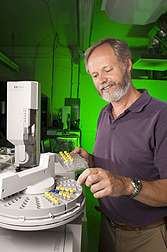
ARS chemist Hans Alborn is part of an ARS-University of Florida team that has identified chemicals released into the soil by citrus tree roots when chewed on by insect pests. These chemicals can attract beneficial nematodes that prey on the insects.

Substances released into the soil by citrus tree roots when chewed on by insect pests could lead to new ways of improving the effectiveness of roundworm "first responders."

Substances released into the soil by tree roots when chewed on by could lead to new ways of improving the effectiveness of roundworm "first responders."

That's the implication of studies by a team of U.S. Department of Agriculture (USDA) and University of Florida (UF) scientists who identified several citrus chemicals, including terpenes, which attract Steinernema riobrave, Heterorhabditis indica and other beneficial species that prey on citrus root weevils.

Upon encountering the weevil's grub-like , the nematodes wriggle inside and feed on the pests internally, killing them 24-48 hours later. The nematodes' reduction of grub numbers can range from 0 to 90 percent, depending on soil type, temperature and other factors.

Until recently, little attention has been paid to the complex chemical tete-a-tete that occurs between citrus roots, feeding grubs and the soil's resident nematodes, according to chemist Hans Alborn with USDA's Agricultural Research Service (ARS) and Jared Ali and Lukasz Stelinksi—both with UF's Citrus Research and Education Center in Lake Alfred, Fla. ARS is USDA's principal intramural scientific research agency.

In lab and greenhouse studies with small trees derived from the commercial rootstock "Swingle citrumelo," roots damaged by captive grubs attracted up to three times more S. diaprepesi nematodes than roots that had been mechanically damaged or left intact. An analysis of volatiles released by the trees showed that terpenes accounted for four of six nematode-signaling compounds.

Interestingly, the roots only released the compounds when being fed on by grubs, notes Alborn, with the ARS Chemistry Research Unit in Gainesville, Fla. The researchers have so far tested the signaling capacities of five citrus rootstocks, and hope to screen as many as 20 more by the end of 2011.

Eventually, the team hopes to recommend rootstock-nematode combinations that can be used in an integrated approach to managing the pest.

More information: The research was published in the Journal of Chemical Ecology.
Read more about the research in the January 2011 issue of Agricultural Research magazine.

Provided by USDA Agricultural Research Service


Rank not rated yet
Relevant PhysicsForums posts

More news stories

Thousands of shellfish found dead in Peru

Thousands of crustaceans were found dead off the coast of Lima following the mystery mass death of dolphins and pelicans, the Peruvian Navy said Friday.

Biology / Ecology

created 5 hours ago | popularity 5 / 5 (1) | comments 0

It's in the genes: Research pinpoints how plants know when to flower

Scientists believe they've pinpointed the last crucial piece of the 80-year-old puzzle of how plants "know" when to flower.

Biology / Biotechnology

created 20 hours ago | popularity 3.9 / 5 (8) | comments 1 | with audio podcast

Researchers solve structure of human protein critical for silencing genes

In a study published in the journal Cell on May 24, Cold Spring Harbor Laboratory (CSHL) scientists describe the three-dimensional atomic structure of a human protein bound to a piece of RNA that "guides" the pr ...

Biology / Cell & Microbiology

created 20 hours ago | popularity 4.7 / 5 (7) | comments 0 | with audio podcast

More plant species responding to global warming than previously thought

(Phys.org) -- Far more wild plant species may be responding to global warming than previous large-scale estimates have suggested.

Biology / Ecology

created May 22, 2012 | popularity 4.7 / 5 (13) | comments 17 | with audio podcast

Totally rad: Scientists create rewritable digital data storage in DNA

(Phys.org) -- Scientists from Stanford's Department of Bioengineering have devised a method for repeatedly encoding, storing and erasing digital data within the DNA of living cells.

Biology / Biotechnology

created May 21, 2012 | popularity 4.9 / 5 (15) | comments 11 | with audio podcast


SpotterRF debuts Radar Backpack Kit (w/ Video)

(Phys.org) -- SpotterRF has announced a special radar backpack kit designed to enhance situational awareness for soldiers on the ground. The company says its special radar is designed for warfighters as part ...

Australia hails surprise super-telescope decision

Australia has hailed a surprise decision giving it a role in a radio telescope project aimed at revolutionising astronomy, vowing to draw on its decades of experience in space science.

Astronomers seize last chance in lifetime for Venus Transit

Astronomers are gearing for one the rarest events in the Solar System: an alignment of Earth, Venus and the Sun that will not be seen for another 105 years.

SpaceX capsule has 'new car' smell, astronauts say

SpaceX's Dragon cargo vessel smells like a new car, said astronauts at the International Space Station after opening the hatches Saturday following the spacecraft's landmark mission to the orbiting lab.

Family history of Alzheimer's affects functional connectivity

(HealthDay) -- Cognitively normal individuals with a family history of late-onset Alzheimer's disease (AD) may display lower resting state functional connectivity in the default mode network (DMN) of the brain, ...

Astronauts enter world's 1st private supply ship

(AP) -- Space station astronauts floated into the Dragon on Saturday, a day after its heralded arrival as the world's first commercial supply ship.