China may need 300 years to beat desertification
Jan 05, 2011
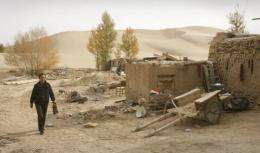
A file picture shows a woman on her onion farm on the edge of the desert that threatens to engulf it in China's northwest Gansu province. Living on the route of the historic Silk Road, she is on the front lines of a national struggle against desertification, a problem that could take 300 years to reverse, according to state media. About 27 percent of China's mass land is considered desertified

Huge population pressures, scarce rainfall and climate change have made China the world's biggest victim of desertification, a problem that could take 300 years to reverse, state media said Wednesday.

Overgrazing, excessive land reclamation and inappropriate water use also make it especially difficult to halt deserts from encroaching on large areas of land in the nation's arid north and west, the China Daily reported.

"China is still a country with the largest area of desertified land in the world," Zhu Lieke, deputy director of the State Forestry Administration, was quoted as saying.

About 27 percent of China's total land mass, or about 2.6 million square kilometres (1.04 million square miles), are considered desertified land, while another 18 percent of the nation's land is eroded by sand, the report said.

Experts believe that 530,000 square kilometres of the nation's deserts can be returned to green land, but the process will take 300 years at the current rate of reversing by 1,700 square kilometres annually, it said.

Some of the worst land erosion in the world occurs in the basin of the , China's second largest river, with 62 percent of the area affected by water and , the paper said in a separate report.

Explore further: Chinese, Indian airlines face EU pollution fines

add to favorites email to friend print save as pdf

Related Stories

Giant green algae slick heads towards China

Jun 22, 2010

A massive floating expanse of green algae is heading towards China's east coast, potentially threatening wildlife and the region's tourist industry, state media reported on Tuesday.

Sandstorms blanket Beijing in yellow dust

Mar 20, 2010

Beijingers woke up Saturday to find the Chinese capital blanketed in yellow dust, as a sandstorm caused by a severe drought in the north and in Mongolia swept into the city.

Snow havoc decimating Chinese forests

Feb 10, 2008

Nearly 67,000 square miles of forest land in China have been decimated by the worst snow storms endured by the country in the last five decades.

Recommended for you

Chinese, Indian airlines face EU pollution fines

May 18, 2013

Eight Chinese and two Indian airlines face fines of up to several million euros for not paying for their greenhouse gas emissions during flights within the bloc, the European Commission said on Friday.

Fracking risks to ground water assessed

May 17, 2013

(Phys.org) —Extraction of "unconventional" gas from sedimentary rocks such as shale could provide a clean energy source and help some regions to become energy independent, but concerns have been raised ...

Caribbean talks conservation on Branson's island

May 17, 2013

(AP)—Surrounded by a turquoise sea and a menagerie of exotic animals on a billionaire's private island, political and business leaders gathered Friday to back an initiative aimed at expanding protection ...

User comments : 2

Adjust slider to filter visible comments by rank

Display comments: newest first

dirk_bruere
not rated yet Jan 05, 2011
Reversing desert at 1700 sq km per year is not a trivial accomplishment
RobertKarlStonjek
1 / 5 (1) Jan 06, 2011
Make bricks ~ you can never have too many bricks. . . maybe time to build a great west wall from sandstone bricks?

More news stories

Galaxy's Ring of Fire

Johnny Cash may have preferred this galaxy's burning ring of fire to the one he sang about falling into in his popular song. The "starburst ring" seen at center in red and yellow hues is not the product of ...

Earth's center is out of sync

(Phys.org) —We all know that the Earth rotates beneath our feet, but new research from ANU has revealed that the center of the Earth is out of sync with the rest of the planet, frequently speeding up and ...