Cassini to probe Rhea for clues to Saturn rings
January 11, 2011 By Jia-Rui C. Cook

Cassini to probe Rhea for clues to Saturn rings

Enlarge

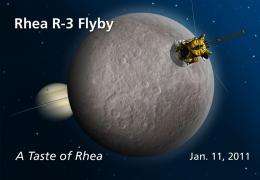
This artist's concept shows the third flyby of Saturn's moon Rhea by NASA's Cassini spacecraft. It is the closest flyby of Cassini's mission. Credit: NASA/JPL/Caltech

(PhysOrg.com) -- Saturn's icy moon Rhea might seem a strange place to look for clues to understanding the vast majestic rings encircling Saturn. But that's what NASA's Cassini spacecraft plans to do on its next flyby of Rhea. At closest approach, Cassini will pass within about 69 kilometers (43 miles) of the surface at 4:53 AM UTC on Tuesday, Jan. 11, which is 10:53 PM Pacific Time on Monday, Jan. 10. This flyby is the closest Cassini will get to the icy moon's surface.

Rhea, Saturn's second largest moon, is the best available chance for studying how often tiny meteoroids bombard a surface. Rhea has almost no atmosphere, which allows Cassini's cosmic dust analyzer and radio and plasma wave instrument to detect the dusty debris that flies off the surface from tiny meteoroid bombardments. Counting these ejected from Rhea's surface helps scientists estimate the bombardment rate for the system and how often the icy rings have been polluted by particles from other places in the . Understanding the contamination rate will enable scientists to improve estimates of the age of the rings.
Cassini to probe Rhea for clues to Saturn rings
Enlarge

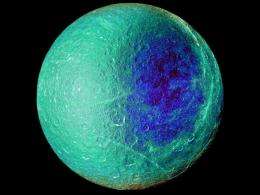
Hemispheric color differences on Saturn's moon Rhea are apparent in this false-color view from NASA's Cassini spacecraft. This image shows the side of the moon that always faces the planet. Credit: NASA/JPL/SSI

Previous attempts to count this rate in the inner part of the Saturn system have been confounded by the dusty E ring, made of icy particles spewed by the . But at Rhea, scientists can sufficiently filter out the E-ring effect. The cosmic dust analyzer will also be set to look for smaller particles than it looked for during a previous Rhea in March 2010.

The upcoming flyby will also enable scientists to gather more data on Rhea’s very thin oxygen-and-carbon-dioxide atmosphere that was recently discovered by Cassini scientists using the ion and neutral mass spectrometer and the Cassini plasma spectrometer. Fields and particles instruments will also investigate the interaction between Rhea and the magnetic bubble around Saturn known as the magnetosphere.

Cassini will also snap pictures of the Rhea surface, a venture that will include making a global mosaic of such regions as the large Tirawa basin and the dark bluish spots around Rhea's equator. The imaging cameras will also take another look to see if there is any more evidence of a ring around Rhea.

This is the third close flyby of Saturn's moon Rhea. The closest flyby before this one was 100 kilometers (60 miles) in altitude.

Provided by JPL/NASA search and more info website

Filter


Move the slider to adjust rank threshold, so that you can hide some of the comments.


Display comments: newest first

71STARS
Jan 12, 2011

Rank: 1 / 5 (1)
Since Rhea is a fully contained "moon" of Saturn, it is my contention that "failed moons" are what produces the rings of Saturn. If planets produce moons, then these moons should contain the same composition as their Parent Planet. When a planet was going through its evolutionary stages and it reached a maximum unsustainable size, it is logical that the planet will eject/birth material from itself intact; we call these objects that are obedient to their Parent Planet: moons.

This process of planets ejecting moons would be a natural process as the planet settles into its stationary size, no longer able to shed a portion of itself. Just as our Moon "came from" our Earth, so too will Rhea come from Saturn.

Failed moons were shattered due to unknown reasons, but they are in obedience to their Parent Planet. Each Planet has a connection to all of its offsprings. Finding that Rhea is the same composition as Saturn should start new thinking. No more accretion theory. R.L. Dwyer
Rank not rated yet
Relevant PhysicsForums posts
  • revamping general concept and cosmological principle
    createdMay 25, 2012
  • Transiting Exoplanet Light Curve
    createdMay 25, 2012
  • Math behind Theoretical Physics
    createdMay 24, 2012
  • Do we know whats at the center of galaxies yet?
    createdMay 23, 2012
  • Structure of the Milky Way?
    createdMay 20, 2012
  • What would it take to terraform Pluto and Charon?
    createdMay 19, 2012
  • More from Physics Forums - General Astronomy

More news stories

Australia hails surprise super-telescope decision

Australia has hailed a surprise decision giving it a role in a radio telescope project aimed at revolutionising astronomy, vowing to draw on its decades of experience in space science.

Space & Earth / Astronomy

created 5 hours ago | popularity 5 / 5 (1) | comments 0

Astronomers seize last chance in lifetime for Venus Transit

Astronomers are gearing for one the rarest events in the Solar System: an alignment of Earth, Venus and the Sun that will not be seen for another 105 years.

Space & Earth / Astronomy

created 5 hours ago | popularity 5 / 5 (1) | comments 0

SpaceX capsule has 'new car' smell, astronauts say

SpaceX's Dragon cargo vessel smells like a new car, said astronauts at the International Space Station after opening the hatches Saturday following the spacecraft's landmark mission to the orbiting lab.

Space & Earth / Space Exploration

created 5 hours ago | popularity 4.5 / 5 (4) | comments 0

Astronauts enter world's 1st private supply ship

(AP) -- Space station astronauts floated into the Dragon on Saturday, a day after its heralded arrival as the world's first commercial supply ship.

Space & Earth / Space Exploration

created 5 hours ago | popularity 5 / 5 (3) | comments 0

Dragon makes history with space station docking

The private company SpaceX made history Friday with the docking of its Dragon capsule to the International Space Station, the most impressive feat yet in turning routine spaceflight over to the commercial ...

Space & Earth / Space Exploration

created 20 hours ago | popularity 4.9 / 5 (8) | comments 0


SpotterRF debuts Radar Backpack Kit (w/ Video)

(Phys.org) -- SpotterRF has announced a special radar backpack kit designed to enhance situational awareness for soldiers on the ground. The company says its special radar is designed for warfighters as part ...

Family history of Alzheimer's affects functional connectivity

(HealthDay) -- Cognitively normal individuals with a family history of late-onset Alzheimer's disease (AD) may display lower resting state functional connectivity in the default mode network (DMN) of the brain, ...

Thousands of shellfish found dead in Peru

Thousands of crustaceans were found dead off the coast of Lima following the mystery mass death of dolphins and pelicans, the Peruvian Navy said Friday.

Transvaginal mesh op restores pelvic organ prolapse at price

(HealthDay) -- Transvaginal mesh (TVM) procedures are effective for anatomical restoration of pelvic organ prolapse (POP), but patients report a worsening of sexual function following surgery, according to ...

Travel to high altitudes tied to Crohn's, colitis flare-ups

(HealthDay) -- People with inflammatory bowel disease, which includes Crohn's disease and colitis, may be at increased risk for flare-ups when they fly or travel to high altitudes for skiing or mountain climbing, ...

High-speed method to aid search for solar energy storage catalysts

Eons ago, nature solved the problem of converting solar energy to fuels by inventing the process of photosynthesis.