Bulwarks with brains: automatic alarms
January 17, 2011

Bulwarks with Brains: Automatic Alarms

Enlarge

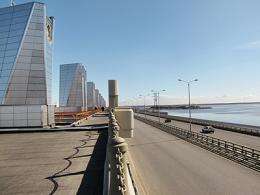
Siemens is researching a monitoring technology that detects damage to levees at an early stage. The researchers expect that with the help of sensors it will be possible to monitor the stability of the protective walls, with measurements accurate to within one meter. On the basis of the measurements, self-controlling software can then forecast dangerous situations before they happen, making it possible to implement measures in good time. The systems is currently being field-tested at Livedijk in Eemshaven, the Netherlands. Siemens Corporate Technology in Russia is developing the technology together with partners for the UrbanFlood research project funded by the European Commission, as the research magazine Pictures of the Future reports.

Worldwide there are 136 coastal cities with populations of over one million that rely on the protection of dikes and levees. The pressure on these protective barriers is mounting because the climate change tends to cause the to rise, and gives us good reason to expect more frequent storms. Until now, levees have been secured by either building them higher or reinforcing them, but this only buys time. Another strategy is the analysis of levees to identify sections that are at risk of being breached. “Smart bulwarks” could even predict fractures or the impact of flooding before they have a chance to happen.

For the levee monitoring the experts are using software designed for the monitoring of production facilities and providing it with new parameters. They determine these parameters from measurements taken at test levees and dikes that were intentionally destroyed using different methods, including by eroding the back side of a dike. This is what led to the disaster of the North Sea flood of 1953, for instance. Another test involves simulating the effects of water that bores a tunnel through the levee, which was one of the reasons for the devastating flooding in New Orleans. Now the software in use at Livedijk is learning to correctly interpret the data measured by the under real conditions. In order to incorporate seasonal influences such as precipitation and wind directions in the analysis, this field test is being conducted for two years.

Other project partners are working on alarm notification options, for example via all mobile phones or navigation devices registered in the region at risk. In a next step, the researchers will equip levee and dike sections in Amsterdam and Saint Petersburg with the early warning system and monitor critical changes by means of an Internet-based software platform. In the long term they want to connect all levees and dikes worldwide to this platform and thus create a global monitoring system.

Provided by Siemens


Rank 5 /5 (1 vote)
Relevant PhysicsForums posts

More news stories

SpotterRF debuts Radar Backpack Kit (w/ Video)

(Phys.org) -- SpotterRF has announced a special radar backpack kit designed to enhance situational awareness for soldiers on the ground. The company says its special radar is designed for warfighters as part ...

Technology / Hi Tech & Innovation

created 4 hours ago | popularity 5 / 5 (2) | comments 5 | with audio podcast report

Yahoo kills 'Livestand' just 6 months after debut

(AP) -- Yahoo is killing a tablet magazine called Livestand just six months its debut on the iPad.

Technology / Business

created 19 hours ago | popularity not rated yet | comments 1

Yahoo! ditches digital newsstand for iPads

Yahoo! shuttered its fledgling digital newsstand for iPads on Friday in what it said was the start of a product purge intended to make the floundering Internet pioneer more nimble.

Technology / Internet

created 20 hours ago | popularity not rated yet | comments 0

Facebook IPO debacle raises investor dander

The spate of complaints and investigations over the Facebook stock offering suggests big institutions had an edge over small investors, raising questions about the process.

Technology / Business

created 21 hours ago | popularity not rated yet | comments 0

Shareholders vote to take China's Alibaba unit private

Minority shareholders of Alibaba.com on Friday voted in favour of a proposal by its parent Alibaba Group Holding to take the Hong Kong-listed online trading unit private, the company said.

Technology / Business

created 21 hours ago | popularity not rated yet | comments 0


Australia hails surprise super-telescope decision

Australia has hailed a surprise decision giving it a role in a radio telescope project aimed at revolutionising astronomy, vowing to draw on its decades of experience in space science.

Astronomers seize last chance in lifetime for Venus Transit

Astronomers are gearing for one the rarest events in the Solar System: an alignment of Earth, Venus and the Sun that will not be seen for another 105 years.

SpaceX capsule has 'new car' smell, astronauts say

SpaceX's Dragon cargo vessel smells like a new car, said astronauts at the International Space Station after opening the hatches Saturday following the spacecraft's landmark mission to the orbiting lab.

Family history of Alzheimer's affects functional connectivity

(HealthDay) -- Cognitively normal individuals with a family history of late-onset Alzheimer's disease (AD) may display lower resting state functional connectivity in the default mode network (DMN) of the brain, ...

Thousands of shellfish found dead in Peru

Thousands of crustaceans were found dead off the coast of Lima following the mystery mass death of dolphins and pelicans, the Peruvian Navy said Friday.

Astronauts enter world's 1st private supply ship

(AP) -- Space station astronauts floated into the Dragon on Saturday, a day after its heralded arrival as the world's first commercial supply ship.