Breathalyzers coming to a doctor near you?
Nobody driving an automobile wants to come face-to-face with a breathalyzer. But if research now under way proves out, patients visiting their doctors will welcome the devices.
By sampling individuals' breath, the instruments promise to yield fast, inexpensive indications of diabetes, cancers, asthma and other illnesses – often early enough to improve the chances of successful treatment.
In a proof of concept study reported earlier this year in the IEEE Sensors Journal, a team of scientists detected a molecule associated with diabetes, with a sensitivity of parts per billion in gas mimicking a patient's breath. That's at least 100 times better than the performance of previous breath analysis technologies, the group asserts. Sensitivity is important because breath contains just tiny amounts of compounds indicative of diseases.
"The goal is having a tool that can eliminate a lot of the hassle of dealing with blood and so on and can also minimize more expensive testing," said Carlos Martinez, a materials engineer at Purdue University in West Lafayette, Ind., and a member of the team developing the device.
If medical breathalyzers become reality, doctors would most likely use them as early warning systems.
"It's not invasive; you can use it when you want," explained Charlene Bayer, principal research scientist at the Georgia Tech Research Institute in Atlanta, whose team is working on its own version of a medical breathalyzer. "It's a screening tool that tells a doctor whether or not to go in and do more expensive tests."
A portable device would have particular value in areas far from hospitals, clinics, and conventional diagnostic instruments.
"We are trying to do it in real time, so you don't have to send samples for analysis to another lab. That reduces the cost and saves time," Martinez said.
"We see this as a screening tool not only for clinical settings but also for at-home use, perhaps monitoring a therapeutic process," added research chemist Kurt Benkstein of the National Institute of Standards and Technology in Gaithersburg, Md., whose team has collaborated with Martinez on a breath analysis sensor.
Just as a conventional breathalyzer senses the amount of alcohol in a driver's breath, the instruments under development will determine the levels of chemical compounds called biomarkers that are associated with specific diseases when present in higher than usual concentrations.
But the medical devices are more complicated for two reasons. In most cases, more than one biomarker is needed to indicate the likelihood of a particular disease. And biomarkers account for just a few of the trillions of molecules in exhaled breath.
"The amounts of the biomarkers are so minute that you usually have to have your patients breathe for a long, long time to capture the breath and concentrate it for later testing," Martinez said.
Several research teams are developing the sophisticated technologies necessary to detect and measure biomarkers under those conditions and to make the process both fast and patient-friendly. Some of the most promising approaches involve the use of nanotechnology, the science that deals with matter on the scale of individual atoms.
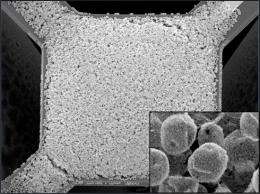
The sensors developed by Benkstein, Martinez and their colleagues consist of tiny hot plates, each scarcely wider than a human hair, coated by minuscule nanoparticles.
"The sensors are very small and can be integrated easily in small packages," Martinez said. "Our advantage is the small size and potentially low cost of the sensors."
In action, gases passing over the sensors stick to the plates' surfaces and change the plates' electrical resistance. Each component of a gas mixture alters the resistance in a characteristic way.
In addition to detecting molecules of acetone associated with diabetes, the team has added other compounds to the gas mixture for detection.
"The challenge is getting faster response rates and picking out the biomarkers among very complex mixtures, working our way up to human breath," Benkstein explained.
Another team, working at Israel's Technion Institute and headed by chemical engineer Hossam Haick, has developed a nanotechnology-based "electronic nose." This sensor detected 33 compounds that appeared more frequently in breath samples from patients with lung cancer than in those from healthy individuals. Studies using rats have shown that the device can also identify early stage kidney diseases.
The Georgia Tech Research Institute group uses a different strategy to detect signs of breast cancer.
"Our approach is pattern recognition: We're looking at changes in the pattern of multiple biomarkers," Bayer explained. "We're also working on lung cancer."
Instead of nanotechnology-based sensors, the group uses two common laboratory techniques to determine the patterns: Gas chromatography separates biomarkers in breath samples and mass spectrometry identifies them. Because those techniques involve bulky equipment, the method is less adaptable to home or field use.
Whichever approaches to medical breath analysis prove effective, researchers emphasize that the devices won't reach your doctor's office for a while. "With good progress, it will take at least five to 10 years," Martinez said.
Provided by Inside Science News Service


