Biologists' favorite worm gets viruses
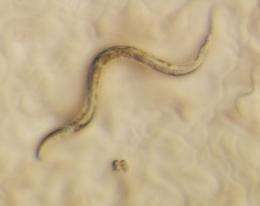
Scientists have discovered that C. elegans, a microscopic worm biologists have used in the lab to identify important biological phenomena, suffers from natural viral infections. This may mean that C. elegans can help scientists learn more about how hosts and viruses interact. Credit: Marie-Anne Felix, the Monod Institute
A workhorse of modern biology is sick, and scientists couldn't be happier.
Researchers at Washington University School of Medicine in St. Louis, the Jacques Monod Institute in France and Cambridge University have found that the nematode C. elegans, a millimeter-long worm used extensively for decades to study many aspects of biology, gets naturally occurring viral infections.
The discovery means C. elegans is likely to help scientists study the way viruses and their hosts interact.
"We can easily disable any of C. elegans' genes, confront the worm with a virus and watch to see if this makes the infection worse, better or has no effect," says David Wang, PhD. "If it changes the worm's response to infection, we will look to see if similar genes are present in humans and other mammals."
Wang notes that several fundamental aspects of human biology, including the ability of cells to self-destruct to prevent cancer, and RNA interference, an important process for regulating how genes are used to make proteins, were first identified in C. elegans and later affirmed to be present in humans.
The findings appear online in PLoS Biology.
Marie-Anne Felix, PhD, a researcher who studies nematodes at the Monod Institute, began the study by gathering C. elegans from rotting fruit in French orchards. Felix noted that some of her sample worms appeared to be sick. Treatment with antibiotics failed to cure them.
Felix then repeated a classic biology experiment that led to the discovery of viruses.
"She ground up the sick worms, passed them through a filter fine enough to remove any bacterial or parasitic infectious agents, and exposed a new batch of worms to the ground-up remains of the first batch," Wang says. "When the new batch got sick, she knew that a viral infection was likely to be present."
Wang, associate professor of pathology and immunology and of molecular microbiology, specializes in the identification of novel viruses. He found the worms had been suffering infections from two viruses related to nodaviruses, a class of viruses previously found to infect insects and fish. Nodaviruses are not currently known to infect humans. Tests showed one of the new viruses can infect the strain of C. elegans most commonly used in research.
"Model organisms are essential to important steps forward in biology, and we're eager to see what C. elegans can teach us about the way hosts and viruses interact," Wang says.
More information: Felix M-A, Ashe A, Piffaretti J, Wu G, Nuez I, Belicard T, Jiang Y, Zhao G, Franz CJ, Goldstein LD, Sanroman M, Miska EA, Wang D. Natural and experimental infection of Caenorhabditis nematodes by novel viruses related to nodaviruses. PLoS Biology, January 25, 2011. doi:10.1371/journal.pbio.1000586
Provided by
Washington University School of Medicine
-
From lemons to lemonade: Reaction uses carbon dioxide to make carbon-based semiconductor,
28 comments
-
Thioridazine kills cancer stem cells in human while avoiding toxic side-effects of conventional cancer treatments,
3 comments
-
SpaceX private rocket blasts off for space station (Update),
41 comments
-
Climate scientists say they have solved riddle of rising sea,
30 comments
-
Scotland passes turbine test to harness tidal power,
40 comments
-
How do I identify different bacteria on culture plates?
5 hours ago
-
Why Do Dogs do Strange things...
21 hours ago
-
What does exophillic and endophillic mean in terms of mosquito and their control?
May 24, 2012
-
Semen stains glows under black lights (uv light)?
May 23, 2012
-
Question on Human Chromosome 2
May 23, 2012
-
How important is composition of TBST in diluting antibodies and Western Blotting?
May 22, 2012
- More from Physics Forums - Biology
More news stories
Thousands of shellfish found dead in Peru
Thousands of crustaceans were found dead off the coast of Lima following the mystery mass death of dolphins and pelicans, the Peruvian Navy said Friday.
4 hours ago |
5 / 5 (1) |
0
It's in the genes: Research pinpoints how plants know when to flower
Scientists believe they've pinpointed the last crucial piece of the 80-year-old puzzle of how plants "know" when to flower.
19 hours ago |
3.9 / 5 (8) |
1
|
Researchers solve structure of human protein critical for silencing genes
In a study published in the journal Cell on May 24, Cold Spring Harbor Laboratory (CSHL) scientists describe the three-dimensional atomic structure of a human protein bound to a piece of RNA that "guides" the pr ...
20 hours ago |
4.7 / 5 (7) |
0
|
More plant species responding to global warming than previously thought
(Phys.org) -- Far more wild plant species may be responding to global warming than previous large-scale estimates have suggested.
May 22, 2012 |
4.7 / 5 (13) |
17
|
Totally rad: Scientists create rewritable digital data storage in DNA
(Phys.org) -- Scientists from Stanford's Department of Bioengineering have devised a method for repeatedly encoding, storing and erasing digital data within the DNA of living cells.
May 21, 2012 |
4.9 / 5 (15) |
11
|
SpotterRF debuts Radar Backpack Kit (w/ Video)
(Phys.org) -- SpotterRF has announced a special radar backpack kit designed to enhance situational awareness for soldiers on the ground. The company says its special radar is designed for warfighters as part ...
Australia hails surprise super-telescope decision
Australia has hailed a surprise decision giving it a role in a radio telescope project aimed at revolutionising astronomy, vowing to draw on its decades of experience in space science.
Astronomers seize last chance in lifetime for Venus Transit
Astronomers are gearing for one the rarest events in the Solar System: an alignment of Earth, Venus and the Sun that will not be seen for another 105 years.
SpaceX capsule has 'new car' smell, astronauts say
SpaceX's Dragon cargo vessel smells like a new car, said astronauts at the International Space Station after opening the hatches Saturday following the spacecraft's landmark mission to the orbiting lab.
Family history of Alzheimer's affects functional connectivity
(HealthDay) -- Cognitively normal individuals with a family history of late-onset Alzheimer's disease (AD) may display lower resting state functional connectivity in the default mode network (DMN) of the brain, ...
Astronauts enter world's 1st private supply ship
(AP) -- Space station astronauts floated into the Dragon on Saturday, a day after its heralded arrival as the world's first commercial supply ship.