Astronomers discover close-knit pairs of massive black holes
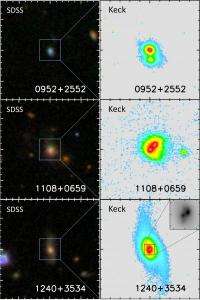
Three of the newly discovered black-hole pairs. On the left are images from the Sloan Digital Sky Survey. The images on the right show the same galaxies taken with the Keck telescope and the aid of adaptive optics, revealing pairs of active galactic nuclei, which are powered by massive black holes. Credit: S. George Djorgovski
Astronomers at the California Institute of Technology (Caltech), University of Illinois at Urbana-Champaign (UIUC), and University of Hawaii (UH) have discovered 16 close-knit pairs of supermassive black holes in merging galaxies.
The discovery, based on observations done at the W. M. Keck Observatory on Hawaii's Mauna Kea, is being presented in Seattle on January 12 at the meeting of the American Astronomical Society, and has been submitted for publication in the Astrophysical Journal.
These black-hole pairs, also called binaries, are about a hundred to a thousand times closer together than most that have been observed before, providing astronomers a glimpse into how these behemoths and their host galaxies mergea crucial part of understanding the evolution of the universe. Although few similarly close pairs have been seen previously, this is the largest population of such objects observed as the result of a systematic search.
"This is a very nice confirmation of theoretical predictions," says S. George Djorgovski, professor of astronomy, who will present the results at the conference. "These close pairs are a missing link between the wide binary systems seen previously and the merging black-hole pairs at even smaller separations that we believe must be there."
As the universe has evolved, galaxies have collided and merged to form larger ones. Nearly every oneor perhaps allof these large galaxies contains a giant black hole at its center, with a mass millionsor even billionsof times higher than the sun's. Material such as interstellar gas falls into the black hole, producing enough energy to outshine galaxies composed of a hundred billion stars. The hot gas and black hole form an active galactic nucleus, the brightest and most distant of which are called quasars. The prodigious energy output of active galactic nuclei can affect the evolution of galaxies themselves.
While galaxies merge, so should their central black holes, producing an even more massive black hole in the nucleus of the resulting galaxy. Such collisions are expected to generate bursts of gravitational waves, which have yet to be detected. Some merging galaxies should contain pairs of active nuclei, indicating the presence of supermassive black holes on their way to coalescing. Until now, astronomers have generally observed only widely separated pairsbinary quasarswhich are typically hundreds of thousands of light-years apart.
"If our understanding of structure formation in the universe is correct, closer pairs of active nuclei must exist," adds Adam Myers, a research scientist at UIUC and one of the coauthors. "However, they would be hard to discern in typical images blurred by Earth's atmosphere."
The solution was to use Laser Guide Star Adaptive Optics, a technique that enables astronomers to remove the atmospheric blur and capture images as sharp as those taken from space. One such system is deployed on the W. M. Keck Observatory's 10-meter telescopes on Mauna Kea.
The astronomers selected their targets using spectra of known galaxies from the Sloan Digital Sky Survey (SDSS). In the SDSS images, the galaxies are unresolved, appearing as single objects instead of binaries. To find potential pairs, the astronomers identified targets with double sets of emission linesa key feature that suggests the existence of two active nuclei.
By using adaptive optics on Keck, the astronomers were able to resolve close pairs of galactic nuclei, discovering 16 such binaries out of 50 targets. "The pairs we see are separated only by a few thousands of light-yearsand there are probably many more to be found," says Hai Fu, a Caltech postdoctoral scholar and the lead author of the paper.
"Our results add to the growing understanding of how galaxies and their central black holes evolve," adds Lin Yan, a staff scientist at Caltech and one of the coauthors of the study.
"These results illustrate the discovery power of adaptive optics on large telescopes," Djorgovski says. "With the upcoming Thirty Meter Telescope, we'll be able to push our observational capabilities to see pairs with separations that are three times closer."
More information: Images of some of the merging systems are available at http://www.astro.c … /~george/bbh
Provided by
California Institute of Technology
-
From lemons to lemonade: Reaction uses carbon dioxide to make carbon-based semiconductor,
28 comments
-
Thioridazine kills cancer stem cells in human while avoiding toxic side-effects of conventional cancer treatments,
3 comments
-
SpaceX private rocket blasts off for space station (Update),
41 comments
-
Climate scientists say they have solved riddle of rising sea,
30 comments
-
Scotland passes turbine test to harness tidal power,
40 comments
-
revamping general concept and cosmological principle
23 hours ago
-
Transiting Exoplanet Light Curve
May 25, 2012
-
Math behind Theoretical Physics
May 24, 2012
-
Do we know whats at the center of galaxies yet?
May 23, 2012
-
Structure of the Milky Way?
May 20, 2012
-
What would it take to terraform Pluto and Charon?
May 19, 2012
- More from Physics Forums - General Astronomy
More news stories
Australia hails surprise super-telescope decision
Australia has hailed a surprise decision giving it a role in a radio telescope project aimed at revolutionising astronomy, vowing to draw on its decades of experience in space science.
4 hours ago |
5 / 5 (1) |
0
Astronomers seize last chance in lifetime for Venus Transit
Astronomers are gearing for one the rarest events in the Solar System: an alignment of Earth, Venus and the Sun that will not be seen for another 105 years.
4 hours ago |
5 / 5 (1) |
0
SpaceX capsule has 'new car' smell, astronauts say
SpaceX's Dragon cargo vessel smells like a new car, said astronauts at the International Space Station after opening the hatches Saturday following the spacecraft's landmark mission to the orbiting lab.
Space & Earth / Space Exploration
4 hours ago |
4 / 5 (2) |
0
Astronauts enter world's 1st private supply ship
(AP) -- Space station astronauts floated into the Dragon on Saturday, a day after its heralded arrival as the world's first commercial supply ship.
Space & Earth / Space Exploration
4 hours ago |
5 / 5 (2) |
0
Dragon makes history with space station docking
The private company SpaceX made history Friday with the docking of its Dragon capsule to the International Space Station, the most impressive feat yet in turning routine spaceflight over to the commercial ...
Space & Earth / Space Exploration
19 hours ago |
4.9 / 5 (7) |
0
SpotterRF debuts Radar Backpack Kit (w/ Video)
(Phys.org) -- SpotterRF has announced a special radar backpack kit designed to enhance situational awareness for soldiers on the ground. The company says its special radar is designed for warfighters as part ...
Family history of Alzheimer's affects functional connectivity
(HealthDay) -- Cognitively normal individuals with a family history of late-onset Alzheimer's disease (AD) may display lower resting state functional connectivity in the default mode network (DMN) of the brain, ...
Thousands of shellfish found dead in Peru
Thousands of crustaceans were found dead off the coast of Lima following the mystery mass death of dolphins and pelicans, the Peruvian Navy said Friday.
Transvaginal mesh op restores pelvic organ prolapse at price
(HealthDay) -- Transvaginal mesh (TVM) procedures are effective for anatomical restoration of pelvic organ prolapse (POP), but patients report a worsening of sexual function following surgery, according to ...
Travel to high altitudes tied to Crohn's, colitis flare-ups
(HealthDay) -- People with inflammatory bowel disease, which includes Crohn's disease and colitis, may be at increased risk for flare-ups when they fly or travel to high altitudes for skiing or mountain climbing, ...
It's in the genes: Research pinpoints how plants know when to flower
Scientists believe they've pinpointed the last crucial piece of the 80-year-old puzzle of how plants "know" when to flower.
Jan 12, 2011
Rank: not rated yet
Jan 12, 2011
Rank: 1 / 5 (4)
You would find that these connectors are at each galaxies "Side boundary" if you could just overlay the glue "map" and I even gave out the clues for that also.
Oh,and such a bad,bad wording that you folks have "Glommed onto" Gravitational lensing.Bad,bad boys.
The universe is engineered,not bang created,your Phd claiming so owes you boys alot of money.
The reset will finally silence the place.
Peace,NOT
Jan 12, 2011
Rank: 5 / 5 (2)
How did you escape The Matrix?
Jan 12, 2011
Rank: not rated yet
Jan 13, 2011
Rank: 1 / 5 (4)
Anti grav is easy and it takes just 4 to 8 days to get to mars. Take that NSA As------, you boys owe me my money and our science case.
Jan 13, 2011
Rank: not rated yet
Excellent. An interesting article AND a floor show :-)
Jan 13, 2011
Rank: 1 / 5 (1)