An astronomer's field of dreams
January 26, 2011

An Astronomer's Field of Dreams

Enlarge

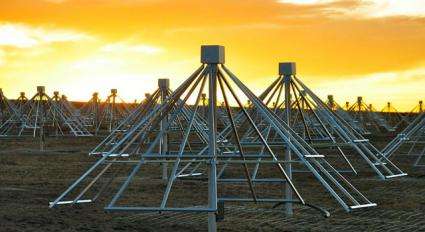
Multiple antennas of the LWA-1 station of the Long Wavelength Array in central New Mexico, photographed at sunset. Each antenna stands about 1.5 meters (5 feet) high and about 2.7 meters (9 feet) across the base. Image credit: LWA Project (at UNM)

(PhysOrg.com) -- An innovative new radio telescope array under construction in central New Mexico will eventually harness the power of more than 13,000 antennas and provide a fresh eye to the sky. The antennas, which resemble droopy ceiling fans, form the Long Wavelength Array, designed to survey the sky from horizon to horizon over a wide range of frequencies.

The University of New Mexico leads the project, and NASA's Jet Propulsion Laboratory, Pasadena, Calif., provides the advanced digital electronic systems, which represent a major component of the observatory.

The first station in the Long Wavelength Array, with 256 antennas, is scheduled to start surveying the sky by this summer. When complete, the Long Wavelength Array will consist of 53 stations, with a total of 13,000 antennas strategically placed in an area nearly 400 kilometers (248 miles) in diameter. The antennas will provide sensitive, high-resolution images of a region of the sky hundreds of times larger than the full moon. These images could reveal coming from planets outside our solar system, and thus would turn out to be a new way to detect these worlds. In addition to planets, the telescope will pick up a host of other cosmic phenomena.

"We'll be looking for the occasional celestial flash," said Joseph Lazio, a radio astronomer at JPL. "These flashes can be anything from explosions on surfaces of nearby , deaths of distant stars, exploding , or even perhaps transmissions by other civilizations." JPL scientists are working with multi-institutional teams to explore this new area of astronomy. Lazio is lead author of an article reporting scientific results from the Long Wavelength Demonstrator Array, a precursor to the new array, in the December 2010 issue of Astronomical Journal.

The new Long Wavelength Array will operate in the radio-frequency range of 20 to 80 megahertz, corresponding to wavelengths of 15 meters to 3.8 meters (49.2 feet to 12.5 feet). These frequencies represent one of the last and most poorly explored regions of the electromagnetic spectrum.

In recent years, a few factors have triggered revived interest in radio astronomy at these frequencies. The cost and technology required to build these low-frequency antennas has improved significantly. Also, advances in computing have made the demands of image processing more attainable. The combination of cost-effective hardware and technology gives scientists the ability to return to these wavelengths and obtain a much better view of the universe.
The predecessor Long Wavelength Demonstrator Array was also in New Mexico. It was successful in identifying radio flashes, but all of them came from non-astronomy targets -- either the sun, or meteors reflecting TV signals high in Earth's atmosphere. Nonetheless, its findings indicate how future searches using the Long Wavelength Array technology might lead to new discoveries.

Radio astronomy was born at frequencies below 100 megahertz and developed from there. The discoveries and innovations at this frequency range helped pave the way for modern astronomy. Perhaps one of the most important contributions made in radio astronomy was by a young graduate student at New Hall (since renamed Murray Edwards College) of the University of Cambridge, U.K. Jocelyn Bell discovered the first hints of radio pulsars in 1967, a finding that was later awarded a Nobel Prize. Pulsars are neutron stars that beam radio waves in a manner similar to a lighthouse beacon.

Long before Bell's discovery, astronomers believed that neutron stars, remnants of certain types of supernova explosions, might exist. At the time, however, the prediction was that these cosmic objects would be far too faint to be detected. When Bell went looking for something else, she stumbled upon neutron stars that were in fact pulsing with radio waves -- the pulsars. Today about 2,000 pulsars are known, but within the past decade, a number of discoveries have hinted that the radio sky might be far more dynamic than suggested by just pulsars.

"Because nature is more clever than we are, it's quite possible that we will discover something we haven't thought of," said Lazio.

More information: http://lwa.unm.edu/

Provided by JPL/NASA search and more info website

Filter


Move the slider to adjust rank threshold, so that you can hide some of the comments.


Display comments: newest first

omatumr
Jan 26, 2011

Rank: 1 / 5 (4)
Trends in nuclear rest mass data indicate that neutron repulsion is the energy source that powers neutron stars and AGN ["Neutron Repulsion", The APEIRON Journal, in press; Scientific Genesis. 3. Neutron Repulsion]
youtube.com/watch?v=sXNyLYSiPO0

With kind regards,
Oliver K. Manuel
Rank 5 /5 (5 votes)
Relevant PhysicsForums posts
  • revamping general concept and cosmological principle
    created23 hours ago
  • Transiting Exoplanet Light Curve
    createdMay 25, 2012
  • Math behind Theoretical Physics
    createdMay 24, 2012
  • Do we know whats at the center of galaxies yet?
    createdMay 23, 2012
  • Structure of the Milky Way?
    createdMay 20, 2012
  • What would it take to terraform Pluto and Charon?
    createdMay 19, 2012
  • More from Physics Forums - General Astronomy

More news stories

Australia hails surprise super-telescope decision

Australia has hailed a surprise decision giving it a role in a radio telescope project aimed at revolutionising astronomy, vowing to draw on its decades of experience in space science.

Space & Earth / Astronomy

created 4 hours ago | popularity 5 / 5 (1) | comments 0

Astronomers seize last chance in lifetime for Venus Transit

Astronomers are gearing for one the rarest events in the Solar System: an alignment of Earth, Venus and the Sun that will not be seen for another 105 years.

Space & Earth / Astronomy

created 4 hours ago | popularity 5 / 5 (1) | comments 0

SpaceX capsule has 'new car' smell, astronauts say

SpaceX's Dragon cargo vessel smells like a new car, said astronauts at the International Space Station after opening the hatches Saturday following the spacecraft's landmark mission to the orbiting lab.

Space & Earth / Space Exploration

created 4 hours ago | popularity 4 / 5 (2) | comments 0

Astronauts enter world's 1st private supply ship

(AP) -- Space station astronauts floated into the Dragon on Saturday, a day after its heralded arrival as the world's first commercial supply ship.

Space & Earth / Space Exploration

created 4 hours ago | popularity 5 / 5 (2) | comments 0

Dragon makes history with space station docking

The private company SpaceX made history Friday with the docking of its Dragon capsule to the International Space Station, the most impressive feat yet in turning routine spaceflight over to the commercial ...

Space & Earth / Space Exploration

created 19 hours ago | popularity 4.9 / 5 (7) | comments 0


SpotterRF debuts Radar Backpack Kit (w/ Video)

(Phys.org) -- SpotterRF has announced a special radar backpack kit designed to enhance situational awareness for soldiers on the ground. The company says its special radar is designed for warfighters as part ...

Family history of Alzheimer's affects functional connectivity

(HealthDay) -- Cognitively normal individuals with a family history of late-onset Alzheimer's disease (AD) may display lower resting state functional connectivity in the default mode network (DMN) of the brain, ...

Thousands of shellfish found dead in Peru

Thousands of crustaceans were found dead off the coast of Lima following the mystery mass death of dolphins and pelicans, the Peruvian Navy said Friday.

Transvaginal mesh op restores pelvic organ prolapse at price

(HealthDay) -- Transvaginal mesh (TVM) procedures are effective for anatomical restoration of pelvic organ prolapse (POP), but patients report a worsening of sexual function following surgery, according to ...

Travel to high altitudes tied to Crohn's, colitis flare-ups

(HealthDay) -- People with inflammatory bowel disease, which includes Crohn's disease and colitis, may be at increased risk for flare-ups when they fly or travel to high altitudes for skiing or mountain climbing, ...

It's in the genes: Research pinpoints how plants know when to flower

Scientists believe they've pinpointed the last crucial piece of the 80-year-old puzzle of how plants "know" when to flower.