Analysis of bread mold genomes demos 'reverse-ecology' tool
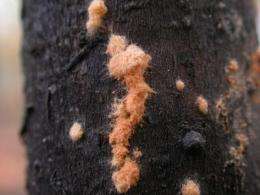
In a demonstration of "reverse-ecology," biologists at the University of California, Berkeley, have shown that one can determine an organism's adaptive traits by looking first at its genome and checking for variations across a population.
The study, to be published the week of Jan. 31 in the journal Proceedings of the National Academy of Sciences, offers a powerful new tool in evolutionary genetics research, one that could be used to help monitor the effects of climate change and habitat destruction.
The researchers scanned the genes of 48 different strains of Neurospora crassa, a type of red bread mold commonly used in genetics research. It is considered a model microbe because different strains can be mated and grown very quickly, and its growth occurs in a light-sensitive daily cycle that has been useful for studying circadian rhythms.
Yet for all its popularity in the lab, little was known about this fungus in its natural habitat, so the researchers specifically chose wild samples of the microbe from the Caribbean basin, South America and Africa. From this population-wide analysis, they found a striking pattern of variation in two regions of the genome that indicated the action of natural selection.
Within one of these regions, they found a gene that is known to be important to survival at cold temperatures, and posited that genes in the other region might play the same role. They then showed that members of the population that contained unique variants of their candidate cold-tolerant genes lived in regions with lower minimum temperatures – up to 9 degrees Celsius – on average and were able to grow better at cold temperatures than were strains found in more tropical climates.
The researchers also grew wild strains of Neurospora crassa in the lab alongside strains where the candidate cold-tolerant genes had been deleted from the genome, keeping all things the same except for the temperature. They confirmed that the strains with the genes for cold tolerance disabled fared more poorly in chillier temperatures.
"This is the first time that population genomics has been used to find genes important for adaptation without any idea of the environmental parameters, phenotype, candidate genes or even the population boundaries," said the study's principal investigator, John Taylor, UC Berkeley professor of plant and microbial biology.
Taylor pointed out that the normal route for adaptation studies is to first look at obvious differences – such as hair or skin color – between two closely related organisms. Scientists next observe the environment in which the organism lives to see if it might explain those differences, and then examine the genes to see if there is evidence of natural selection.
For example, the researchers referred to a 2003 study noting that rock pocket mice with tan-colored fur are often found among light-colored rocks, while those with black fur were found on dark lava flows. They identified the genetic basis of this adaptive trait by targeting genes for further study that were known to be involved in pigmentation and showed that different gene variants were associated with the different habitats.
"For our study, we turned this around, beginning with genes that showed evidence of selection, and then looking at the environmental factors that might influence those genes," said Taylor.
This "reverse-adaptation" approach is especially useful when studying microbes, the researchers argued.
"Microbes are inconspicuous by nature and, unlike mice which can have different colored coats, different strains and species look pretty much the same," said study lead author Christopher Ellison, a UC Berkeley graduate student in plant and microbial biology.
As if to demonstrate this point, the researchers discovered that what had been considered a single group of interrelated strains was instead two distinct populations.
The relative ease of studying a microbe such as Neurospora crassa in the lab may make it an appealing tool to monitor the impact of environmental stress, the researchers said.
"If temperature is a key adaptive factor in populations of fungi and microbes in general, this could have important implications in the study of climate change," said Ellison. "Adaptation is a crucial part of evolution, so microbes could be used to monitor global temperature change."
Provided by University of California - Berkeley


