White ibis mating habits altered by mercury consumption
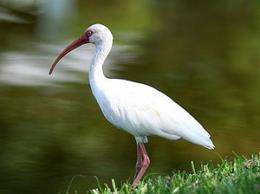
When University of Florida researchers began studying the effects of mercury consumption on white ibises, they had a hunch the contaminant might affect the birds' ability to produce chicks.
And while their suspicions of poor breeding were confirmed, they didn’t expect this: altered courtship behavior in males and high percentages of male birds mating with other males.
“We knew that mercury can disrupt hormones – what is most disturbing about this study is the low levels of mercury at which we saw effects on hormones and mating behavior,” said Peter Frederick, a UF wildlife ecology and conservation professor who led the five-year study. “This suggests that wildlife may be commonly affected.”
The study marks the first time that mercury’s effects on birds’ sexual preference and courtship behavior have been documented, and provides a critical link between low levels of mercury contamination and impaired reproduction. The results suggest that even low levels of mercury – which is widespread in the U.S. and global environment — can result in major impairment for wild bird populations.
The study will be published online Dec. 1 in Proceedings of the Royal Society B.
In the late 1980s and early 1990s, Everglades researchers began to notice high levels of mercury in many wildlife species, such as panthers, birds and fish, Frederick said. By the late 1990s, mercury levels in the Everglades had dropped dramatically, and suddenly the ibises were nesting like crazy.
Researchers believed that better hydrological conditions probably caused much of the birds’ renewed nesting enthusiasm, but something else also seemed to be at work, Frederick said – and that’s what prompted him and then-doctoral student Nilmini Jayasena to begin looking at mercury. The contaminant found its way into the Everglades via municipal and medical waste incineration, but during the 1990s, medical waste became more closely regulated and flashlight batteries that didn’t contain mercury replaced those that did.
The UF scientists built a 13,000-square-foot, net-covered aviary, and brought in 160 young ibises, which were divided into four groups made up of equal numbers of males and females.
Three groups ate a diet that included low, medium or high levels of mercury; a fourth control group ate a mercury-free diet.
The scientists took great care to ensure that even the birds in the high-mercury group weren’t consuming more than they would have in the wild, Frederick said.
Among the findings: in 2006, about 55 percent of the high-mercury-diet males were nesting with other males. The degree of homosexual pairing for all three dosed groups increased as did their mercury exposure, he said.
“Many years ago, I spent thousands of hours in the field documenting pairing behavior in ibises in a place that did not have mercury contamination – and I never once saw males pairing with males,” he said.
High-mercury males were far less likely to be approached by females during courtship and all of the males given mercury showed lower rates of performing the ritual head bobs and bows of bird courtship than those in the control group.
Overall, high-mercury females produced 35 percent fewer fledglings than females in the control group.
After the study, which lasted three breeding seasons, some 260 birds were released back into the Everglades, but only after spending several months on a cleansing, mercury-free diet.
Frederick is quick to warn against drawing any inferences about human homosexuality based on the results of the white ibis study.
First, Frederick said, there have been a number of long-term studies of mercury’s effects on humans, and none have found changes in sexual behavior. Second, the drivers of human sexuality appear to be complex, so a single contaminant would be an unlikely cause. Finally, the reproductive physiology and sexual behavior of birds and humans are very different.
Lou Guillette, an internationally known zoologist whose research looks at environmental contaminants’ effects on wildlife, said the UF study is part of a growing body of research that shows how contaminants alter the way cells communicate – and how that affects behavior.
Guillette, the CoEE Endowed Chair of Marine Genomics at the Medical University of South Carolina, likened such disrupted cell communication to someone trying to make sense of 75 radio stations, all playing at once.
“One of the great frustrations the scientific community has had trying to understand environmental contamination are lab studies that do acute, high-dose exposure studies and almost never predict what we see in the wild,” he said. “So a study like this that looks at environmentally appropriate levels of mercury is probably the most powerful kind of study to tell us what’s going on in the real world.”
More information: Frederick, P. & Jayasena, N. Proc. R. Soc. B. doi:10.1098/rspb.2010.2189
Provided by University of Florida


