USC nanosatellite blasts off from Cape Canaveral on SpaceX launch
Dec 13, 2010
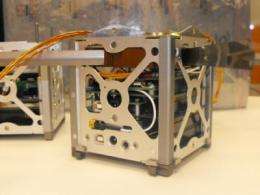
This USC-built cubesat unit is now part of MAYFLOWER satellite in earth orbit. Credit: SERC/CAERUS

and went perfectly -- December 8 at Cape Canaveral, with the newly developed Falcon 9 heavy lift vehicle sending into earth orbit a packet of nanosatellites, including a unit that the USC Viterbi School's Information Sciences Institute (ISI) and its Department of Astronautical Engineering's Space Engineering Research Center (SERC) jointly played a key role in developing.

This was only the second flight of SpaceX's Falcon 9 and the first commercial flight of a recoverable capsule, the Dragon. By demonstrating the ability to carry astronauts to the (ISS), the launch was widely regarded as a breakthrough for the private space industry.

The orbiting packet, a three-unit "cubesat" called "MAYFLOWER," is a Next Generation Technology Nanosatellite that is a joint effort between USC, Northrop Grumman's NOVAWORKS Division and other companies. USC supplied one of the three units, named CAERUS (the Greek word for "opportunity") to support communications.

MAYFLOWER is now orbiting around the earth about every 90 minutes at an altitude of more than 300 kilometers.

The CAERUS team included David Barnhart, who originated space projects at ISI, and Senior Design Engineer Tim Barrett. Technical specialists are Will Bezouska, Michael Aherne and Jeff Sachs.

Working with a host of undergraduate and graduate students from the Viterbi School's Department of Astronautical Engineering and other engineering departments, the team delivered CAERUS just 14 weeks after receiving authorization to proceed on the project.

USC Professors Joseph Kunc and Daniel Erwin led the campus teams from the Department of Astronautical Engineering and SERC. A joint effort between Astronautics and ISI, SERC's expertise and student involvement provided critical support for the rapid ground-station development timeline.

"We are proud to be associated with a paradigm shift in space flight," said Yannis C. Yortsos, dean of the Viterbi School.

"It was indeed a great day for USC," said Joseph Sullivan, associate director at Information Sciences Institute. "The first flight is the hardest to achieve."

"It is amazing what can be accomplished in an 'engineering teaching hospital' environment by students with a passion for space," said Kunc.

The SERC and ISI will go back into space in 2011 with a different satellite project, another three-unit , this one called AENEAS, that also is being developed at ISI with SERC. CAERUS components and software are similar to AENEAS, allowing USC a very rare risk mitigation test of its hardware – the 'opportunity' referred to in the CAERUS name -- before delivery of AENEAS.

Explore further: Field tests in Mojave Desert pave way for human exploration of small bodies

More information: http://www.isi.edu/projects/serc/caerus

add to favorites email to friend print save as pdf

Related Stories

US space capsule launch set for Wednesday

Dec 07, 2010

A US company has received the go-ahead to launch its first space capsule into orbit Wednesday, in a key test for the future of commercial space flight as NASA looks to end its shuttle program.

Bringing order to 'what if?'

May 31, 2007

[B]USC builds a risk assessment system for the Department of Homeland Security[/B] A team working under the auspices of the Department of Homeland Security-funded Center for Risk and Economic Analysis of ...

NASA's Webb telescope's systems engineering evolves

Oct 18, 2010

As the James Webb Space Telescope enters its next critical phase of development NASA and Northrop Grumman Corporation have forged an integrated, consolidated and "badgeless" Mission Systems Engineering team.

Recommended for you

Mars rover Opportunity examines clay clues in rock

14 hours ago

(Phys.org) —NASA's senior Mars rover, Opportunity, is driving to a new study area after a dramatic finish to 20 months on "Cape York" with examination of a rock intensely altered by water.

NASA's STEREO detects a CME from the sun

May 17, 2013

On 5:24 a.m. EDT on May 17, 2013, the sun erupted with an Earth-directed coronal mass ejection or CME, a solar phenomenon that can send billions of tons of solar particles into space that can reach Earth ...

Nine-year-old Mars rover passes 40-year-old record

May 17, 2013

While Apollo 17 astronauts Eugene Cernan and Harrison Schmitt visited Earth's moon for three days in December 1972, they drove their mission's Lunar Roving Vehicle 19.3 nautical miles (22.210 statute miles ...

Bright explosion on the Moon

May 17, 2013

For the past 8 years, NASA astronomers have been monitoring the Moon for signs of explosions caused by meteoroids hitting the lunar surface. "Lunar meteor showers" have turned out to be more common than anyone ...

User comments : 0

More news stories

Galaxy's Ring of Fire

Johnny Cash may have preferred this galaxy's burning ring of fire to the one he sang about falling into in his popular song. The "starburst ring" seen at center in red and yellow hues is not the product of ...

Alaska volcano shoots ash 15,000 feet into the air

(AP)—One of Alaska's most restless volcanoes has shot an ash cloud 15,000 feet into the air in an ongoing eruption that has drawn attention from a nearby community but isn't expected to threaten air traffic.

Chinese, Indian airlines face EU pollution fines

Eight Chinese and two Indian airlines face fines of up to several million euros for not paying for their greenhouse gas emissions during flights within the bloc, the European Commission said on Friday.

Morocco to harness the wind in energy hunt

Morocco is ploughing ahead with a programme to boost wind energy production, particularly in the southern Tarfaya region, where Africa's largest wind farm is set to open in 2014.

US seizes Bitcoin operator accounts

US authorities seized the accounts of a Bitcoin digital currency exchange operator, claiming it was functioning as an "unlicensed money service business," court documents showed Friday.