Researchers uncover new cell biological mechanism that regulates protein stability in cells
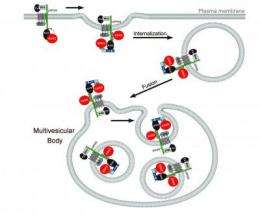
Multivesicular bodies (MVBs) are an obligatory step in the trafficking of cell surface receptors for degradation. In the Dec. 23, 2010, issue of Cell, Taelman et al. show that during canonical Wnt signaling the enzyme Glycogen Synthase Kinase 3 (GSK3, shown in red in the diagram) is bound by the Wnt receptor complex, becoming sequestered from the cytoplasm inside MVBs. In this way, the Wnt growth factor inhibits GSK3 activity, causing the stabilization of many proteins. This “enzyme imprisonment” mechanism links the basic intracellular membrane trafficking machinery to cell signaling. Credit: UCLA
The cell signaling pathway known as Wnt, commonly activated in cancers, causes internal membranes within a healthy cell to imprison an enzyme that is vital in degrading proteins, preventing the enzyme from doing its job and affecting the stability of many proteins within the cell, researchers at UCLA's Jonsson Comprehensive Cancer Center have found.
The finding is important because sequestering the enzyme, Glycogen Synthase Kinase 3 (GSK3), results in the stabilization of proteins in the cell, at least one of which is known to be a key player in cancer, said Dr. Edward De Robertis, senior author of the study and a Jonsson Cancer Center scientist.
"Surprisingly, we found that the degradation of about 20 percent of proteins in the cell is triggered by the GSK3 enzyme," said De Robertis, who also is a Howard Hughes Medical Institute investigator. "That's a great many proteins and one of them, beta-Catenin, is known to cause cancer. We also know that Wnt signaling is activated in about 85 percent of colorectal cancers and other forms of cancer start with mutations that activate Wnt signaling. So, this finding could have ramifications for potential new treatments for cancer."
The study, a collaboration with cell biologist Dr. David D. Sabatini of New York University, appears in the Dec. 23, 2010 issue of the peer-reviewed journal Cell.
De Robertis said Wnt signaling requires inhibition of GSK3, but the enzyme sequestration mechanism was not known until now. The enzyme becomes imprisoned inside membrane-bounded organelles, known as multivesicular bodies, found within the cell cytoplasm.
"We knew these multivesicular bodies were involved in degradation of proteins, but that they had a role in how cells communicate with each other by switching on a signaling pathway was not known," De Robertis said. "This finding raises the possibility that other signaling pathways could operate through this sequestration mechanism."
When cells receive Wnt, it's a signal for cells to degrade their proteins more slowly, to keep them for a longer period of time because they're needed to regulate cell functions, such as proliferation. Wnt signaling, for example, is very high in all stem cells and rises during the regeneration of most tissues, De Robertis said.
"Perhaps one of the functions of Wnt is to stabilize certain cell functions and it may be that cancer needs higher protein stability than other cells, which is why increased Wnt signaling if found in so many cancers," De Robertis said. "These findings may give us new therapeutic targets for preventing sequestrations inside these membranes, which would decrease Wnt signaling."
De Robertis said this study also links two formerly unrelated areas of biology. The cell cytoplasm is filled with internal membranes that shuttle proteins to their final destinations. Cells in tissues communicate with their neighbors by receiving external signals called growth factors. The new work links the cell biology of membrane trafficking and the interpretation of the signals that control cell proliferation.
"Protein degradation is a very important part of the life of a cell. About 10 percent of the genes in the genome are dedicated to protein degradation," De Robertis said. "We now know that Wnt causes an enzyme that degrades proteins to be sequestered and because of that becomes a regulator of cellular protein stability."
De Robertis characterized this finding as "very unexpected."
"No one thought you could have cell signaling through sequestration of an enzyme inside a membrane organelle like these multivesicular bodies," he said. This is because the GSK3 enzyme is normally found everywhere in the cell, but becomes tightly bound to the internal side of membrane receptors when the Wnt signal is received.
Provided by University of California - Los Angeles
-
From lemons to lemonade: Reaction uses carbon dioxide to make carbon-based semiconductor,
28 comments
-
Thioridazine kills cancer stem cells in human while avoiding toxic side-effects of conventional cancer treatments,
3 comments
-
SpaceX private rocket blasts off for space station (Update),
41 comments
-
Climate scientists say they have solved riddle of rising sea,
30 comments
-
Scotland passes turbine test to harness tidal power,
40 comments
-
How do I identify different bacteria on culture plates?
3 hours ago
-
Why Do Dogs do Strange things...
19 hours ago
-
What does exophillic and endophillic mean in terms of mosquito and their control?
May 24, 2012
-
Semen stains glows under black lights (uv light)?
May 23, 2012
-
Question on Human Chromosome 2
May 23, 2012
-
How important is composition of TBST in diluting antibodies and Western Blotting?
May 22, 2012
- More from Physics Forums - Biology
More news stories
Thousands of shellfish found dead in Peru
Thousands of crustaceans were found dead off the coast of Lima following the mystery mass death of dolphins and pelicans, the Peruvian Navy said Friday.
2 hours ago |
not rated yet |
0
Researchers solve structure of human protein critical for silencing genes
In a study published in the journal Cell on May 24, Cold Spring Harbor Laboratory (CSHL) scientists describe the three-dimensional atomic structure of a human protein bound to a piece of RNA that "guides" the pr ...
18 hours ago |
4.7 / 5 (7) |
0
|
It's in the genes: Research pinpoints how plants know when to flower
Scientists believe they've pinpointed the last crucial piece of the 80-year-old puzzle of how plants "know" when to flower.
17 hours ago |
3.9 / 5 (8) |
1
|
Copy of the genetic makeup travels in a protein suitcase
Scientists from the Institute for Physical and Theoretical Chemistry at the University of Bonn have succeeded for the first time in the real time filming of the transport of an important information carrier in biological ...
23 hours ago |
not rated yet |
0
|
More plant species responding to global warming than previously thought
(Phys.org) -- Far more wild plant species may be responding to global warming than previous large-scale estimates have suggested.
May 22, 2012 |
4.7 / 5 (13) |
16
|
SpotterRF debuts Radar Backpack Kit (w/ Video)
(Phys.org) -- SpotterRF has announced a special radar backpack kit designed to enhance situational awareness for soldiers on the ground. The company says its special radar is designed for warfighters as part ...
Family history of Alzheimer's affects functional connectivity
(HealthDay) -- Cognitively normal individuals with a family history of late-onset Alzheimer's disease (AD) may display lower resting state functional connectivity in the default mode network (DMN) of the brain, ...
Transvaginal mesh op restores pelvic organ prolapse at price
(HealthDay) -- Transvaginal mesh (TVM) procedures are effective for anatomical restoration of pelvic organ prolapse (POP), but patients report a worsening of sexual function following surgery, according to ...
Oldest Jewish archaeological evidence on the Iberian Peninsula
German archaeologists of the Friedrich Schiller University Jena found one of the oldest archaeological evidence so far of Jewish Culture on the Iberian Peninsula at an excavation site in the south of Portugal, ...
Travel to high altitudes tied to Crohn's, colitis flare-ups
(HealthDay) -- People with inflammatory bowel disease, which includes Crohn's disease and colitis, may be at increased risk for flare-ups when they fly or travel to high altitudes for skiing or mountain climbing, ...
Astronomers seize last chance in lifetime for Venus Transit
Astronomers are gearing for one the rarest events in the Solar System: an alignment of Earth, Venus and the Sun that will not be seen for another 105 years.