Tracking down particulates
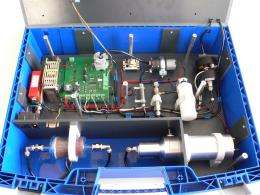
Wood-burning stoves are enjoying a surge in popularity. But burning biomass releases fine dust particles that are hazardous to health. Consequently, new legal limits for particulate emissions from such stoves were introduced last March. Researchers have now developed a measuring device that determines precise levels of dust emissions.
For some years now, consumers have been making increasing use of wood as a fuel – and not only on account of the rising cost of heating oil and natural gas. “Comfort fireplaces” have become all the rage because open fires, tiled and wood-burning stoves give a room a snug and cozy feel. But using wood for heating has one distinct disadvantage. When pellets, logs or briquettes are burnt, fine dust particles that are hazardous to health are released into the atmosphere. These particles are known to cause coughs, place stress on the cardiovascular system, and are thought to be carcinogenic. Indeed, studies by the World Health Organization have found that fine dust particles reduce average life expectancy in Germany by approximately ten months.
According to the Federal Ministry for the Environment, Nature Conservation and Nuclear Safety, there are now 14 million small, single-room combustion plants installed all over Germany – and that figure is on the rise. Wood use by private individuals has gone up by 60 to 80 per cent since the year 2000. In 2004, emissions from domestic heating systems exceeded road traffic emissions for the first time ever. Earlier this year, in an attempt to deal with this increase in pollution, the federal government passed an amendment to the First Ordinance on the Implementation of the Federal Immission Control Act, and new pollution limits for small combustion plants – which include both wood-burning stoves and wood-fired boilers – came into effect at the end of March. One significant change is that these limits now apply to heating systems with a rated heat output of 4 kilowatts or more, whereas previously only systems with a rated heat output of 15 kilowatts or more were affected. As a result, the number of stoves that will have to be inspected for dust emissions will rise dramatically.
Working together with the firm Vereta, researchers at the Fraunhofer Institute for Toxicology and Experimental Medicine ITEM in Hannover and the Institute for Mechanical Process Engineering at Clausthal University of Technology have now developed a measuring device that determines levels of fine dust emissions at source. The project was funded by the German Federation of Industrial Research Associations (AiF), and Professor Wolfgang Koch, head of department at the ITEM, explains their achievement: “To date there is no validated method for measuring the dust content in flue gases. The Bosch smoke count method used with oil-fired heating systems is not appropriate, as it looks primarily at soot particles, and soot is not the principal component of emissions from wood-fired combustion. Our device makes it possible to measure particulate concentrations instead. To do this, we simply place a sampling probe developed by us in the stove flue.” The probe draws off some of the flue gases, which are diluted with pre-treated air at the tip of the probe and then cooled in a conditioning unit. The conditioned flue gases are subsequently fed through two optoelectronic sensors which use different measuring techniques: the aerosol light-scattering photometry method devised by ITEM, and the aerosol photoemission method developed by Clausthal University of Technology. An algorithm combines the electrical signals from both these sensors to produce a definitive reading.
Professor Alfred Weber of Clausthal University of Technology is proud to report: “We have successfully tested a prototype of the new measuring device. We conducted numerous tests on wood-burning stoves that were being run on a variety of fuels, and were able to prove a linear relationship between the calculated signal received from the device and the mass concentration that was simultaneously measured using a filtering process. This innovative technology provides heating engineers with a cost-effective tool for determining the precise concentration of particulate matter.” The researchers have applied for a patent for their new measuring method, and Vereta, supplier of the electronic control technology that supports the sensor, has submitted the device for evaluation by the German Technical Inspection Association (TÜV).
Provided by Fraunhofer-Gesellschaft


