Thai tech pioneer converts waste into wealth
December 4, 2010 by Daniel Rook
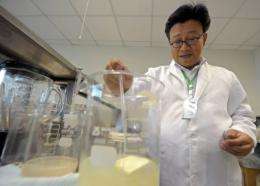
Paijit Sangchai demonstrates recycling laminated paper at his office in Bangkok. His Thai firm, Flexoresearch, has developed a series of blended enzymes that can recover pulp or fibre from laminated paper such as cigarette packets, stickers or milk cartons that were previously hard or impossible to recycle.
Paijit Sangchai drops a small piece of laminated paper into a jar of cloudy liquid which he hopes will transform his start-up into a multi-million dollar company and help revolutionise recycling.
"Now this is the fun part," he says a few minutes later, holding it under the tap to wash away soggy paper pulp and reveal a clear plastic film.
His Thai firm, Flexoresearch, has developed a series of blended enzymes that can recover pulp or fibre from laminated paper such as cigarette packets, stickers or milk cartons that were previously hard or impossible to recycle.
First one enzyme attacks the water resistant chemical coating the surface, then others take over and tackle the paper and adhesive layers.
The resulting pulp, he says, can be used to produce new paper products -- thus saving trees -- or turned into building materials that can be used as an alternative to asbestos, which is potentially hazardous to human health.
The technique, believed to be the first of its kind, also produces clean plastic that can be recycled and used to produce new products.
The firm was recently named one of 31 "Technology Pioneers" by the World Economic Forum, which said its products were "poised to reduce the use of asbestos in the developing world, positively impacting people's health."
Time Magazine described Flexoresearch as one of "10 start-ups that will change your life".
It is a rare honour to be bestowed on an entrepreneur in a country hardly renowned for its technological prowess.
In developing countries such as Thailand, laminated paper is usually thrown away, Paijit says.
"Most people burn it illegally and that causes toxic fumes which harm people's health," he tells AFP at his small laboratory in a science park on the northern outskirts of Bangkok.
"For people in developing countries who suffer from the fumes and don't know why they are sick ... it can help improve their lives," he adds.
And while developed countries like the United States are able to incinerate laminated paper such as fast food wrappers safely, they do not have any commercially viable way to recycle it either, he says.
"Every country uses laminated paper, in stickers and wrappers of food like McDonald's and Kentucky Fried Chicken. That's all laminated and people throw it away," he says. "I think this a global market."
Since winning the Technology Pioneer award -- previous recipients of which include Google and Twitter -- Paijit has been flooded with thousands of emails, mostly from venture capitalists interested in investing in his start-up.
But the affable company founder and CEO is not interested in borrowing more money or selling stakes to investors.
He is looking for people overseas who want to licence the technology, which is already attracting interest in countries including Malaysia, Japan, China, South Korea and India.
"I want to work with people around the world to heal the environment," says Paijit.
It is a far cry from the days he spent experimenting with enzymes produced from mushrooms in a home laboratory after quitting a more than decade-long, well-paid career with a leading Thai industrial giant four years ago.
He invested his savings, then borrowed heavily from the bank, putting up his house as collateral to keep the project going and build a paper mill in eastern Bangkok.
At one point the firm was in debt to the tune of about 1.5 million dollars, but it has since repaid all the money and now employs 17 people.
And Paijit is already eyeing ways to turn other problems into profits, including a technique to turn used liquid coolant drained from refrigeration systems into oil that can be used in the construction industry.
"I make a profit from a problem. I convert waste into wealth," he says.
(c) 2010 AFP
-
From lemons to lemonade: Reaction uses carbon dioxide to make carbon-based semiconductor,
28 comments
-
Thioridazine kills cancer stem cells in human while avoiding toxic side-effects of conventional cancer treatments,
3 comments
-
SpaceX private rocket blasts off for space station (Update),
41 comments
-
Climate scientists say they have solved riddle of rising sea,
30 comments
-
Scotland passes turbine test to harness tidal power,
40 comments
-
magnets or EMF in car bumpers to protect from fender bender
3 hours ago
-
length of wire in a coil of known dimensions?
20 hours ago
-
India Engineering Powerhouse
May 25, 2012
-
electromagnet core dereference between hard and soft iron
May 25, 2012
-
Measuring water pressure in an open tank
May 24, 2012
-
Question from a non-engineer: Pulley Systems
May 24, 2012
- More from Physics Forums - General Engineering
More news stories
SpotterRF debuts Radar Backpack Kit (w/ Video)
(Phys.org) -- SpotterRF has announced a special radar backpack kit designed to enhance situational awareness for soldiers on the ground. The company says its special radar is designed for warfighters as part ...
Apple CEO Cook gives up $75M in stock dividends
(AP) -- Apple CEO Tim Cook is giving up $75 million in dividends on restricted stock that the company is awarding to all of its employees.
21 hours ago |
1.8 / 5 (4) |
2
Yahoo kills 'Livestand' just 6 months after debut
(AP) -- Yahoo is killing a tablet magazine called Livestand just six months its debut on the iPad.
16 hours ago |
not rated yet |
1
Yahoo! ditches digital newsstand for iPads
Yahoo! shuttered its fledgling digital newsstand for iPads on Friday in what it said was the start of a product purge intended to make the floundering Internet pioneer more nimble.
17 hours ago |
not rated yet |
0
Facebook IPO debacle raises investor dander
The spate of complaints and investigations over the Facebook stock offering suggests big institutions had an edge over small investors, raising questions about the process.
18 hours ago |
not rated yet |
0
Transvaginal mesh op restores pelvic organ prolapse at price
(HealthDay) -- Transvaginal mesh (TVM) procedures are effective for anatomical restoration of pelvic organ prolapse (POP), but patients report a worsening of sexual function following surgery, according to ...
Family history of Alzheimer's affects functional connectivity
(HealthDay) -- Cognitively normal individuals with a family history of late-onset Alzheimer's disease (AD) may display lower resting state functional connectivity in the default mode network (DMN) of the brain, ...
Travel to high altitudes tied to Crohn's, colitis flare-ups
(HealthDay) -- People with inflammatory bowel disease, which includes Crohn's disease and colitis, may be at increased risk for flare-ups when they fly or travel to high altitudes for skiing or mountain climbing, ...
Thousands of shellfish found dead in Peru
Thousands of crustaceans were found dead off the coast of Lima following the mystery mass death of dolphins and pelicans, the Peruvian Navy said Friday.
Astronomers seize last chance in lifetime for Venus Transit
Astronomers are gearing for one the rarest events in the Solar System: an alignment of Earth, Venus and the Sun that will not be seen for another 105 years.
Australia hails surprise super-telescope decision
Australia has hailed a surprise decision giving it a role in a radio telescope project aimed at revolutionising astronomy, vowing to draw on its decades of experience in space science.
Dec 04, 2010
Rank: not rated yet
Dec 04, 2010
Rank: not rated yet
Perverse situation in parts of UK is that plastic, paper or card items may be recycled easily, but the convenient *layered* packaging that uses a lot less raw material and takes less space in wheelie bin cannot be recycled and, often, only bio-degrades / composts very slowly, leaving plastic film residues...
Dec 04, 2010
Rank: 1 / 5 (2)
What a greedy SOB! Why shouldn't the UN force him to donate his process for humanity?
Dec 04, 2010
Rank: not rated yet
I wonder if this would work to break down other cellulose materials for the production of ethanol. Currently, they have to blast plant material apart with heat mechanical abrasion. If they could just dump it in a single vat of enzymes, that performs all of the various steps, and then distil off the alcohol, they could greatly reduce the cost and increase the array of viable feedstocks.
Dec 04, 2010
Rank: 4.7 / 5 (3)
I suppose that that was sarcasm but since some people actually think that way I will answer the question.
A) Because punishing people instead of rewarding them for the time, effort and money they use to innovate is a great way to bring innovation to a halt. How many people had been volunteering their own life and money to get this sort of education and pursue this line of inquiry so they could donate the fruits of their labour to the world for free in order to die poor and in debt? Did you do all this? Maybe he is not greedy but rather, you are negligent.
B) Because the UN is too busy with the following: concealing sex crimes against third-world refugees by UN employees, passing resolutions condemning Israel for existing, covering up corruption and placing representatives of human rights violating regimes on "prestigious" human rights committees.
Dec 05, 2010
Rank: not rated yet
trees need saving? plant more trees.
Dec 05, 2010
Rank: not rated yet
Dec 10, 2010
Rank: not rated yet