Sumatran 'tiger map' reveals tiger population higher than expected
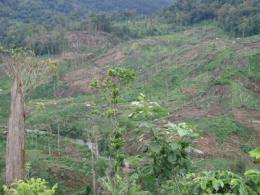
The destruction and fragmentation of Sumatran tiger habitats is driven by illegal logging, infrastructure developments and pervasive rural communities. These actions bring people and tigers into close proximity and often lead to conflict and the illegal killing of the tigers themselves and the prey species on which they depend. Credit: (credit to PHKA/WCS) Note: PHKA is the Directorate of Forest Protection and Nature Conservation of the Ministry of Forestry of Indonesia.
Scientists have created the highest resolution map of the Sumatran tiger distribution ever produced, revealing that the island now hosts the second largest tiger population on earth. The research, carried out with the Wildlife Conservation Society's Indonesia Program and Forum HarimauKita, will be published in a special issue of Integrative Zoology, on tiger conservation and research methodologies.
Hariyo T. Wibisono and Wulan Pusparini conducted a questionnaire-based survey across the island to identify the status of Sumatran tiger distribution. They found that tigers still occupy a large majority of the remaining available habitat in Sumatra. Of the 144,160 square kilometers (55,660 sq mi) of remaining potential habitat, tigers are present in over 97% (140,226 sq km; 55,141 sq mi). However, only 29% of the habitat found to contain tigers is protected.
"These findings imply that Sumatran tiger population might be much larger than we believed, and could potentially be the second largest tiger population in the world after India," said Wibisono.
The survey also revealed that tigers occupy a great diversity of ecosystems. Tigers were found from 0 meters above sea level in coastal lowland forests, to 3200 meters (10,500 feet) above sea level in high mountain forests and in every eco-region in between.
"There is a need for further scientific population assessment," said Wibisono, "but if the population is indeed as large as this new survey suggests then real actions and more support from tiger experts and the international community should be mobilized in the conservation of Sumatran tigers."
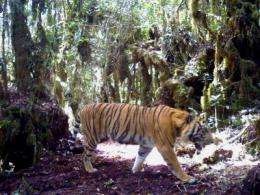
Tigers are able to live in a wide range of habitats. A male tiger photographed by a camera trap in montane forest habitat within the Leuser Ecosystem, North Sumatra Province, Sumatra. In this region, tiger signs were discovered at up to 3.200m asl by WCS survey teams. Credit: (credit to PHKA/WCS/LIF/Panthera) ote: PHKA is the Directorate of Forest Protection and Nature Conservation of the Ministry of Forestry of Indonesia.
Based on their findings, the scientists recommend that at least five habitats should be reassessed as Tiger Conservation Landscapes (TCLs). A TCL is an area where there is sufficient habitat for at least five tigers and in which tigers have been confirmed to be present in the last 10 years.These habitats include: 1.) Leuser Ecosystem which contains lowland to montane habitat in the northwest, 2.) Berbak-Sembilang containing lowland peat swamps and coastal habitat in southeast, 3.) Ulu Masen Ecosystem containing lowland to montane habitat in northwest, 4.) Batang Gadis containing lowland to lower montane habitat in central Sumatra, and 5.) Giam Siak Kecil in the central part of the island.
Mr. Wibisono sought to undertake this survey because he believed, based on his extensive experience working on the ground in Sumatra, that previous studies underestimated tiger population distribution. He and his colleague's findings verify his hunch and demonstrate that tigers are present at an island-wide scale in Sumatra.
The world tiger population has declined by 50% since 1998, and only an estimated 3,200-3,600 remain in the wild. The presence of tigers over a wide area of habitat in Sumatra is one of the few bright spots in the current state of wild tigers, but more protection is needed to ensure a viable future for this magnificent animal.
"Although tigers are clearly in peril, I am encouraged by the historic commitments made at the recent global tiger summit to increase the number of tigers worldwide," said Zhibin Zhang, editor-in-chief of Integrative Zoology. "At the end of November, the International Tiger Conservation Forum was held in St. Petersburg, Russia. The governments of the 13 tiger range countries agreed to double tiger numbers by 2022."
"By publishing this special issue on tiger conservation and research methodologies we hope to contribute to the efforts by governments, scientists and conservationists to brink tigers back from the brink."
Provided by
Wiley
-
From lemons to lemonade: Reaction uses carbon dioxide to make carbon-based semiconductor,
28 comments
-
Thioridazine kills cancer stem cells in human while avoiding toxic side-effects of conventional cancer treatments,
3 comments
-
SpaceX private rocket blasts off for space station (Update),
41 comments
-
Climate scientists say they have solved riddle of rising sea,
30 comments
-
Scotland passes turbine test to harness tidal power,
40 comments
-
How do I identify different bacteria on culture plates?
1 hour ago
-
Why Do Dogs do Strange things...
17 hours ago
-
What does exophillic and endophillic mean in terms of mosquito and their control?
May 24, 2012
-
Semen stains glows under black lights (uv light)?
May 23, 2012
-
Question on Human Chromosome 2
May 23, 2012
-
How important is composition of TBST in diluting antibodies and Western Blotting?
May 22, 2012
- More from Physics Forums - Biology
More news stories
Thousands of shellfish found dead in Peru
Thousands of crustaceans were found dead off the coast of Lima following the mystery mass death of dolphins and pelicans, the Peruvian Navy said Friday.
47 minutes ago |
not rated yet |
0
Researchers solve structure of human protein critical for silencing genes
In a study published in the journal Cell on May 24, Cold Spring Harbor Laboratory (CSHL) scientists describe the three-dimensional atomic structure of a human protein bound to a piece of RNA that "guides" the pr ...
16 hours ago |
4.7 / 5 (7) |
0
|
It's in the genes: Research pinpoints how plants know when to flower
Scientists believe they've pinpointed the last crucial piece of the 80-year-old puzzle of how plants "know" when to flower.
15 hours ago |
4.2 / 5 (6) |
1
|
Copy of the genetic makeup travels in a protein suitcase
Scientists from the Institute for Physical and Theoretical Chemistry at the University of Bonn have succeeded for the first time in the real time filming of the transport of an important information carrier in biological ...
21 hours ago |
not rated yet |
0
|
'Transformer' protein makes different sized transport pods
These spheres may look almost identical, but subtle differences between them revealed a molecular version of the robots from Transformers. Each sphere is a vesicle, a pod that cells use to transport materials ...
22 hours ago |
not rated yet |
0
SpotterRF debuts Radar Backpack Kit (w/ Video)
(Phys.org) -- SpotterRF has announced a special radar backpack kit designed to enhance situational awareness for soldiers on the ground. The company says its special radar is designed for warfighters as part ...
Astronauts enter world's 1st private supply ship
(AP) -- Space station astronauts floated into the Dragon on Saturday, a day after its heralded arrival as the world's first commercial supply ship.
Australia hails surprise super-telescope decision
Australia has hailed a surprise decision giving it a role in a radio telescope project aimed at revolutionising astronomy, vowing to draw on its decades of experience in space science.
SpaceX capsule has 'new car' smell, astronauts say
SpaceX's Dragon cargo vessel smells like a new car, said astronauts at the International Space Station after opening the hatches Saturday following the spacecraft's landmark mission to the orbiting lab.
Astronomers seize last chance in lifetime for Venus Transit
Astronomers are gearing for one the rarest events in the Solar System: an alignment of Earth, Venus and the Sun that will not be seen for another 105 years.
Travel to high altitudes tied to Crohn's, colitis flare-ups
(HealthDay) -- People with inflammatory bowel disease, which includes Crohn's disease and colitis, may be at increased risk for flare-ups when they fly or travel to high altitudes for skiing or mountain climbing, ...
