Solar panels, anti-freeze beetles in space
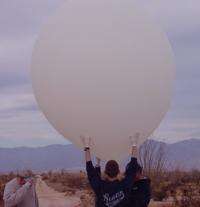
San Diego engineering students recently sent a weather balloon up 80,000 feet to near space to study the effects of solar power, climate change and even the survival rate of anti-freeze beetles. The launch, sponsored by the California Space Grant Consortium, is the fifth of its kind for UC San Diego since 2008.
For the most recent launch, the students headed for the Salton Sea in the Southern California desert at 4:30 a.m. on a Saturday to release the balloon and its various payloads, which included a 360-degree panoramic camera they designed; CO2, ozone and temperature sensors; small solar panels; a GPS system; cockroaches; and beetles.
“We have a unique region for a weather balloon launch,” said Tim Wheeler, one of the balloon launch leaders who is in his second year as a UC San Diego aerospace engineering student. “We have Mexico to the south, the Salton Sea to the North and bombing and mountain ranges around us.”
Wheeler said one of the most interesting payloads was the group of Cucujus beetles, freeze-tolerant Alaskan beetles that are able to survive temperatures below minus 100 degrees. Near space is well below freezing.
“After we collected the data results from the weather balloon, every single set of beetles reached negative 55 degrees Celsius,” Wheeler said, adding that the students are waiting on the data from the beetles’ survival rate.
None of the cockroaches, by the way, survived the flight. “So you definitely can kill cockroaches by sending them to near space,” Wheeler said.
Joking and fun aside, the main focus of the balloon launch was the environment. It was the first time the UC San Diego students launched solar panels into near space. The students wanted to test how the solar panels would perform at high altitude since there is more UV radiation. The goal, Wheeler said, is to see if solar panels are a future viable solution for power onboard a weather balloon. The students measured the voltage the solar panels produced and what times the UV radiation was the best. The result – a power output increase of 70 percent in high altitude.
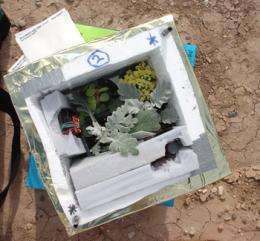
The weather balloon project also included San Diego high school students, who chose to send a Twinkie; chocolate bars, marshmallow, a banana, hand lotion, a small potted flower, and bacteria in a Petri dish to near space. The data for those payloads have been sent back to the high schools for the teachers and students to analyze. The local schools were also interested in the effects of climate change. The schools, led and organized by Stephanie Rico at LEADS High School, included Mission Bay High School, Helix Charter High School, San Diego High School and Kearny High School.
“We wanted to do a launch that appealed to high school teachers and one that they could incorporate into their classrooms,” Wheeler said. “We gave presentations about near space in the classrooms before the launch. This is such a good opportunity to do something hands on and design your own experiment where there is no right and wrong answers and you do not know 100 percent what will happen. The sky’s the limit quite literally in this experiment.”
Led by the UC San Diego engineering students, the team set up ground stations and used a radio beacon and GPS systems to monitor the location of the balloon during flight (it took about two hours for the balloon to reach near space, ascending at 800 feet per minute). Wheeler said the UC San Diego engineering students are designing their own radio beacon that can be connected to a computer chip on board future weather balloons that can monitor and then transmit temperature, pressure and humidity data.
Some of the students, including Wheeler, used their iPhones to track and predict where the balloon would land.
“Advancements in technology have aided these projects,” said Wheeler, a San Jose, Calif. native who began his quest in the fifth grade to find everything he needed to know to be a rocket scientist. “For example, we used a $30 circuit board on the weather balloon that does data sensing. Technology didn’t allow you to do that 10 years ago at a low cost.”
Trial and error is also a critical part of such experiments, said Kim Wright, another one of the weather balloon project leaders.
“Sometimes the data we get back teaches us a lot about experiment design,” said Wright, a UC San Diego aerospace engineering grad student. “We want to know, for example, why we have erroneous results. Did our equipment malfunction? What caused the problem, and can we replicate it on the ground? How can we improve this experiment for our next flight? Through this process, we are constantly learning, and constantly improving.”
During the project, Wright handled a lot of the logistics and acted as a liaison between the UC San Diego team and the high school teachers, helping them to prepare for launch day. She also worked on constructing payload boxes with the rest of the team. She is excited about the future data collected by her and other engineers that can help aid the environment.
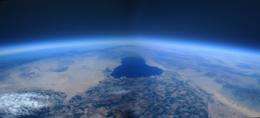
“Weather balloons are frequently used by meteorologists to collect information about the atmosphere – wind speed, direction, temperature, and humidity to name a few,” Wright said. “By comparing data from a weather balloon flight to predicted values, we can measure how well our weather prediction models work and make changes when needed. This results in a better understanding of our environment, and helps us predict our impact upon it.”
The UC San Diego weather balloon project was headed by John Kosmatka, a professor in both the UC San Diego structural engineering and mechanical and aerospace engineering departments.
Kosmatka and his students are planning another weather balloon launch with local high school students in February 2011, in conjunction with the San Diego Science Festival. They also plan to do another launch in early 2011 to test a weather balloon that can travel beyond San Diego. The goal, Kosmatka said, is to be able to collect and measure atmospheric data all the way across the United States to Europe in one day. For now, he said, they hope to fly the weather balloon to the Gulf of Mexico.
Kosmatka said the weather balloon launches are not just for fun – they are real science experiments that may one day aid in tracking smoke plumes, for example.
“We are collecting air quality data now as a baseline, using oxygen, CO, CO2, and ozone sensors,” he said. “Then when we launch a balloon in the near future we can monitor atmospheric changes due to manmade or natural events. When San Diego County has another wild fire, we could launch a weather balloon and track the smoke plume and monitor the presence and movement of pollutants in the upper atmosphere. For example, knowing what pollutants were in the recent smoke plume from the intentional burning of the Escondido house that had explosives in it would have been valuable.”
Kosmatka added that such projects also engage future would-be engineers.
“One of the important things we’re trying to do with these launches is to get high school students involved who are thinking about pursing a college degree in the science engineering and technology fields,” he said. “We want to show them that engineering and science can be fun and how they can apply what they are already learning.”
Provided by University of California - San Diego


