Scientists to make stellar observations with airborne observatory
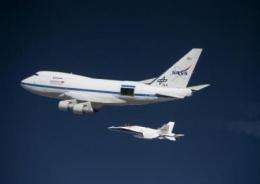
NASA's SOFIA aircraft is slated to take off this week and use an on-board telescope to peer at distant star-forming regions. Credit: NASA
A University of Colorado at Boulder faculty member is one of two scientists who will use data gathered by a world-class telescope flying aboard a modified Boeing 747 to peer at a distant star-forming region during its inaugural science flight this week.
Known as the Stratospheric Observatory for Infrared Astronomy, or SOFIA, the jet was significantly modified in order to mount a 2.5-meter reflecting telescope in the rear fuselage, said Senior Research Associate Paul Harvey of CU-Boulder's Center for Astrophysics and Space Astronomy, one of the scientists involved in the mission.
The jet will fly at 40,000 to 45,000 feet in altitude, putting it above more than 99 percent of the water vapor in the atmosphere -- which blocks infrared light from reaching the ground -- and will allow scientists to observe stellar targets in wavelengths of light that can't be observed by ground-based telescopes, said Harvey.
The aircraft and telescope were successfully tested in the summer of 2009. SOFIA's Faint Object InfraRed Camera, known as FORCAST, is a versatile camera that collects light from the visible, infrared and sub-millimeter portions of the electromagnetic spectrum, Harvey said.
Harvey will be observing and analyzing the distribution of dust and gas in a young, star-forming cluster known as Sharpless 140 that is roughly 3,000 light-years from Earth in the constellation Cepheus. One light-year is equal to about 6 trillion miles.
"Observing the birth of stars in our own galaxy is critical because planetary systems form at the same time that a central star is formed," said Harvey. "In addition, some of the most luminous galaxies in the universe appear to be powered by extreme bursts of star formation."
Harvey flew on several hundred flights of SOFIA's predecessor, the Kuiper Airborne Observatory, but will not be aboard the first science flight of SOFIA. The second set of observations on this week's SOFIA science flight will be led by Mark Morris of UCLA, who will be targeting star-forming regions in the Orion nebula.
Harvey said the FORCAST camera on the telescope has large, two-dimensional array detectors that are similar to charge-coupled devices found in digital cameras. The goal is to obtain a sequence of images of the star cluster with the telescope, which will move almost imperceptibly between each image in order to sample "sub-pixels."
One advantage of the SOFIA observatory is that scientists can make changes and improvements to the craft's instruments between flights as well as change observing techniques, said Harvey. "These are impossible tasks for orbiting telescopes that have very fixed procedures for the instruments and observations."
He also is working with the FORCAST team to interpret data gathered during the first science flight in order to carefully characterize SOFIA's imaging capabilities for future users.
Harvey said he hopes to build a long-term program of specialized observations on SOFIA that eventually will involve data analysis by CU-Boulder students.
NASA hopes SOFIA will continue to fly astronomical science observations for the next two decades, with research flights expected to ramp up to two or three flights a week by 2015. SOFIA's suite of instruments are expected to gather new information on a wide variety of astronomical targets, including black holes, distant galaxies, the formation of stars and planets, and up close views of comets and asteroids.
Provided by
University of Colorado at Boulder
-
From lemons to lemonade: Reaction uses carbon dioxide to make carbon-based semiconductor,
28 comments
-
Thioridazine kills cancer stem cells in human while avoiding toxic side-effects of conventional cancer treatments,
3 comments
-
SpaceX private rocket blasts off for space station (Update),
41 comments
-
Climate scientists say they have solved riddle of rising sea,
30 comments
-
Scotland passes turbine test to harness tidal power,
40 comments
-
revamping general concept and cosmological principle
19 hours ago
-
Transiting Exoplanet Light Curve
May 25, 2012
-
Math behind Theoretical Physics
May 24, 2012
-
Do we know whats at the center of galaxies yet?
May 23, 2012
-
Structure of the Milky Way?
May 20, 2012
-
What would it take to terraform Pluto and Charon?
May 19, 2012
- More from Physics Forums - General Astronomy
More news stories
Astronauts enter world's 1st private supply ship
(AP) -- Space station astronauts floated into the Dragon on Saturday, a day after its heralded arrival as the world's first commercial supply ship.
Space & Earth / Space Exploration
20 minutes ago |
not rated yet |
0
Australia hails surprise super-telescope decision
Australia has hailed a surprise decision giving it a role in a radio telescope project aimed at revolutionising astronomy, vowing to draw on its decades of experience in space science.
18 minutes ago |
not rated yet |
0
SpaceX capsule has 'new car' smell, astronauts say
SpaceX's Dragon cargo vessel smells like a new car, said astronauts at the International Space Station after opening the hatches Saturday following the spacecraft's landmark mission to the orbiting lab.
Space & Earth / Space Exploration
18 minutes ago |
not rated yet |
0
Astronomers seize last chance in lifetime for Venus Transit
Astronomers are gearing for one the rarest events in the Solar System: an alignment of Earth, Venus and the Sun that will not be seen for another 105 years.
15 minutes ago |
5 / 5 (1) |
0
Dragon arrives at space station in historic 1st (Update 2)
The privately bankrolled Dragon capsule made a historic arrival at the International Space Station on Friday, triumphantly captured by astronauts wielding a giant robot arm.
Space & Earth / Space Exploration
22 hours ago |
5 / 5 (8) |
16
SpotterRF debuts Radar Backpack Kit (w/ Video)
(Phys.org) -- SpotterRF has announced a special radar backpack kit designed to enhance situational awareness for soldiers on the ground. The company says its special radar is designed for warfighters as part ...
Thousands of shellfish found dead in Peru
Thousands of crustaceans were found dead off the coast of Lima following the mystery mass death of dolphins and pelicans, the Peruvian Navy said Friday.
Travel to high altitudes tied to Crohn's, colitis flare-ups
(HealthDay) -- People with inflammatory bowel disease, which includes Crohn's disease and colitis, may be at increased risk for flare-ups when they fly or travel to high altitudes for skiing or mountain climbing, ...
Of mice and mental models: Neuroscientific implications of risk-optimized behavior in the mouse
(Medical Xpress) -- Regardless of an organism’s biological complexity, every encephalized animal continuously makes under-informed behavioral choices that can have serious consequences. Despite its ubiquity, ...
Aliens don't want to eat us, says former SETI director
Alien life probably isnt interested in having us for dinner, enslaving us or laying eggs in our bellies, according to a recent statement by former SETI director Jill Tarter.
Researchers demonstrate possible primitive mechanism of chemical info self-replication
(Phys.org) -- When scientists think about the replication of information in chemistry, they usually have in mind something akin to what happens in living organisms when DNA gets copied: a double-stranded molecule ...