Scientists rediscover Africa's 'terrible hairy fly'
December 8, 2010

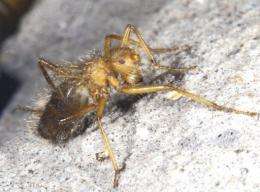
A handout image shows a specimen of Mormotomiya Hirsuta, also known as the "terrible hairy fly"

Enlarge

A handout photo provided by the International Center of Insect Physiology and Ecology (Icipe) and taken on on December 4, 2010 shows a specimen of Mormotomiya Hirsuta, also known as the "terrible hairy fly." A group of scientists have rediscovered the world's rarest and strangest fly in a cave in Kenya, collecting the first specimen since 1948, a statement said on December 8.

A group of scientists has rediscovered the world's rarest and strangest fly in a cave in Kenya, collecting the first "terrible hairy fly" specimen since 1948, a statement said Wednesday.

Dr Robert Copeland and fellow dipterist Dr Ashley Kirk-Spriggs found the fly, known as Mormotomyia Hirsuta, in its only known habitat, a cave-like rock cleft in Ukazi Hill east of Nairobi.

"The re-discovery of the species, which has been collected on only two occasions before, in 1933 and 1948, has caused excitement in insect museums world-wide," said the statement.

The mission was led by the International Centre of Insect Physiology and Ecology (Icipe), an organisation which aims to reduce poverty and improve health and food security by enhancing tropical African countries' ability to harness their natural resources through the study of .

The spider-like fly is described as "strange, due to its relatively large size, the males of which can stretch over one centimetre its long legs and covering of yellow hairs, reduced eyes and its non-functional wings."

"Since Mormotomyia cannot fly, there is a strong possibility that it is really restricted to this tiny habitat," Copeland said.

"If that is the case, it would be wonderful if the entire Ukazi Hill, on which it is found, were declared a national heritage area and given suitable conservation protection," he added.

(c) 2010 AFP

3.8 /5 (4 votes)  

Filter


Move the slider to adjust rank threshold, so that you can hide some of the comments.


Display comments: newest first

Shootist
Dec 08, 2010

Rank: 1.7 / 5 (6)
"If that is the case, it would be wonderful if the entire Ukazi Hill, on which it is found, were declared a national heritage area and given suitable conservation protection," he added.


For a flipping bug? How stupid are these people?
Glyndwr
Dec 08, 2010

Rank: 5 / 5 (3)
Typical human arrogance from shootist ;)....its a unusual species and could provide valuable information for evolutionary and phylogenetic studies...who are you to say yet?
Rank 3.8 /5 (4 votes)
Relevant PhysicsForums posts

More news stories

Thousands of shellfish found dead in Peru

Thousands of crustaceans were found dead off the coast of Lima following the mystery mass death of dolphins and pelicans, the Peruvian Navy said Friday.

Biology / Ecology

created 17 minutes ago | popularity not rated yet | comments 0

Researchers solve structure of human protein critical for silencing genes

In a study published in the journal Cell on May 24, Cold Spring Harbor Laboratory (CSHL) scientists describe the three-dimensional atomic structure of a human protein bound to a piece of RNA that "guides" the pr ...

Biology / Cell & Microbiology

created 15 hours ago | popularity 4.7 / 5 (6) | comments 0 | with audio podcast

It's in the genes: Research pinpoints how plants know when to flower

Scientists believe they've pinpointed the last crucial piece of the 80-year-old puzzle of how plants "know" when to flower.

Biology / Biotechnology

created 15 hours ago | popularity 4 / 5 (5) | comments 1 | with audio podcast

Copy of the genetic makeup travels in a protein suitcase

Scientists from the Institute for Physical and Theoretical Chemistry at the University of Bonn have succeeded for the first time in the real time filming of the transport of an important information carrier in biological ...

Biology / Cell & Microbiology

created 21 hours ago | popularity not rated yet | comments 0 | with audio podcast

'Transformer' protein makes different sized transport pods

These spheres may look almost identical, but subtle differences between them revealed a molecular version of the robots from Transformers. Each sphere is a vesicle, a pod that cells use to transport materials ...

Biology / Cell & Microbiology

created 21 hours ago | popularity not rated yet | comments 0


SpotterRF debuts Radar Backpack Kit (w/ Video)

(Phys.org) -- SpotterRF has announced a special radar backpack kit designed to enhance situational awareness for soldiers on the ground. The company says its special radar is designed for warfighters as part ...

Astronauts enter world's 1st private supply ship

(AP) -- Space station astronauts floated into the Dragon on Saturday, a day after its heralded arrival as the world's first commercial supply ship.

Australia hails surprise super-telescope decision

Australia has hailed a surprise decision giving it a role in a radio telescope project aimed at revolutionising astronomy, vowing to draw on its decades of experience in space science.

SpaceX capsule has 'new car' smell, astronauts say

SpaceX's Dragon cargo vessel smells like a new car, said astronauts at the International Space Station after opening the hatches Saturday following the spacecraft's landmark mission to the orbiting lab.

Astronomers seize last chance in lifetime for Venus Transit

Astronomers are gearing for one the rarest events in the Solar System: an alignment of Earth, Venus and the Sun that will not be seen for another 105 years.

Travel to high altitudes tied to Crohn's, colitis flare-ups

(HealthDay) -- People with inflammatory bowel disease, which includes Crohn's disease and colitis, may be at increased risk for flare-ups when they fly or travel to high altitudes for skiing or mountain climbing, ...