Engineers take plasmon lasers out of deep freeze
December 20, 2010 By Sarah Yang
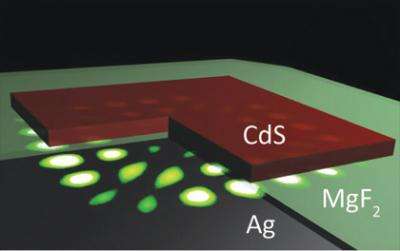
Schematic of a plasmon laser showing a cadmium sulfide (CdS) square atop a silver (Ag) substrate separated by a 5 nanometer gap of magnesium fluoride (MgF2). The cadmium sulfide square measures 45 nanometers thick and 1 micrometer long. The most intense electric fields of the device reside in the magnesium fluorid gap. (Renmin Ma and Rupert Oulton)
(PhysOrg.com) -- Researchers at the University of California, Berkeley, have developed a new technique that allows plasmon lasers to operate at room temperature, overcoming a major barrier to practical utilization of the technology.
The achievement, described Dec. 19 in an advanced online publication of the journal Nature Materials, is a "major step towards applications" for plasmon lasers, said the research team's principal investigator, Xiang Zhang, UC Berkeley professor of mechanical engineering and faculty scientist at Lawrence Berkeley National Laboratory.
"Plasmon lasers can make possible single-molecule biodetectors, photonic circuits and high-speed optical communication systems, but for that to become reality, we needed to find a way to operate them at room temperature," said Zhang, who also directs at UC Berkeley the Center for Scalable and Integrated Nanomanufacturing, established through the National Science Foundation's (NSF) Nano-scale Science and Engineering Centers program.
In recent years, scientists have turned to plasmon lasers, which work by coupling electromagnetic waves with the electrons that oscillate at the surface of metals to squeeze light into nanoscale spaces far past its natural diffraction limit of half a wavelength. Last year, Zhang's team reported a plasmon laser that generated visible light in a space only 5 nanometers wide, or about the size of a single protein molecule.
But efforts to exploit such advancements for commercial devices had hit a wall of ice.
"To operate properly, plasmon lasers need to be sealed in a vacuum chamber cooled to cryogenic temperatures as low as 10 kelvins, or minus 441 degrees Fahrenheit, so they have not been usable for practical applications," said Renmin Ma, a post-doctoral researcher in Zhang's lab and co-lead author of the Nature Materials paper.
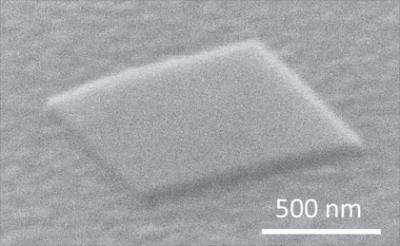
Electron microscope image of the plasmon laser. (Renmin Ma and Rupert Oulton)
In previous designs, most of the light produced by the laser leaked out, which required researchers to increase amplification of the remaining light energy to sustain the laser operation. To accomplish this amplification, or gain increase, researchers put the materials into a deep freeze.
To plug the light leak, the scientists took inspiration from a whispering gallery, typically an enclosed oval-shaped room located beneath a dome in which sound waves from one side are reflected back to the other. This reflection allows people on opposite sides of the gallery to talk to each other as if they were standing side by side. (Some notable examples of whispering galleries include the U.S. Capitol's Statuary Hall, New York's Grand Central Terminal, and the rotunda at San Francisco's city hall.)
Instead of bouncing back sound waves, the researchers used a total internal reflection technique to bounce surface plasmons back inside a nano-square device. The configuration was made out of a cadmium sulfide square measuring 45 nanometers thick and 1 micrometer long placed on top of a silver surface and separated by a 5 nanometer gap of magnesium fluoride.
The scientists were able to enhance by 18-fold the emission rate of light, and confine the light to a space of about 20 nanometers, or one-twentieth the size of its wavelength. By controlling the loss of radiation, it was no longer necessary to encase the device in a vacuum cooled with liquid helium. The laser functioned at room temperature.
"The greatly enhanced light matter interaction rates means that very weak signals might be observable," said Ma. "Lasers with a mode size of a single protein are a key milestone toward applications in ultra-compact light source in communications and biomedical diagnostics. The present square plasmon cavities not only can serve as compact light sources, but also can be the key components of other functional building-blocks in integrated circuits, such as add-drop filters, direction couplers and modulators."
Provided by
University of California - Berkeley
-
From lemons to lemonade: Reaction uses carbon dioxide to make carbon-based semiconductor,
28 comments
-
Thioridazine kills cancer stem cells in human while avoiding toxic side-effects of conventional cancer treatments,
3 comments
-
SpaceX private rocket blasts off for space station (Update),
41 comments
-
Climate scientists say they have solved riddle of rising sea,
30 comments
-
Scotland passes turbine test to harness tidal power,
40 comments
-
The need for practical electronic and mechanical skills for aspiring experimentalists
5 hours ago
-
Refraction and splitting of a photon
6 hours ago
-
Total pressure load on a chain...
7 hours ago
-
Water under pressure and temperature effects
10 hours ago
-
Flow, different liquid, pressure
11 hours ago
-
Dimensions and Degrees of Freedom
12 hours ago
- More from Physics Forums - General Physics
More news stories
Landmark calculation clears the way to answering how matter is formed
(Phys.org) -- An international collaboration of scientists, including Thomas Blum, associate professor of physics, is reporting in landmark detail the decay process of a subatomic particle called a kaon ...
May 25, 2012 |
4.8 / 5 (12) |
32
|
Is a classical electrodynamics law incompatible with special relativity?
(Phys.org) -- The laws of classical electromagnetism that were developed in the 19th century are the same laws that scientists use today. They include Maxwell’s four equations along with the Lorentz la ...
Lying in wait for WIMPs: Researchers seek to dramatically increase sensitivity of Large Underground Xenon detector
Although it's invisible, dark matter accounts for at least 80 percent of the matter in the universe. No one knows what it is, but most scientists would bet on weakly interacting massive particles, or WIMPs.
May 23, 2012 |
4 / 5 (5) |
14
|
Hall effect at the speed of light: How can you demonstrate relativistic effects with your mobile phone?
The relativistic Hall effect describing objects rotating at speeds comparable with the speed of light has been reported.
May 21, 2012 |
4.3 / 5 (3) |
8
Cloak of invisibility: Engineers use plasmonics to create an invisible photodetector
A team of engineers at Stanford and the University of Pennsylvania has for the first time used "plasmonic cloaking" to create a device that can see without being seen - an invisible machine that detects light. It is the first ...
May 21, 2012 |
4.8 / 5 (16) |
7
|
SpotterRF debuts Radar Backpack Kit (w/ Video)
(Phys.org) -- SpotterRF has announced a special radar backpack kit designed to enhance situational awareness for soldiers on the ground. The company says its special radar is designed for warfighters as part ...
Astronauts enter world's 1st private supply ship
(AP) -- Space station astronauts floated into the Dragon on Saturday, a day after its heralded arrival as the world's first commercial supply ship.
Australia hails surprise super-telescope decision
Australia has hailed a surprise decision giving it a role in a radio telescope project aimed at revolutionising astronomy, vowing to draw on its decades of experience in space science.
SpaceX capsule has 'new car' smell, astronauts say
SpaceX's Dragon cargo vessel smells like a new car, said astronauts at the International Space Station after opening the hatches Saturday following the spacecraft's landmark mission to the orbiting lab.
Thousands of shellfish found dead in Peru
Thousands of crustaceans were found dead off the coast of Lima following the mystery mass death of dolphins and pelicans, the Peruvian Navy said Friday.
Astronomers seize last chance in lifetime for Venus Transit
Astronomers are gearing for one the rarest events in the Solar System: an alignment of Earth, Venus and the Sun that will not be seen for another 105 years.

Dec 20, 2010
Rank: 5 / 5 (1)
Dec 20, 2010
Rank: 5 / 5 (1)
Dec 21, 2010
Rank: not rated yet
given the "folding" method I proposed as a first step to translating our existing technologies to optical technologies, it should be possible to see computers thousands, even millions of times more powerful than anything in existence within just a few years.
It's hard to even comprehend the amount of space you can save at every level of design of a computer, by the combination of getting into 3-d, and the optical circuitry cutting out most of the space wasted by wires.
This news comes faster and faster. We are seeing breakthroughs that are an order of magnitude more potential every year or two.
Now they need to get to work actually designing a 3-d chip architecture, and the 3-d tools that will be needed to build them.
It might take several years before engineers can figure out what manner of design allows the greatest density of processors and ram in 3-d.
Dec 21, 2010
Rank: 4 / 5 (1)
The scale in the photo does not seem consistent with the description of the device, since that appears to be about 1 micron * 1 micron square device...
Dec 21, 2010
Rank: not rated yet
Dec 21, 2010
Rank: not rated yet
Hmmm...seems too big to be useful then?
I mean if that's 1 micron * 0.75micron * 50nm, that's completely huge compared to existing transistors.
One of the other optical circuits on another article is like 7000 atoms. By comparison, this device is several million atoms.
Not quite what we had hoped...
It still be used to replace electronic buses, but seems far too big to be particularly useful at the chip scale...
Dec 21, 2010
Rank: not rated yet
I'm wrong, I'm forgetting how primitive our 2-d architecture is compared to what optics and 3-d allows.
It would still be worth it to use these, in spite of their size, even in individual chips, because it still facilitates the "folding" into 3d, which saves so much space even if the only thing you count is wires that you no longer need, or when you still need wires they can run in one straight line or groups of "almost straight lines," instead of circumventing everything...
It's not nearly as good as it would be if it were the same size as an intel transistor, but it is still worth it at that scale, even though I was initially pissed when I realized how big it was...
Dec 21, 2010
Rank: not rated yet
Further, it will be so efficient on power usage, that you'll probably be able to power it with piezo-electric devices just by shaking it a few times, etc.