Scientists crash lead nuclei together to create the hottest and densest nuclear material ever
December 6, 2010 By Phillip F. Schewe
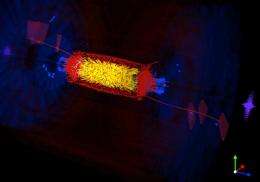
A computer display taken from the first lead collisions. Credit: CERN | iSpy and Fireworks, CMS
The thousand-degree temperatures reached in the hottest of industrial furnaces is nothing compared to the equivalent temperatures achieved when particles traveling near the speed of light slam into each other.
On December 2 several scientists at the CERN laboratory in Geneva, Switzerland reported the first results of an experiment in which the nuclei of lead atoms were shot around the 17 mile racetrack called the Large Hadron Collider and then smashed into each other to create, for an instant, a speck of matter at a temperature of trillions of degrees.
Although the miniature fireballs that occur at the lead-lead collision points only last a fleeting moment -- about a trillionth of a trillionth of a second -- the immense detectors poised nearby are designed to act rapidly and sort through the myriad debris particles streaming outwards.
"This is the hottest nuclear matter ever created in a lab," said Bolek Wyslouch of the Ecole Polytechnique near Paris who spoke at the CERN gathering. He is a representative of the Compact Muon Solenoid collaboration, which uses one of the giant detectors at LHC to observe the lead-lead collisions.
"I like to call this the Little Bang," said Juergen Schukraft, also speaking at the CERN colloquium, suggesting that the violent collisions of heavy ions at the LHC were smaller cousins of the Big Bang explosion that ushered in the visible universe some 14 billion years ago. Indeed, the conditions of the mini-fireballs at LHC resemble the early universe as it was only microseconds after the Big Bang in terms of energy density and temperature. Schukraft represented a second CERN detector group called Alice.
Never before has so much energy -- in this case hundreds of trillions of electron volts abbreviated as TeV -- been deliberately deposited in a volume of space only a few times the size of a proton. A proton is one of the constituents of the nucleus inside each atom, and is some 10,000 times smaller than the atom itself. Scientists who work at accelerators often use the electron volt as their unit of energy since it is precisely the energy gained by an electron accelerated by an electric force difference of one volt.
What happens when two lead nuclei containing hundreds of protons and neutrons, each of which have an energy of 1.4 TeV, smash into each other in an almost head-on collision? As they meet and interact the protons and neutrons melt into even more basic constituents, called quarks and gluons. What you get is a seething liquid of hundreds of strongly interacting particles, called by physicists a quark-gluon plasma.
Earlier this year scientists at the Relativistic Heavy Ion Collider at Brookhaven National Laboratory in New York reported on RHIC's collision measurements from a quark-gluon plasma made by colliding gold nuclei. They reported the temperature of the plasma to be 4 trillion degrees, the hottest temperature ever carefully measured in an experiment.
The LHC scientists haven't yet directly measured the temperature of their quark plasma. Schukraft said that since the energy density of the collisions is some three times larger at LHC than at RHIC, the temperatures will be higher also.
In following weeks, a series of specific results from the LHC heavy ions will appear in scientific journals. Scientists from the Atlas collaboration -- which operates a third large detector at LHC -- report on their observations of huge jets emerging sideways from the collisions. A jet is a powerful cone of energy, in the form of flying particles that emerges from the fireball shortly after the collision. Scientists expect that if a powerful jet shoots out of the collision on one side, there should be a complementary jet on the other side that balances momentum.
In many collision events, however, only one jet is observed. In an article about to appear in the journal Physical Review Letters, the Atlas scientists report the first such examples of the imbalance between jets in the lead-lead collisions. But what happened to the missing jet?
Brian Cole, speaking at CERN on behalf of the Atlas team, said that the quark-gluon plasma itself is probably absorbing part or all of the jets on their way outwards. This process doesn't have to be symmetric.
"The more central the collision," Cole said, referring to how head-on the collision, "the more asymmetric the jets are."
Another Atlas scientist, Peter Steinberg, said that scientists expected that some of the jet energy would be absorbed, but were surprised that in some events the jet seemed to be completely absorbed.
The asymmetric appearance of jets, the scientists hope, can be used to understand the unprecedented nature of this densest matter ever observed in a lab.
Provided by
Inside Science News Service
-
From lemons to lemonade: Reaction uses carbon dioxide to make carbon-based semiconductor,
28 comments
-
Thioridazine kills cancer stem cells in human while avoiding toxic side-effects of conventional cancer treatments,
3 comments
-
SpaceX private rocket blasts off for space station (Update),
41 comments
-
Climate scientists say they have solved riddle of rising sea,
30 comments
-
Scotland passes turbine test to harness tidal power,
40 comments
-
The need for practical electronic and mechanical skills for aspiring experimentalists
5 hours ago
-
Refraction and splitting of a photon
6 hours ago
-
Total pressure load on a chain...
7 hours ago
-
Water under pressure and temperature effects
10 hours ago
-
Flow, different liquid, pressure
11 hours ago
-
Dimensions and Degrees of Freedom
12 hours ago
- More from Physics Forums - General Physics
More news stories
Landmark calculation clears the way to answering how matter is formed
(Phys.org) -- An international collaboration of scientists, including Thomas Blum, associate professor of physics, is reporting in landmark detail the decay process of a subatomic particle called a kaon ...
May 25, 2012 |
4.8 / 5 (12) |
32
|
Is a classical electrodynamics law incompatible with special relativity?
(Phys.org) -- The laws of classical electromagnetism that were developed in the 19th century are the same laws that scientists use today. They include Maxwell’s four equations along with the Lorentz la ...
Lying in wait for WIMPs: Researchers seek to dramatically increase sensitivity of Large Underground Xenon detector
Although it's invisible, dark matter accounts for at least 80 percent of the matter in the universe. No one knows what it is, but most scientists would bet on weakly interacting massive particles, or WIMPs.
May 23, 2012 |
4 / 5 (5) |
14
|
Hall effect at the speed of light: How can you demonstrate relativistic effects with your mobile phone?
The relativistic Hall effect describing objects rotating at speeds comparable with the speed of light has been reported.
May 21, 2012 |
4.3 / 5 (3) |
8
Cloak of invisibility: Engineers use plasmonics to create an invisible photodetector
A team of engineers at Stanford and the University of Pennsylvania has for the first time used "plasmonic cloaking" to create a device that can see without being seen - an invisible machine that detects light. It is the first ...
May 21, 2012 |
4.8 / 5 (16) |
7
|
SpotterRF debuts Radar Backpack Kit (w/ Video)
(Phys.org) -- SpotterRF has announced a special radar backpack kit designed to enhance situational awareness for soldiers on the ground. The company says its special radar is designed for warfighters as part ...
Astronauts enter world's 1st private supply ship
(AP) -- Space station astronauts floated into the Dragon on Saturday, a day after its heralded arrival as the world's first commercial supply ship.
Australia hails surprise super-telescope decision
Australia has hailed a surprise decision giving it a role in a radio telescope project aimed at revolutionising astronomy, vowing to draw on its decades of experience in space science.
SpaceX capsule has 'new car' smell, astronauts say
SpaceX's Dragon cargo vessel smells like a new car, said astronauts at the International Space Station after opening the hatches Saturday following the spacecraft's landmark mission to the orbiting lab.
Thousands of shellfish found dead in Peru
Thousands of crustaceans were found dead off the coast of Lima following the mystery mass death of dolphins and pelicans, the Peruvian Navy said Friday.
Astronomers seize last chance in lifetime for Venus Transit
Astronomers are gearing for one the rarest events in the Solar System: an alignment of Earth, Venus and the Sun that will not be seen for another 105 years.
Dec 06, 2010
Rank: 3.6 / 5 (10)
- HA HA -- thats what SHE said !!!
oh my - that will be my laugh for the whole week
Dec 06, 2010
Rank: 2.3 / 5 (3)
Dec 06, 2010
Rank: 3 / 5 (5)
Dec 06, 2010
Rank: 5 / 5 (6)
Dec 06, 2010
Rank: 4.7 / 5 (6)
Dec 06, 2010
Rank: 3.7 / 5 (3)
Dec 06, 2010
Rank: 5 / 5 (13)
Dec 07, 2010
Rank: 2.5 / 5 (2)
Dec 07, 2010
Rank: not rated yet
Dec 07, 2010
Rank: 5 / 5 (1)
Like those sparklers you had on fireworks night when you were a kid - white hot metal, small mass, so you didn't burn your hand when the sparks hit!
Dec 07, 2010
Rank: 1.5 / 5 (2)
Reading it, I've scared that there is a problem with momentum conservation ... fortunately seeing the ATLAS pictures:
http://atlas.ch/i...ies.html
it looks that the asymmetry is only that one jet is more spread than the other - like there was some additional delayed explosion inside one jet, spreading it ...
There will probably return hypothesis that it was a micro black hole ... my candidate for source of energy of such additional delayed explosion is PROTON DECAY (also breaks baryon number conservation) - which should be expected not in room temperature water as is today, but to destroy baryon's internal structure, there should be rather required extreme conditions, like in LHC or in neutron star core...
Dec 07, 2010
Rank: 5 / 5 (4)
The explanation that a QGP is formed is far more likely and supported by other evidence rather than the formation of a micro black hole.
Dec 07, 2010
Rank: 1 / 5 (2)
I also don't take micro black holes seriously, but proton decay (effect of QGP?) is needed in many particle theories (supersymmetric), to explain matter-antimatter asymmetry, baryon number conservation is broken in black hole theories (Hawking radiation) ...
Do you treat proton decay seriously?
Isn't QGP a perfect phenomenon to search for it?
Have you a better way to explain this very large momentum change in one jet?
Dec 07, 2010
Rank: 1 / 5 (1)
Dec 07, 2010
Rank: 1 / 5 (4)
Dec 07, 2010
Rank: not rated yet
Dec 07, 2010
Rank: 5 / 5 (5)
Dec 07, 2010
Rank: 5 / 5 (5)
Dec 07, 2010
Rank: 1 / 5 (1)
http://atlas.ch/i...ies.html
About proton decay - the main question is if there was possible baryogenesis which created more baryons than anti-baryons - is baryon number conserved - or in other words: can baryons be created of pure energy and so: can their structure be completely destroyed, releasing its energy - or in energetic picture: 'tunneling' from deep energy well of proton's structure into the vacuum ...
Such hypothetical destruction would involve quarks - and so freeing them into QGP seems to be good step towards completely releasing energy hold in proton's structure ... ?
Dec 07, 2010
Rank: 4.2 / 5 (5)
So while the collision is "symmetric" with regards to lead on lead. The lead is each made up of protons and neutrons in a random configuration, each of these made up of quarks and gluons in another random configuration. The only thing symmetric about the collision is the mass-energy and momentum terms.
Dec 07, 2010
Rank: 5 / 5 (4)
It's a subtle misconception of physics that there is some 'pure' energy. Energy is always present in one form or another. Within the QGP it's predominantly the binding energy of gluons, so you're usually looking at gluon-to-hadronic processes and seeing if they favor baryon processes over anti-baryon ones.
Dec 08, 2010
Rank: 5 / 5 (1)
About random configurations of nucleus, I think you overestimate such randomness (see e.g. http://www.physor...721.html ) - sure, there are thermal fluctuations, but generally nucleus is some relatively stable configuration near energy minimum of some potential well and quickly deexcitate when excited (in higher local minimum) - has rather fixed structure.
About proton decay, directly it has nothing to do with CPT violation - favoring matter is one thing, but the most essential question is: can baryon be destroyed - converted mainly into (massless) photons?
By 'pure energy' I've meant massless: not part of rest energy(mass) of a particle - not 'prisoned' in a structure of e.g. baryon.
Dec 08, 2010
Rank: 5 / 5 (5)
Sure, let's even suppose that every atom has its nucleons arranged in the exact same physical way. We don't have the precision to make sure that each atom hits dead center each other atom, at the same rotation and everything. Many collisions are glancing blows and certainly there's a monte carlo distribution of hits. Furthermore, within the nucleons all we know of the structure is the probability of a quark or gluon to carry a certain amount of momentum. Nothing is known about their "position" within the nucleon (if something could be known).
Dec 08, 2010
Rank: 5 / 5 (5)
To the best of our knowledge the baryon is "disintegrated" but baryon 'conservation' is only a proxy value for maintaining certain rules about quark content and decays. Does the whole baryon turn into photons and gluons? No. The quarks are free to combine with whatever quarks are around, free to transmute into other quarks provided they follow the rules, etc. That's where CPT violation comes in. CPT might allow quarks to break the rules from time to time and favor matter quarks rather than anti-matter.
Dec 08, 2010
Rank: not rated yet
I agree that there still are degrees of freedom which break symmetry, like rotation ... but it's difficult for me to imagine large energy imbalance between jets created this way - not using kind of 'delayed explosion' ...
About proton decay: http://en.wikiped...on_decay
CPT conservation says that anti-proton has quite analogous decay possible ... and yes - quarks can recombine, but what is essential is the final balance: is there a missing baryon? if yes, there should be 1GeV more energy there ...
Dec 08, 2010
Rank: 5 / 5 (2)
Dec 08, 2010
Rank: 5 / 5 (2)
Proton Decay in a non-QGP would definitely be like a 1GeV energy gap. But again, there are no protons in the QGP. Only quarks and gluons.
Dec 10, 2010
Rank: not rated yet
Dec 13, 2010
Rank: not rated yet
Said physicist called Gawd is worshiped today as the creator GOD . ;)