Schiaparelli on Mars shaped by wind, water
Dec 10, 2010
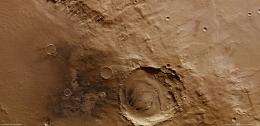
The image is centred on the equator of Mars, at a longitude of about 14°E. The image was taken on 15 July 2010 by the High-Resolution Stereo Camera (HRSC) on ESA’s Mars Express. The spacecraft was completing orbit 8363 of Mars and the ground resolution of the image is about 19 m per pixel. Credits: ESA/DLR/FU Berlin (G. Neukum)

The small crater embedded in the northwestern rim of the Schiaparelli impact basin features prominently in this new image from ESA’s Mars Express. All around is evidence for past water and the great martian winds that periodically blow.
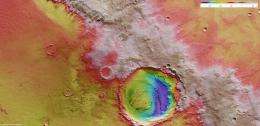
Schiaparelli is a large impact basin about 460 km across, located in the eastern Terra Meridiani region of the planet’s equator. The image shows just a small part of the basin’s northwestern rim cutting diagonally across the image and a smaller, 42 km-diameter, crater embedded in its rim. The image is centred on the equator of Mars, at a longitude of about 14°E. This image was created using a Digital Terrain Model (DTM) obtained from the High-Resolution Stereo Camera on ESA’s Mars Express spacecraft. Elevation data from the DTM are colour-coded: purple indicates the lowest-lying regions, and grey the highest elevations. The scale is in metres. Credits: ESA/DLR/FU Berlin (G. Neukum)

Schiaparelli is a large impact basin about 460 km in diameter located in the eastern Terra Meridiani region of the equator of . The centre of the basin lies at about 3°S/17°E and is named after the Italian astronomer Giovanni Schiaparelli (1835–1910). Although he also studied Mercury and Venus, he is best known for his observations of the Red Planet.

During the ‘Great Opposition’ of 1877, when Mars passed close to Earth, Schiaparelli mapped the planet, perceiving a number of straight dark lines across the red surface. He assumed that these were natural water-filled channels and used the equivalent Italian word, ‘canali’.
However, other astronomers thought he meant canals, meaning artificial irrigation and transportation routes, which led to a few astronomers, and a large number of the general public, believing that they had been created by intelligent Martians.
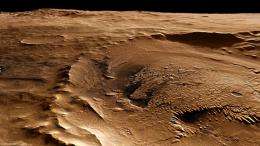
Schiaparelli is a large impact basin about 460 km across, located in the eastern Terra Meridiani region of the planet’s equator. This perspective image from the High-Resolution Stereo Camera on ESA’s Mars Express is focused on a smaller 42 km-diameter crater embedded in its rim. The interior of the crater is filled with sediments. Credits: ESA/DLR/FU Berlin (G. Neukum)

Now we know that Schiaparelli’s ‘canali’ were illusions created by the comparatively poor telescopes of the time and there are no water-filled channels on Mars today. Nevertheless, there is evidence in this new picture that water was once present in this region of the planet, perhaps in the form of a lake.

The scene shows a small part of the northwestern area of the Schiaparelli basin with the crater rim, the crater interior and parts of the surrounding highlands. Evidence for water can be seen in the form of dark sediments that appear on the floor of Schiaparelli, resembling those deposited by evaporated lakes on Earth.
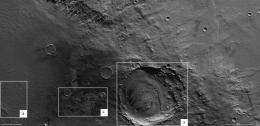
The image is centred on the equator of Mars, at a longitude of about 14°E, and was taken on 15 July 2010 by the High-Resolution Stereo Camera (HRSC) on ESA’s Mars Express. The spacecraft was completing orbit 8363 of Mars. Credits: ESA/DLR/FU Berlin (G. Neukum)

The interior of Schiaparelli has been modified by multiple geological processes, including the fall of ejecta blasted upwards by the initial impact, flows of lava to create the smooth plains, and watery sediments. Box 1 shows part of these sedimentary deposits. Also in the crater floor, smaller impact craters have been partially flooded and filled.

The sediments forming the smooth plains in Box 2 have been modified by erosion, either by wind, water or both to form sharp contours such as the skinny plateau at bottom left. In other places, material has been deposited by the wind to form hills and dunes.

The prominent crater in Box 3 is 42 km across and rests on the inner rim of Schiaparelli. The interior of the smaller crater is filled with sediments that appear to form a terrace in the northern part and a delta-like structure near the centre. The latter seems to be partially composed of rounded light-coloured mounds. Dark wind-borne material has accumulated in the southern portion of the .

Explore further: Slooh Space Camera to broadcast live feed of recent lunar impact site

add to favorites email to friend print save as pdf

Related Stories

'Happy face' crater on Mars

Apr 10, 2006

These images, taken by the High Resolution Stereo Camera (HRSC) on board ESA's Mars Express spacecraft, show the Galle Crater, an impact crater located on the eastern rim of the Argyre Planitia impact basin ...

Layered Crater on Mars

Jul 18, 2007

This image covers an impact crater roughly 4 kilometers (2.5 miles) in diameter. The subimage shows just a small segment of the crater rim (1336 x 889; 3 MB). ...

Volcanic ash in Meridiani Planum

May 12, 2010

Deposits of volcanic ash colour this view of the Meridiani Planum, as seen by the Mars Express High Resolution Stereo Camera. They also give clues to the prevailing wind direction in this region of Mars.

Impact Craters in Tyrrhena Terra

Jul 31, 2007

The High Resolution Stereo Camera (HRSC) on board ESA’s Mars Express obtained images of the Tyrrhena Terra region on Mars.

Hummocky and shallow Maunder crater

Oct 16, 2007

The High Resolution Stereo Camera (HRSC) on ESA’s Mars Express orbiter has obtained pictures of the Noachis Terra region on Mars, in particular, the striking Maunder crater.

Just how low can Mars go?

Oct 08, 2010

There are few places on Mars lower than this. On the left of this image, the floor of Melas Chasma sinks nine kilometres below the surrounding plains. New images from ESA’s Mars Express highlight the ...

Recommended for you

Building a better team—on Mars

15 hours ago

Sometime in the next quarter-century, NASA plans to send the first humans to Mars, a mission that will push the boundaries of teamwork for a handful of astronauts who will spend as long as three years together ...

User comments : 0

More news stories

NASA's BARREL mission launches 20 balloons

(Phys.org) —In Antarctica in January, 2013 – the summer at the South Pole – scientists released 20 balloons, each eight stories tall, into the air to help answer an enduring space weather question: ...

Power of US tornado dwarfs Hiroshima bomb

Wind, humidity and rainfall combined precisely to create Monday's massive killer tornado in Oklahoma. The awesome amount of energy released dwarfed the power of the atomic bomb that leveled Hiroshima.

If you can remember it, you can remember it wrong

(Medical Xpress)—Native peoples in regions where cameras are uncommon sometimes react with caution when their picture is taken. The fear that something must have been stolen from them to create the photo ...

Encouraging signs for bee biodiversity

Declines in the biodiversity of pollinating insects and wild plants have slowed in recent years, according to a new study. Researchers led by the University of Leeds and the Naturalis Biodiversity Centre in the Netherlands ...

B vitamins could delay dementia

(Medical Xpress)—Despite spending billions of dollars on research and development, drug companies have been unable to come up with effective treatments for dementia and Alzheimer's Disease (AD). Now, A. ...