Russia's Soyuz soon to be only lifeline to space
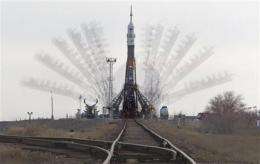
(AP) -- As a Soyuz spacecraft slowly rolls to its launchpad on the icy cold steppes of Kazakhstan, even the most seasoned space fan cannot help but be spellbound by the sight.
With NASA finally retiring the shuttle program next year, the venerable Russian workhorse is now set to become the world's only lifeline to the International Space Station. That predicament is provoking mixed feelings of concern over excess reliance on Russia's space program and enduring admiration for the hardiness of the Soviet-designed Soyuz.
"The vehicle is a rugged 'one trick pony,' no frills or luxuries, and can take any licking and keep on ticking," said James Oberg, a veteran of NASA Space Shuttle Mission Control in Houston.
The next Soyuz mission begins Thursday, when NASA astronaut Catherine Coleman, Russian cosmonaut Dmitry Kondratyev and European Space Agency's Paolo Nespoli of Italy lift off from the Baikonur cosmodrome in southern Kazakhstan.
In a procedure polished over more than four decades of Soyuz launches, the carrier rocket was horizontally rolled out of its hangar on a flatbed train at 7 a.m. local time Monday and carefully carried to the blastoff site in the winter darkness.
In contrast to NASA's distinctive winged shuttle, which is reusable albeit exorbitantly expensive to operate, the Soyuz can only be used once. It is a relatively streamlined craft consisting of a tiny capsule sitting atop powerful booster rockets.
The name, which comes from the Russian word for "union," was both a tribute to its Soviet design and a reference to the Soyuz's ability to dock with other modules. That detail was an absolute must even to begin thinking about long-term space missions or possible travel beyond the Earth's orbit.
Whereas the shuttle's viability has been hamstrung by countless delays, the last time a Soyuz launch was postponed was as far back as 1971.
Yet for all its trustworthiness, the first Soyuz launch in April 1967 ended in tragedy when Col. Vladimir Komarov, the sole cosmonaut onboard, died on re-entry.
Soviet authorities had grown alarmed at U.S. strides in the space race and had pushed for hasty deployment of the Soyuz before the United States could get its Apollo rocket off the ground.
That Soyuz disaster led to an immediate postponement of manned flights and injected a new spirit of caution into the Soviet space program. A minute attention to detail, most evident in Russian space officials' obsession with running operations on a timetable counted in seconds, has earned the Soyuz a well-deserved reputation for safety.
"My biggest dream in life has always been to fly in orbit someday, but I can tell you that I would feel a hell of a lot more at ease in a Soyuz than in a shuttle," space historian Bert Vis said.
Despite such oft-heard endorsements, a clutch of incidents in recent years has aroused concern. Most notably, problems with the Soyuz capsule's service module during a landing in April 2008 caused a perilously steep re-entry trajectory, which placed crushing gravitational pressure on its three-person crew.
Ahead of watching the Soyuz being winched into place at the launchpad Monday, NASA astronaut Peggy Whitson, who traveled onboard that capsule, said the luxuries afforded by the shuttle would indeed be missed.
"The Soyuz is kind of a gentler launch, but I'd much rather land in a shuttle, because it's much more civilized," Whitson said.
Critics also complain that by leaving themselves so heavily reliant on the Soyuz, the United States could fall victim to costly price gouging at the hands of Russian space authorities.
"Moscow already uses it for leverage and has raised the price to NASA repeatedly over the years, to $50 million now," said Brian Harvey, an expert on the history of the Russian space program. "But a shuttle launch costs $550 million a go, so it's still good value."
And while the Russian space program is set to enjoy almost a complete monopoly on ferrying people to space for the next few years, things might change. The successful test launch last week of a privately developed rocket from Cape Canaveral is a clear example of how the market could breed viable space competitors.
"If new, commercially developed space transportation systems in the West leapfrog the tried-and-true Russian booster stable in the next decade, Russia will be left with no significant capability of interest to foreign customers," Oberg said.
The politics and economics of space travel is usually far from astronauts' minds, however, and while in Baikonur, most relish the pleasure of witnessing the ingenuity that goes into assembling the rockets.
"It was Michelangelo that said the sculpture was always inside the rock, I just have to take away the unnecessary pieces. The Soyuz is one of those sculptures," said Canadian astronaut Chris Hadfield, who plans to fly to the International Space Station onboard a Soyuz spacecraft in 2012.
©2010 The Associated Press. All rights reserved. This material may not be published, broadcast, rewritten or redistributed.


