Robots imitate honey bees for aircraft aerobatics
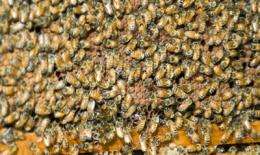
Honey bees have taught researchers how to guide planes through complex manoeuvres
(PhysOrg.com) -- Australian scientists have developed a novel autopilot that guides aircraft through complex aerobatic manoeuvres by watching the horizon like a honey bee.
Allowing aircraft to quickly sense which way is "up" by imitating how honeybees see, engineers and researchers at The Vision Centre, Queensland Brain Institute and the School of Information Technology and Electrical Engineering at The University of Queensland have made it possible for planes to guide themselves through extreme manoeuvres, including the loop, the barrel roll and the Immelmann turn, with speed, deftness and precision.
Current aircraft use gyroscopes to work out their orientation, but they are not always reliable, as the errors accumulate over long distances, said Vision Centre researcher Saul Thurrowgood.
Our system, which takes 1000ths of a second to directly measure the position of the horizon, is much faster at calculating position, and more accurate.
With exact information about the aircraft's surroundings delivered in negligible time, the plane can focus on other tasks.
The group first trained the system to recognise the sky and the ground by feeding hundreds of different landscape images to it and teaching to it compare the blue colour of the sky with red-green colours of the ground.
Simple, low resolution cameras that are similar to a bee's visual system are then attached to the aircraft, allowing the plane to take its own landscape pictures to identify the horizon while flying.
Imagine a plane that has eyes attached to each side at the front the wide-angle camera lenses provide a view of 360 degrees.
Mr Thurrowgood says that the challenge was to figure out the optimal resolution of images that will allow the system to both locate the horizon quickly and not compromise the accuracy of its information.
The measurement process can certainly be quickened we only have to adjust the cameras to take images with a smaller resolution, he says. However, it won't produce the same quality of data, so the key is to find an optimal resolution where you have both speed and quality.
Testing the aircraft in an air field, the unmanned plane was directed to perform three aerobatic movements, the barrel roll, Immelmann turn and a full loop.
We had two pieces of evidence that it worked out first, the plane didn't crash and second, the system's identification of the horizon matched with what we measured ourselves.
Mr Thurrowgood says that the system can potentially be adapted for all types of aircraft including military, sporting and commercial planes.
We have created an autopilot that overcomes the errors generated from gyroscopes by imitating a biological system the honeybees, says Professor Mandyam Srinivasan.
Although we don't fully understand how these insects work, we know that they are good at stabilising themselves while making complicated flight manoeuvres by watching the horizon.
This project required tremendous effort, as separating the sky from the ground visually is not always as easy as we imagine it can be difficult to pick out the horizon, so my hat's off to Mr Thurrowgood for achieving this.
The group is presenting its paper UAV attitude control using the visual horizon today at the Eleventh Australasian Conference on Robotics and Automation. Videos of the test flights are also available from the group.
Provided by
University of Queensland
-
From lemons to lemonade: Reaction uses carbon dioxide to make carbon-based semiconductor,
28 comments
-
Thioridazine kills cancer stem cells in human while avoiding toxic side-effects of conventional cancer treatments,
3 comments
-
SpaceX private rocket blasts off for space station (Update),
41 comments
-
Climate scientists say they have solved riddle of rising sea,
30 comments
-
Scotland passes turbine test to harness tidal power,
40 comments
-
magnets or EMF in car bumpers to protect from fender bender
5 hours ago
-
length of wire in a coil of known dimensions?
21 hours ago
-
India Engineering Powerhouse
May 25, 2012
-
electromagnet core dereference between hard and soft iron
May 25, 2012
-
Measuring water pressure in an open tank
May 24, 2012
-
Question from a non-engineer: Pulley Systems
May 24, 2012
- More from Physics Forums - General Engineering
More news stories
MIT researchers devise new means to synchronize a group of robots (w/ Video)
(Phys.org) -- For several years, roboticists have been working out ways to get a group of robots to perform synchronized activities as demonstrated most often in dance routines. Its not just about trying ...
OmniVision tops up sensors for cameras, phones
(Phys.org) -- OmniVision has announced two high-resolution image sensors for the digital still and digital video camera market (DS/DVC) and higher end smartphones. In end-user language, it is a claim for superior ...
Nvidia says Kai platform will turn price tide for tablets
(Phys.org) -- In March, Nvidia gave some signs that they were working to lower the cost of their Tegra 3 processors and they suggested consumers might see prices for Android tablets as low as $199. Connect ...
Raspberry Pi to add camera later this year
(Phys.org) -- The Raspberry Pi, a uniquely priced, no casing computer that plugs into your TV and a keyboard., will be given a camera accessory later this year. That may be oh-so-what news if this ...
Several iOS developers welcome Apple's larger-screen iPhone
The sixth-generation iPhone is expected to have a larger screen, and several iOS developers say they would receive that change with a warm welcome.
Electronics / Consumer & Gadgets
May 24, 2012 |
1 / 5 (4) |
0
Family history of Alzheimer's affects functional connectivity
(HealthDay) -- Cognitively normal individuals with a family history of late-onset Alzheimer's disease (AD) may display lower resting state functional connectivity in the default mode network (DMN) of the brain, ...
SpotterRF debuts Radar Backpack Kit (w/ Video)
(Phys.org) -- SpotterRF has announced a special radar backpack kit designed to enhance situational awareness for soldiers on the ground. The company says its special radar is designed for warfighters as part ...
Transvaginal mesh op restores pelvic organ prolapse at price
(HealthDay) -- Transvaginal mesh (TVM) procedures are effective for anatomical restoration of pelvic organ prolapse (POP), but patients report a worsening of sexual function following surgery, according to ...
Travel to high altitudes tied to Crohn's, colitis flare-ups
(HealthDay) -- People with inflammatory bowel disease, which includes Crohn's disease and colitis, may be at increased risk for flare-ups when they fly or travel to high altitudes for skiing or mountain climbing, ...
Thousands of shellfish found dead in Peru
Thousands of crustaceans were found dead off the coast of Lima following the mystery mass death of dolphins and pelicans, the Peruvian Navy said Friday.
Astronomers seize last chance in lifetime for Venus Transit
Astronomers are gearing for one the rarest events in the Solar System: an alignment of Earth, Venus and the Sun that will not be seen for another 105 years.
Dec 01, 2010
Rank: not rated yet