Polar bears no longer on 'thin ice': researchers say polar bears could face brighter future
Dec 21, 2010
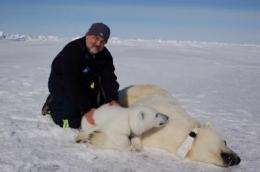
Wildlife biologist Bruce Marcot is placing a radio collar on a cub. Credit: Bruce Marcot, USDA Forest Service

In the snowy spring of 2009, Portland-based Marcot traveled with several colleagues onto the frozen Arctic Ocean north of Alaska to study and survey polar bear populations. These findings may have implications for citizens and natural resource managers in the Pacific Northwest working to manage resources for a warming climate, particularly in high mountain areas.

"When I first picked up the cub, she was biting my hand," explains wildlife biologist Bruce Marcot. He was trying to calm the squirming cub while its sedated mother slept nearby.

In the snowy spring of 2009, Portland-based Marcot traveled with several colleagues onto the frozen Arctic Ocean north of Alaska to study and survey polar bear populations. From their base of operations at the settlements of Deadhorse, next to Prudhoe Bay, Alaska, they ventured by small plane and helicopter over a wide area of the in a study to determine the bears' health and to learn the impact of warming Arctic temperatures on their population.

"From the helicopter, we located radio-collared polar bears by their signals. Then, swooping in like a cowboy after a bull, our lead scientist would dart the bear with a tranquilizer dart," explains Marcot. "We then landed, corralled any cubs, and made the sleeping mother comfortable on the sea ice while we studied her health, weighed her, took measurements, and changed her radio collar so she could be further tracked."

This video is not supported by your browser at this time.
Science team placing radio collars on polar bears. Credit: Bruce Marcot, USDA Forest Service.

Marcot, a scientist at the Forest Service's Pacific Northwest Research Station, is a co-author on the recently published paper about the impact of climate change on polar bears, in the journal Nature. He was invited to be a member of the study team because of his expertise in the analysis and modeling of wildlife population viability. The study's lead scientist, Steven Amstrup, of the U.S. Geological Survey's Alaska Science Center, had asked Marcot several years earlier to join a polar bear science team organized to advise the U.S. Fish and Wildlife Service. That team examined and analyzed global polar bear populations, habitats, and climate change. They presented their results in 2007 before several federal agencies and the U.S. Department of the Interior, in Washington, D.C., and in 2008 the Federal government designated the polar bear as a globally threatened species.

The 2007 study projected that about two-thirds of the roughly 25,000 polar bears in the world would disappear by mid-century because of the effects of climate change and the ice melting in the Arctic. Now, in the December 2010 Nature study, Marcot and his colleagues learned that decline of the bear could be mitigated if greenhouse gas emissions are significantly reduced.

These findings may have implications for citizens and natural resource managers in the Pacific Northwest working to manage resources for a warming climate, particularly in high mountain areas.

For the past several years Marcot has collaborated with the U.S. Geological Survey's Alaska Science Center, the National Park Service, the U.S. Fish and Wildlife Service, and others on studies examining the impacts of climate change on wildlife and the environment.

The most recent study published in Nature, "Greenhouse Gas Mitigation Can Reduce Sea-ice Loss and Increase Polar Bear Persistence," was coauthored by Amstrup; Eric DeWeaver, National Science Foundation; David Douglas, U.S. Geological Survey, Alaska Science Center; Marcot; George Durner, U.S. Geological Survey; Cecilia Bitz, University of Washington; and David Bailey, National Center for Atmospheric Research, issue of Nature. It appears online at www http://www.nature.com/nature/journal/v468/n7326/full/nature09653.html

The study's key findings says Marcot are:

  • The results of modeling regional polar bear populations indicate a potentially brighter future for the species if global greenhouse gas concentrations can be kept under control at levels less than those expected under current conditions.
  • Sea ice habitat for polar bears will likely not face a "tipping point" of sudden catastrophic loss over the 21st century, particularly under a mitigation scenario to reduce global greenhouse gas emissions.
  • Even under relatively stringent mitigation reductions in future greenhouse gas concentration, in two of the four eco-regions, constituting about 2/3 of all current polar bear numbers, will still incur at least reductions in numbers and distribution. However, the best future outcome for these populations would result from a combination of mitigation control of greenhouse gas concentration with best on-the-ground management practices to control hunting and human activities such as levels of shipping, oil and gas activities, etc.
  • There will still be significant uncertainty as to the future of polar bear populations from the combination of all sources of stressors from climate change, direct human disruption, and other biological factors.
The team's study is significant. "It demonstrates for the first time that—and how—a combination of greenhouse gas mitigation and control of adverse human activities in the Arctic can lead to a more promising future for polar bear populations and their sea ice habitat," says Marcot. "It also provides specific predictions of the future, couched in terms of probabilities of polar bear response that decision-makers could use in risk management."

Explore further: Thinking 'big' may not be best approach to saving large-river fish

add to favorites email to friend print save as pdf

Related Stories

Scientists want polar bear protection

Jun 20, 2006

A U.S. climate researcher is leading a team of 30 North American and European scientists in urging the polar bear be listed as a threatened species.

Global Warming Reduces Polar Bear Survival

Nov 15, 2006

Researchers for the first time have shown a connection between global warming and decreased polar bear survival, says a University of Wyoming scientist.

Recommended for you

Wildlife losses now stabilising

13 hours ago

Efforts to conserve biodiversity in the UK, Belgium and Netherlands may be working, despite the widespread perception that wildlife is in terminal decline, a new study suggests.

User comments : 18

Adjust slider to filter visible comments by rank

Display comments: newest first

sfmediacreator
5 / 5 (2) Dec 21, 2010
Great to hear some good news!
samweiss
4 / 5 (8) Dec 21, 2010
It's hardly good news. The kicker, very clearly as spelled out by the research, is that the way to save the Arctic ice (and thus polar bears in their natural habitat) would be for humans to stop driving the climate to be warmer. However, it is also clear (e.g., latest UNFCCC gathering) that the nations of this planet are not really planning on mitigating AGW.

Shootist
2 / 5 (8) Dec 21, 2010
Neither good nor bad news, as it is NOT news.

Once again, "the polar bears will be fine." - Freeman Dyson

I do not advocate burning all the coal and oil to flood the atmosphere with soot and CO2. That smells of an open ended experiment. However, there is little evidence (Freeman Dyson, others) that Climate Change is driven by human activity.

Humanity is too small and the planet too large (Freeman Dyson, Russell Sietz, Jerry Pournelle), for such large effects to be possible. The models used to predict such catastrophe are wrong (Freeman Dyson, Jerry Pournelle, others). One medium sized volcanic eruption (St. Helens, Pinatubo) emits more 'greenhouse' gas than human activity does in a year.
thermodynamics
4.2 / 5 (5) Dec 21, 2010
Shootist: We have gone over this before. All of the volcanoes in the world do not release more than 1% of the CO2 humans produce.

http://volcanoes....mate.php

I have given you that reference before. Are you just not able to read?

Oh, wait. You must be able to read because you read Pournelle. I love his science fiction stories. According to Wikipedia his education is in: experimental statistics and systems engineering, and Ph.D.'s in both psychology and political science. Clearly a climatologist at heart.

Are you just ignoring the fact that volcanoes do not contribute a fraction of the amount of CO2 to the atmosphere people do are are you just lying about it time after time?
MarcoB
2.6 / 5 (5) Dec 22, 2010
Ok, so volcanoes might not produce more co2 than us, but how much co2 do we really produce in comparison to nature?

Figures from Energy Tribune
Total Greenhouse gasses are H2o=93%, CO2=5%, Other=2%
So your absolutely massive 0.04% is a more realistic 0.002% GHG

http://www.glebed.../?p=1008
Raveon
3.9 / 5 (7) Dec 22, 2010
Nature is in balance, that should be obvious even to a climate skeptic. Any CO2 released by nature is offset by the balance. What we release isn't natural and imbalances the system. It's like throwing more weight on one end of a balanced balance scale and expecting it to stay in balance.

And stop expecting climate nuts like shootist to think. If they could think, they wouldn't be skeptics.

In 2005 China equaled us in CO2 emissions. Between us we emitted about 10 billion metric tons that year. And that's just us and just CO2. Measurements of the average percentage of CO2 in the atmosphere are rising steadily. You have to be a complete idiot to not know that we are tipping the balance. Percentages be damned. How much extra weight does it take to make a balance scale tip? (answer for the scientifically challenged: almost nothing)
rgwalther
3.7 / 5 (3) Dec 22, 2010
Solution is still the same. Get rid of most of the people, but not you and me of course!

Merry Christmas.
wiyosaya
3 / 5 (2) Dec 22, 2010
Neither good nor bad news, as it is NOT news.

Once again, "the polar bears will be fine." - Freeman Dyson

I do not advocate burning all the coal and oil to flood the atmosphere with soot and CO2. That smells of an open ended experiment. However, there is little evidence (Freeman Dyson, others) that Climate Change is driven by human activity.

Humanity is too small and the planet too large (Freeman Dyson, Russell Sietz, Jerry Pournelle), for such large effects to be possible. The models used to predict such catastrophe are wrong (Freeman Dyson, Jerry Pournelle, others). One medium sized volcanic eruption (St. Helens, Pinatubo) emits more 'greenhouse' gas than human activity does in a year.

It is easy to pick the words of a respected scientist to support your cause. However, I assert that Dyson forgot one element in his statement. That element is that he was also human, and being human, is subject to making errors.
3432682
3 / 5 (6) Dec 22, 2010
How did the polar bears survive the previous 10,000 years, when it was a few degrees warmer for most of that time? These guys should tell us about the 25,000 bears, not advise that we must mitigate CO2 and thus temperature. BTW, the bears are more numerous than 100 years ago. If we want more bears, we can stop shooting them. How far can and will scientists stretch to get those global warming research billions our governments lay out every year? I want to do some global warming research in Tahiti and Hawaii, and probably Vegas.
Vendicar_Decarian
3.7 / 5 (3) Dec 25, 2010
"However, there is little evidence (Freeman Dyson, others) that Climate Change is driven by human activity." - KooKaMungA

Dyson is very old, mentally feeble, and knows nothing about climate.

Science progresses with ideas from fresh minds, not old feeble ones.
Vendicar_Decarian
4 / 5 (4) Dec 25, 2010
"How did the polar bears survive the previous 10,000 years, when it was a few degrees warmer for most of that time?" - LaTard

The fact that they did, illustrates that it wasn't.

Poor Tard.
Vendicar_Decarian
3.7 / 5 (3) Dec 25, 2010
"Ok, so volcanoes might not produce more co2 than us, but how much co2 do we really produce in comparison to nature? " Tard of Tards

We produce the 9 gigatonn excess that is pouring into the atmosphere every year.

The net flux of Carbon into the atmosphere from nature is measured to be ZERO since the amount entering is offset by the amount leaving.
Vendicar_Decarian
3.7 / 5 (3) Dec 25, 2010
"Get rid of most of the people, but not you and me of course!" - SlushFund

One child per family will reduce the worlds population by half in 2 to 3 generations.

The only party needing mass extermination is the Republican Party.

ryggesogn2
2 / 5 (4) Dec 25, 2010
The only party needing mass extermination is the Republican Party.

Unfortunately for you, intolerant 'progressives' like you are the dying breed.
"Consider what the Vermont Governor Douglas has to say:

Employers cite adequacy of the workforce as one major concern for future success here. We have employers who have created good jobs and want to create more, but they need a qualified workforce to take those jobs.

In the last year the number of people in Vermont’s workforce fell by 2,000. The low birth rate is a component of a much bigger problem. The median age of Vermont’s workforce, at 42.3 years old, is the highest in the nation. In the next twenty years the workforce is expected to shrink annually as those wage-earners reach retirement age. Because surrounding states also have low birth rates the competition for a shrinking pool of workers will become intense."
http://www.ricket...rtility/
ryggesogn2
2 / 5 (4) Dec 25, 2010
Further problems for 'progressives':
"Texas' diversified economy, business-friendly regulations and low taxes have attracted not only immigrants but substantial inflow from the other 49 states. As a result, the 2010 reapportionment gives Texas four additional House seats. In contrast, California gets no new House seats, for the first time since it was admitted to the Union in 1850."
"Florida gains two seats in the reapportionment and New York loses two."
http://www.realcl...332.html
Caliban
3 / 5 (2) Dec 26, 2010
The study's key findings says Marcot are:

The results of modeling regional polar bear populations indicate a potentially brighter future for the species if global greenhouse gas concentrations can be kept under control at levels less than those expected under current conditions.

Sea ice habitat [...]greenhouse gas concentration with best on-the-ground management practices to control hunting and human activities such as lev{..}


The summation of the study seems to be in direct contradiction of the rosy prediction indicated by the title of the article, not to mention the remarks of Marcot himself---one of my favorites from the article:

"From the helicopter, we located radio-collared polar bears by their signals. Then, swooping in like a cowboy after a bull, our lead scientist would dart the bear with a tranquilizer dart," explains Marcot.


Spoken like a true Bush-era industry/political Agency tool.

These conclusions are _at best_ highly suspect.

NameIsNotNick
5 / 5 (1) Dec 27, 2010
How did the polar bears survive the previous 10,000 years, when it was a few degrees warmer for most of that time?

Previous natural warming trends' onset have been slow enough that animals have a much greater opportunity to adapt.
_nobby_abushka
not rated yet Dec 28, 2010
Better find a way to stop the poles from moving, the oceans from recirculating and of course the sun from zapping us if humans want to save Artic/Anartica ice

More news stories

White tiger mystery solved

White tigers today are only seen in zoos, but they belong in nature, say researchers reporting new evidence about what makes those tigers white. Their spectacular white coats are produced by a single change ...

Controlling mood through the motions of mitochondria

(Medical Xpress)—Regulating the distribution of power in neurons is done by a system that makes the national electric grid look simple by comparison. Each neuron has several thousand mitochondria confined ...

A quantum simulator for magnetic materials

Physicists understand perfectly well why a fridge magnet sticks to certain metallic surfaces. But there are more exotic forms of magnetism whose properties remain unclear, despite decades of intense research. ...