Penn astronomer opens new window on the universe's past
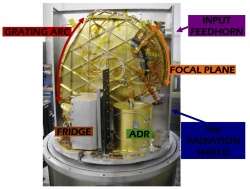
A new instrument designed, built and operated by University of Pennsylvania astronomer James Aguirre, with collaborators at the California Institute of Technology, Jet Propulsion Laboratory and University of Colorado, is helping to open new views on a vital epoch of star formation in the early universe, using a convenient natural phenomenon called gravitational lensing. The instrument is Z-Spec.
Their work, led by Penn post-doctoral fellows Roxana Lupu and Kim Scott, was an essential ingredient in a new result published in Science.
When astronomers peer into deep space, they are also looking back in time. But the view becomes ever dimmer and fainter as distance and time increase, making the study of the ancient universe a major challenge. The light from a distant, dim galaxy can be magnified by a nearer, massive object such as an elliptical galaxy. The closer object acts as a gravitational lens, creating a distorted but much brighter image of the background object.
“If two galaxies are lined up just right along our line of sight, you can see this effect,” Aguirre said.
But although nature has gifted astronomers with this useful tool, it’s not easy to use. Not only does the effect depend on a chance alignment between the foreground and background objects, but gravitational lenses discovered in optical images tend to be outshined by nearer, brighter stars and galaxies.
“They’re not necessarily the brightest thing in an image,” Aguirre said. “Their intrinsic brightness is increased, but they might be quite faint.”
That makes finding gravitational lenses largely a matter of sheer luck, particularly with objects from earlier astronomical epochs with large redshifts, the change in the wavelength of light from a star or galaxy caused by the expansion of the universe. These include an interesting class of distant, prodigiously star-forming galaxies, which tend to be enshrouded in heavy dust that blocks visible light, forcing astronomers to observe them at submillimeter wavelengths in the far-infrared and radio portions of the electromagnetic spectrum.
Using Z-Spec in conjunction with other instruments to analyze data from a wide-area sky survey, Aguirre and a group of international collaborators have demonstrated a new and efficient technique to identify these gravitationally lensed galaxies.
Most of the data were gathered by the Herschel Space Observatory, a space telescope launched in 2009 and dedicated to far-infrared and submillimeter observations. The researchers examined more than 6,600 submillimeter sources cataloged in the ongoing Herschel Astrophysical Terahertz Large Area Survey, or H-ATLAS, ultimately selecting five very bright objects that appeared to be good gravitational lensing candidates.
“The claim is that the brightest things [in the survey images] are all going to be gravitationally lensed,” Aguirre said, “which means they’re all good candidates for studying in great detail because they’re 10 to 20 times brighter by virtue of this and they’ve also been expanded in angular size.”
To confirm the existence of a gravitational lens, astronomers must be able to separate the massive foreground object acting as the lens from the faint background object, demonstrating the alignment necessary to produce the effect.
“That’s where our instrument comes in,” Aguirre said. “We provide the ability to do the third dimension for these dusty galaxies. The foreground galaxy is typically a massive elliptical-type galaxy which has no active star formation, as opposed to the galaxy that we think is halfway back to the big bang, which has a lot of gas and dust in it and a lot of active star formation.”
The Z-Spec instrument, based at the Caltech Submillimeter Observatory in Hawaii, determines the redshift of an object by measuring the spectral shift in carbon monoxide emission lines, a telltale signature of these dusty galactic star factories. The greater the redshift of an object, the farther away it lies, and the older it is. Follow-up observations of the five candidate objects with Z-Spec and another instrument, Zpectrometer at the Green Bank Telescope in West Virginia, demonstrated that the brightness of the objects was due to gravitational lensing.
"We were able to show that in every case, when you look at one of these bright galaxies in the far infrared, there’s a foreground galaxy which is nearby and there is a background galaxy which we were able to detect that’s much further away,” Aguirre said.
This new method of detecting submillimeter galaxies promises to bring our picture of the early universe into ever sharper focus.
“We’ve been able to combine our instrument with these very wide area surveys in the far infrared, both of which are sort of new technological achievements, in order to find very bright galaxies at the peak of cosmic star formation,” he said. “This can really give us a leg up on trying to understand these galaxies.”
The technique will prove even more valuable in the coming decade, as the sensitivity and resolution of submillimeter astronomy are revolutionized by the Herschel telescope and other new instruments such as the ALMA radio telescope array in Chile.
“The Z-Spec instrument is sort of in a unique place right now that of all the groups trying to do this, we’ve sort of been the most productive in terms of generating these redshifts,” Aguirre said.
Provided by University of Pennsylvania


