Odyssey orbiter nears martian longevity record
December 9, 2010

Odyssey orbiter nears martian longevity record

Enlarge

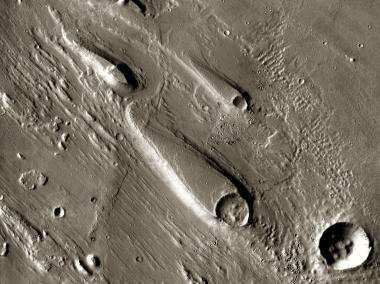
In Ares Vallis, teardrop mesas extend like pennants behind impact craters, where the raised rocky rims diverted the floods and protected the ground from erosion. Image credit: NASA/JPL-Caltech/ASU

(PhysOrg.com) -- By the middle of next week, NASA's Mars Odyssey orbiter will have worked longer at Mars than any other spacecraft in history.

Odyssey entered orbit around on Oct. 24, 2001. On Dec. 15, the 3,340th day since that arrival, it will pass the Martian career longevity record set by its predecessor, Mars Global Surveyor, which operated in orbit from Sept. 11, 1997, to Nov. 2, 2006.

Odyssey made its most famous discovery -- evidence for copious water ice just below the dry surface of Mars -- during its first few months, and it finished its radiation-safety check for future astronauts before the end of its prime mission in 2004. The bonus years of extended missions since then have enabled many accomplishments that would not have been possible otherwise.

"The extra years have allowed us to build up the highest-resolution maps covering virtually the entire planet," said Odyssey Project Scientist Jeffrey Plaut of NASA's Jet Propulsion Laboratory, Pasadena, Calif.

The maps are assemblages of images from the orbiter's (THEMIS) camera, provided and operated by Arizona State University, Tempe. To mark the approach to the Mars longevity record, the camera team and NASA prepared a slide show of remarkable images, posted today at http://www.nasa.gov/mission_pages/odyssey/images/all-stars.html .

The orbiter's longevity has given Odyssey scientists the opportunity to monitor seasonal changes on Mars year-to-year, such as the cycle of carbon-dioxide freezing out of the atmosphere in polar regions during each hemisphere's winter. "It is remarkable how consistent the patterns have been from year to year, and that's a comparison that wouldn't have been possible without our mission extensions," Plaut said.

Odyssey's performance has boosted benefits from other missions, too. When NASA's Mars Exploration Rovers, Spirit and Opportunity, far exceeded their own expected lifetimes, Odyssey remained available as the rover's primary communication relay. Nearly all the science data from the rovers and NASA's Phoenix Mars Lander has reached Earth via Odyssey relay. Odyssey also became the middle segment of continuous observation of Martian weather by a series of NASA orbiters: Mars Global Surveyor, Odyssey, and NASA's Mars Reconnaissance Orbiter, which began its science mission in late 2006.

A continuing partnership between JPL and Lockheed Martin Space Systems, Denver, operates Odyssey.

"Hundreds of people who built the Odyssey spacecraft here, in addition to the much smaller crew operating it today, have great pride in seeing the spacecraft achieve this milestone," said Bob Berry, Odyssey program manager at Lockheed Martin Space Systems Company.

Odyssey's science triumphs began in early 2002 with detection of hydrogen just below the surface throughout the planet's high-latitude regions. Deduction that the hydrogen is in frozen water prompted the Phoenix mission, which confirmed that fact in 2008.

Investigators at the University of Arizona, Tucson, have headed the operation of Odyssey's Gamma Ray Spectrometer suite of instruments, which detected the hydrogen and subsequently mapped the distribution of several other elements on Mars. Additional science partners are located at the Russian Aviation and Space Agency, which provided the suite's high-energy neutron detector, and at Los Alamos National Laboratories, New Mexico, which provided the neutron spectrometer.

The mission's science goal of checking radiation levels around Mars to aid planning of future human missions was completed by the Mars Radiation Environment Experiment, developed at NASA Johnson Space Center, Houston.

NASA has planned future work for Odyssey, in addition to having the orbiter continue its own science and its relay service for the Mars Exploration Rover mission. If required, controllers will adjust Odyssey's orbit so the spacecraft is in a favorable position for a communication relay role during the August 2012 landing of NASA's next Mars rover, Curiosity.

Mars Odyssey, launched April 7, 2001, is managed by JPL, a division of the California Institute of Technology in Pasadena, for NASA's Science Mission Directorate, Washington.

More information: http://mars.jpl.na … .gov/odyssey

Provided by JPL/NASA search and more info website

Filter


Move the slider to adjust rank threshold, so that you can hide some of the comments.


Display comments: newest first

rgwalther
Dec 09, 2010

Rank: 5 / 5 (1)
Sand Worms!!!!
Santabug
Dec 09, 2010

Rank: 5 / 5 (1)
The Spice!
jwalkeriii
Dec 09, 2010

Rank: not rated yet
10 years of mapping and not a single martian city found. Not fair at all.
resinoth
Dec 10, 2010

Rank: not rated yet
the important part of the article:

http://www.nasa.g...ars.html

anybody see the double shadow on the Chasmas Boreal picture (front hill)? What do you think of that?
Rdavid
Dec 10, 2010

Rank: not rated yet
Remnants of the Climate Orbiter?
mrcircumspect
Dec 10, 2010

Rank: not rated yet
resinoth: The article associated with the shot you point us to says the image was a series captured over a period of time. I would imagine that as the seasons changed so would the shadows -- so that even with computer enhanced graphics they couldn't get it perfect without skewing the visual data. Still, my explanation now seems weak as the 2nd shadow parallels the primary shadow so perfectly ...
Rank 5 /5 (1 vote)
Relevant PhysicsForums posts
  • revamping general concept and cosmological principle
    created20 hours ago
  • Transiting Exoplanet Light Curve
    createdMay 25, 2012
  • Math behind Theoretical Physics
    createdMay 24, 2012
  • Do we know whats at the center of galaxies yet?
    createdMay 23, 2012
  • Structure of the Milky Way?
    createdMay 20, 2012
  • What would it take to terraform Pluto and Charon?
    createdMay 19, 2012
  • More from Physics Forums - General Astronomy

More news stories

Astronomers seize last chance in lifetime for Venus Transit

Astronomers are gearing for one the rarest events in the Solar System: an alignment of Earth, Venus and the Sun that will not be seen for another 105 years.

Space & Earth / Astronomy

created 1 hour ago | popularity 5 / 5 (1) | comments 0

Australia hails surprise super-telescope decision

Australia has hailed a surprise decision giving it a role in a radio telescope project aimed at revolutionising astronomy, vowing to draw on its decades of experience in space science.

Space & Earth / Astronomy

created 1 hour ago | popularity not rated yet | comments 0

SpaceX capsule has 'new car' smell, astronauts say

SpaceX's Dragon cargo vessel smells like a new car, said astronauts at the International Space Station after opening the hatches Saturday following the spacecraft's landmark mission to the orbiting lab.

Space & Earth / Space Exploration

created 1 hour ago | popularity not rated yet | comments 0

Astronauts enter world's 1st private supply ship

(AP) -- Space station astronauts floated into the Dragon on Saturday, a day after its heralded arrival as the world's first commercial supply ship.

Space & Earth / Space Exploration

created 1 hour ago | popularity 5 / 5 (2) | comments 0

Dragon arrives at space station in historic 1st (Update 2)

The privately bankrolled Dragon capsule made a historic arrival at the International Space Station on Friday, triumphantly captured by astronauts wielding a giant robot arm.

Space & Earth / Space Exploration

created 23 hours ago | popularity 5 / 5 (8) | comments 16


Transvaginal mesh op restores pelvic organ prolapse at price

(HealthDay) -- Transvaginal mesh (TVM) procedures are effective for anatomical restoration of pelvic organ prolapse (POP), but patients report a worsening of sexual function following surgery, according to ...

Family history of Alzheimer's affects functional connectivity

(HealthDay) -- Cognitively normal individuals with a family history of late-onset Alzheimer's disease (AD) may display lower resting state functional connectivity in the default mode network (DMN) of the brain, ...

SpotterRF debuts Radar Backpack Kit (w/ Video)

(Phys.org) -- SpotterRF has announced a special radar backpack kit designed to enhance situational awareness for soldiers on the ground. The company says its special radar is designed for warfighters as part ...

Travel to high altitudes tied to Crohn's, colitis flare-ups

(HealthDay) -- People with inflammatory bowel disease, which includes Crohn's disease and colitis, may be at increased risk for flare-ups when they fly or travel to high altitudes for skiing or mountain climbing, ...

Thousands of shellfish found dead in Peru

Thousands of crustaceans were found dead off the coast of Lima following the mystery mass death of dolphins and pelicans, the Peruvian Navy said Friday.

Oldest Jewish archaeological evidence on the Iberian Peninsula

German archaeologists of the Friedrich Schiller University Jena found one of the oldest archaeological evidence so far of Jewish Culture on the Iberian Peninsula at an excavation site in the south of Portugal, ...