Nissan hopes zero-emission Leaf will electrify drivers
December 2, 2010 by Hiroshi Hiyama
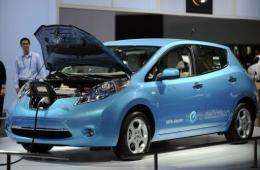
The Nissan Leaf electric car during a press preview at the LA Auto Show in Los Angeles, California in November 2010. Billed as the world's first mass-production electric car, the Nissan Leaf due to be launched this month is expected to send a jolt through an auto industry racing to build greener vehicles.
Billed as the world's first mass-produced electric car, this month's launch of the Nissan Leaf is expected to send a jolt through an auto industry racing to build greener vehicles.
The Leaf -- short for Leading Environmentally-friendly Affordable Family car -- has enjoyed a crescendo of industry buzz, last month becoming the first electric vehicle to win European Car of the Year.
The fulcrum of Nissan's green ambitions, the mid-sized five-seat hatchback is already a sell-out in Japan and the United States on pre-orders and is set to launch in Europe early next year.
Nissan is expected to announce the date of its Japan launch on Friday, with all eyes on whether the automaker's big bet will herald the readiness of electric vehicles to hog the middle of the road.
"The Leaf will serve as a standard, a benchmark, for other manufacturers when they build new electric vehicles," said Mamoru Kato, auto analyst at Tokai Tokyo Research Center.
Emitting none of the tailpipe pollutants that have covered skies over cities from Los Angeles to Mumbai in smog, the all-electric Leaf is touted as an evolutionary step from petrol-electric hybrids made by the likes of Toyota.
It and other electric vehicles' carbon footprint is instead determined by the way its battery is charged -- meaning it can effectively be powered by anything from fossil fuel or nuclear plants to hydro, wind or solar energy.
Despite the development of electric cars being constrained by issues over whether sufficiently large networks of re-charging stations exist worldwide, the Leaf has caught the imagination.
The first US shipment has sold out, Nissan said, with the company having received 20,000 orders and separately at least 6,000 more orders in Japan.
Nissan, controlled by French partner Renault, started mass production of the Leaf in October in Japan and plans to expand production in North America in 2012 and in Europe in 2013.
"This is a significant milestone, not only for Nissan and the Renault-Nissan alliance, but also for the entire automotive industry," Nissan President Carlos Ghosn said at an October ceremony marking the start of production.
The Leaf can top 145 kilometres (90 miles) per hour and can manage 175 kilometres on a single eight-hours charge. For those in a hurry, it can be rapid-charged to 80 percent of capacity in 30 minutes.
By 2020, Nissan predicts, electric cars will account for 10 percent of the global auto market.
American research firm J.D. Power and Associates estimates combined global sales of hybrid and electric vehicles to total 5.2 million units in 2020, 7.3 percent of the global auto market.
But it also warns the current demand for hybrid and electric vehicles is "over-hyped", adding that the firm did not expect "a mass migration to green vehicles in the coming decade".
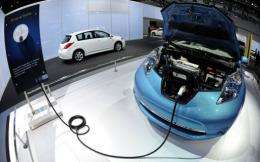
The Nissan Leaf electric vehicle during a press day at the LA Auto Show in Los Angeles, California in November 2010. Nissan is expected to announce the date of its Japan launch on Friday, with all eyes on whether the automaker's big bet will herald the readiness of electric vehicles to hog the middle of the road.
But the concept of a car that can be charged like a cellphone by plugging it into a wall socket, preferably during overnight off-peak hours, is appealing in the face of volatile petrol prices.Nissan estimates the cost of a battery charge for the Leaf to be only 13 percent of gasoline cost for conventional autos.
Despite a price tag of 3.76 million yen (44,700 dollars) in Japan, likely tax breaks and other incentives for green vehicles are expected to reduce that price, analysts say.
The Leaf is not the first electric vehicle to hit Japanese streets, and will face challenges from rivals such as Mitsubishi Motors' "i-MiEV" minicar.
Toyota, which has for more than a decade sold petrol-electric hybrids such as the Prius, aims to launch its own electric car by 2012 but has put its immediate focus on new hybrid models.
Honda's hybrid Fit went on sale in Japan in October as the cheapest petrol-electric car available in the nation at 1.59 million yen.
Last month US giant GM unveiled the battery-powered Chevrolet Volt combining electric power with a gasoline-powered engine/generator.
But the Leaf's advantage, say analysts, lies in its roomy comfort in addition to the silent and powerful performance that has won it rave reviews.
Last month it became the first electric vehicle to receive the 2011 European Car of the Year award, speeding ahead of rival nominees Alfa Romeo Giulietta and Opel/Vauxhall Meriva.
"In spite of the lack of a large recharging network and the limited range, the Leaf represents a technical and commercial bet that might otherwise satisfy many potential consumers, especially where public incentives will come to reduce the paying price," the award jury said in a statement.
(c) 2010 AFP
-
From lemons to lemonade: Reaction uses carbon dioxide to make carbon-based semiconductor,
28 comments
-
Thioridazine kills cancer stem cells in human while avoiding toxic side-effects of conventional cancer treatments,
3 comments
-
SpaceX private rocket blasts off for space station (Update),
41 comments
-
Climate scientists say they have solved riddle of rising sea,
30 comments
-
Scotland passes turbine test to harness tidal power,
40 comments
-
magnets or EMF in car bumpers to protect from fender bender
4 hours ago
-
length of wire in a coil of known dimensions?
20 hours ago
-
India Engineering Powerhouse
May 25, 2012
-
electromagnet core dereference between hard and soft iron
May 25, 2012
-
Measuring water pressure in an open tank
May 24, 2012
-
Question from a non-engineer: Pulley Systems
May 24, 2012
- More from Physics Forums - General Engineering
More news stories
SpotterRF debuts Radar Backpack Kit (w/ Video)
(Phys.org) -- SpotterRF has announced a special radar backpack kit designed to enhance situational awareness for soldiers on the ground. The company says its special radar is designed for warfighters as part ...
Apple CEO Cook gives up $75M in stock dividends
(AP) -- Apple CEO Tim Cook is giving up $75 million in dividends on restricted stock that the company is awarding to all of its employees.
21 hours ago |
1.8 / 5 (4) |
2
Yahoo kills 'Livestand' just 6 months after debut
(AP) -- Yahoo is killing a tablet magazine called Livestand just six months its debut on the iPad.
16 hours ago |
not rated yet |
1
Yahoo! ditches digital newsstand for iPads
Yahoo! shuttered its fledgling digital newsstand for iPads on Friday in what it said was the start of a product purge intended to make the floundering Internet pioneer more nimble.
17 hours ago |
not rated yet |
0
Facebook IPO debacle raises investor dander
The spate of complaints and investigations over the Facebook stock offering suggests big institutions had an edge over small investors, raising questions about the process.
18 hours ago |
not rated yet |
0
Transvaginal mesh op restores pelvic organ prolapse at price
(HealthDay) -- Transvaginal mesh (TVM) procedures are effective for anatomical restoration of pelvic organ prolapse (POP), but patients report a worsening of sexual function following surgery, according to ...
Family history of Alzheimer's affects functional connectivity
(HealthDay) -- Cognitively normal individuals with a family history of late-onset Alzheimer's disease (AD) may display lower resting state functional connectivity in the default mode network (DMN) of the brain, ...
Travel to high altitudes tied to Crohn's, colitis flare-ups
(HealthDay) -- People with inflammatory bowel disease, which includes Crohn's disease and colitis, may be at increased risk for flare-ups when they fly or travel to high altitudes for skiing or mountain climbing, ...
Thousands of shellfish found dead in Peru
Thousands of crustaceans were found dead off the coast of Lima following the mystery mass death of dolphins and pelicans, the Peruvian Navy said Friday.
Astronomers seize last chance in lifetime for Venus Transit
Astronomers are gearing for one the rarest events in the Solar System: an alignment of Earth, Venus and the Sun that will not be seen for another 105 years.
Australia hails surprise super-telescope decision
Australia has hailed a surprise decision giving it a role in a radio telescope project aimed at revolutionising astronomy, vowing to draw on its decades of experience in space science.

Dec 02, 2010
Rank: 2.7 / 5 (3)
No, it won't.
The Leaf's battery is only 24 kWh of which only 80% is usable to account for the fact that the battery ages faster if your Depth of Discharge is 100%.
With 19.2 kWh on the tap, you are lucky to reach 100 kilometers, and if your car is as aerodynamically efficient as a Lotus Elise (or Tesla Roadster), it will go 76.8 miles or 123 kilometers at 250 Wh/mi. That's a far cry from 175 km.
Even with the full 24 kWh available to use, which would rapidly ruin the battery if done repeatedly, it would reach 154 km on average.
Stop lying to the public.
Dec 02, 2010
Rank: 2.7 / 5 (3)
24 kWh is barely enough to visit the next small town and come back, and you might have to recharge half way if the weather is bad. In larger cities, you might not even be able to get out of the city before you have to turn back.
So then, taking these bigger batteries of 50+ kWh, you see that quick charging them starts to consume ridiculous amounts of power. To do it in 30 minutes you need more than 100 kW of power from the station. How are you going to wire that up safely? Every time you halve the charging time, you double the power. Pretty soon you need a dedicated power plant next to the charging station if there's more than 1-2 customers at a time.
And you can't fill your battery at home in a single night anymore. A 16 Amp 230 volt outlet gives you about 24 kWh in 8 hours.
Dec 02, 2010
Rank: 2.7 / 5 (3)
People tend to use their cars at the same time, and plug their cars in at the same time. At 6-8 in the morning, they unplug and drive to work, and at 15-17 they drive home and plug in.
And that means a massive surge in demand given that each car is allowed to draw several kilowatts of power, and there's hundreds of thousands of cars, even millions at some point. Even on a regular 16 Amp circuit, it's the same as putting three kettles to boil.
So you have to regulate when people are Allowed to charge their cars and how much, so you don't bring the local grid down every day after work. I don't think that's a very good selling point for a car - charge when your government gives you the permission.
Dec 02, 2010
Rank: 4.2 / 5 (6)
When you park your car, you charge it up. Theres no need to give it a huge battery if you can just charge it along the way.
Dec 02, 2010
Rank: 2.7 / 5 (3)
Take the fact that batteries can't be recharged instantly. That means the swapping station has to have as many batteries in stock as they expect customers arriving in whatever time it takes to recharge an empty battery.
So, 1 hour to charge, 20 customers per peak hour, 20 batteries required. Multiply that by the number of swapping stations required, and you got much more batteries than you have cars on the roads, and one battery in each car, and every single one of those batteries is going to cost ten grand or more.
Having more batteries per car means that it is no longer economical to drive electric, even if the electricity itself cost nothing, because the batteries themselves don't last forever and they have to be scrapped much earlier due to liability issues. Batteries are not like propane bottles that hold the same amount of gas regardless of age.
Dec 02, 2010
Rank: 2.3 / 5 (3)
Frequently. It's only half an hour drive to go 50 km one way.
And seeing how you can't get much more than 15 km worth of charge per hour from an ordinary socket, I would have to stop for at least an hour for every 8 kilometers beyond 50km that I travel in one go to still be able to get back, even if I'm just dropping a friend to the airport or saying hello to granny.
Dec 02, 2010
Rank: 2.3 / 5 (3)
Take a 8-9 year old Japanese car, costs you about €2000, doesn't consume much fuel and doesn't require much maintenance. Cheap to drive, cheap to own, and you can save money by not driving very much.
Take a 5-6 year old electric car. The battery is bust, the car is practically worthless and extremely cheap, but you have to buy a €9000 battery for it, and that's already half the current market price, and it doesn't get cheaper than that for decades to come.
Second hand sales of electric cars will not exist because of that, and as a consequence, the cars will not be made to last beyond the first owner. Why use rust proof paint, when the car will be squeezed into a cube by the time rust would become a problem?
Dec 02, 2010
Rank: 2 / 5 (2)
Dec 02, 2010
Rank: 4.8 / 5 (5)
Dec 02, 2010
Rank: 2 / 5 (2)
Dec 02, 2010
Rank: 1.7 / 5 (3)
That speaks volumes about your intellect. Most of his points are actually mute.
Dec 02, 2010
Rank: 3 / 5 (4)
You mean moot? Fine, let's discuss about it then: how do you propose pushing 50 kWh into a battery safely and reliably, in 10-15 minutes?
That's right, electric cars are great for the middle class who can afford to have a daddy's car, a mommy's car and a third car for the junior so he wouldn't drain the batteries on mommy's car by blasting the stereos. Daddy drives diesel, mommy goes to work on a G-Wiz.
For everybody else except the well-off, a single car often has to do both the long and the short distance service.
Dec 02, 2010
Rank: 3 / 5 (2)
Dec 02, 2010
Rank: 2.5 / 5 (2)
Dec 02, 2010
Rank: 3.5 / 5 (2)
Are you insane?
You might as well run your car on AA cells for that matter. Have you any idea how much that number of batteries would cost, and how it would be reflected in the price of driving?
The whole problem is that the stockpiles of batteries grows too huge to be economical. Let's take the UK for example. There's 11000 filling statios, and each of them would need as many batteries as they can expect to serve in a single day. Undoubtedly there would have to be even more of them, since the electric car would need service more often than the regular car.
That's millions of batteries on top of the existing millions of batteries already in the cars, and on top of the millions of batteries that are being charged in the mean while, and each costs thousands of pounds.
Who's gonna pay that?
Dec 02, 2010
Rank: 1 / 5 (1)
Which means that you're paying the price of three batteries to drive the kilometers of one battery, when the price of even one battery is a huge problem because they're way too expensive.
Dec 02, 2010
Rank: 1 / 5 (1)
Dealers and advertising media have good reason to be threatened by factory-direct sales, since their blood is in the water, and the constant drone of this middle man was eliminated by Nissan.
Further, electrical utilities generate revenue from increased demand, and are more than willing to increase infrastructure before their competitors can.
Dec 02, 2010
Rank: not rated yet
When larger batteries need to be engineered, chargers can use any combination of boost transformer & parallel-charging cells. 38.4kWh with #2/0cu feeders to garage sub panels are common in North America, under NFPA 70, 310.15(B)(6).
These 200A residential upgrades are bidding near U$D1200 in the Los Angeles basin, and that was subsidized by anyone who purchased a plug-in this year. Toss in car pool access for single drivers and buyers commute time is halved.
Dec 02, 2010
Rank: not rated yet
No dealership lobby or gas-guzzling, big-oil campaign has stopped innovation from shifting the transportation sector away from petrol, and every energy company is scrambling for a piece of the action.
Dec 02, 2010
Rank: 1 / 5 (1)
Dec 03, 2010
Rank: not rated yet
----------------------------------------------------
Take a 5-6 year old electric car. The battery is bust, the car is practically worthless and extremely cheap, but you have to buy a €9000 battery for it, and that's already half the current market price, and it doesn't get cheaper than that for decades to come.
----------------------------------------------------
In a word, no. My 8 year old Prius has never had a battery replacement, still reaches a full charge and I run it over mountainous roads in New England through harsh winters. Your assumptions re: battery life are based on old data. New technology has allowed greater battery life as well as extended travel distance. I've experienced it, both in a hybrid (my own) as well as in all-electric conversions. Be wary of your source material, there are many in the petroleum industry who do not relish the success of the electric vehicle.
Dec 03, 2010
Rank: not rated yet
Take a 5-6 year old electric car. The battery is bust, the car is practically worthless and extremely cheap, but you have to buy a €9000 battery for it, and that's already half the current market price, and it doesn't get cheaper than that for decades to come.
----------------------------------------------------
In a word, no. My 8 year old Prius has never had a battery replacement, still reaches a full charge and I run it over mountainous roads in New England through harsh winters. Your assumptions re: battery life are based on old data. New technology has allowed greater battery life as well as extended travel distance. I've experienced it, both in a hybrid (my own) as well as in all-electric conversions. Be wary of your source material, there are many in the petroleum industry who do not relish the success of the electric vehicle.
Dec 04, 2010
Rank: 5 / 5 (1)
That's because your Prius has a NiMH battery instead of a lithium battery. It's nice for a hybrid, but the energy density isn't nearly enough for a full electric vehicle.
NiMH or NiCD, or NiFE are pretty bombproof as battery chemistries go, but they simply weigh too much.
The Chevrolet Volt has a 16 kWh lithium battery, and the only reason they can assure that it lasts 10 years is because they're actually using only 8 kWh before the gasoline engine turns on. That puts very little wear on the battery, and even though it does lose capacity steadily, it won't show up.
Dec 04, 2010
Rank: 5 / 5 (1)
Electric utilities like increased demand, but only if it is steady demand. Ramping power up and down costs them money and decreases the production efficiency, and wears down the machinery.
Giving a large amount of ordinary households 200 Amp outlets is a guarantee that when the people do plug in at the same time, the resulting demand peak will be absolutely devastating. The system doesn't scale up as far as the infrastructure goes.
If each charger can draw 20 kW, then you only need 50 cars at the same time and you have to turn on an entire power station, and that's going to be a diesel or gas powered peaking plant because nobody else can do it quick enough. 50 000 cars charging together would equal an entire nuclear power plant's output, and there's more than 25 million cars on the roads in the UK.
Dec 04, 2010
Rank: 5 / 5 (1)
An ordinary wall socket with a 10 Amp fuse will give you about 2 Kilowatts to be on the safe side, or 2000 times less energy per second.
That's the scale of the problem we're dealing with here. The grid systems around the world simply aren't built to deal with the sort of surges in demand that the electric car will make if we even try to approach the same level of usability as with the internal combustion engine.
Any attempt to solve the power problem will lead us to intermediate accumulators for energy, which will in turn blow up the cost of the whole thing and lead to more inefficiencies due to various back and forth conversions of energy.
The other solution is heavy regulation and iron fist control over where and when you are allowed to charge and how much.
Dec 05, 2010
Rank: not rated yet
Okay,granted that the utilities would be swamped by millions of electrics charging at once.
However,you have to factor in the fact that adoption of electrics will be a gradual process.As they become more common,I predict there would be a movement towards decentralized power generation.Individual homes would have,in place of the current furnace in the cellar,a natural gas powered co-generation unit providing power and heat.These systems are only a year or two away from availability.See:
http://www.cogenm...lect=162
http://www.whispe...in/HOME/
http://www.engadg...e-video/
Dec 05, 2010
Rank: not rated yet
If you're going to run the car on natural gas anyways, why on earth would you want the expensive and wasteful battery system in between? Just build a cheap hybrid car that runs on the same gas that is piped to your house. You'll solve the range and recharge time problem at the same time.
Cogeneration of heat is a red herring, because to produce 25 kWh of electricity for driving, you will produce 50 kWh of heat, which is the same as running a 2 kW space heater all day long non-stop. Pretty soon your house will be too hot and you'll have to waste the extra heat by venting it out.
And in the meanwhile, your electric car will need a small diesel burner to keep the windows clear in the winter, because using battery power for heating cuts 20% off of your already limited range.
Dec 05, 2010
Rank: not rated yet
E.g. Heating your hot water tank from 55C to 95C, assuming you have a 200 litre tank, would take about 9.3 kWh or less than 1/5 of the waste heat you're putting out. And that's assuming you start at minimum regulation temperature in the boiler and end just before it boils. Better take extra long showers or you'll have no place to put your cogenerated heat.
It also kinda clashes with the idea of low energy housing that are supposed to be so well insulated that they can be kept warm by the inhabitants body heat and the waste heat from electronics alone.
Dec 05, 2010
Rank: not rated yet
Personally,I would prefer a car like the Volt,which would have an all electric range sufficient for my daily driving,and an extended range for cross country trips.For those interested in a pure electric vehicle,home generated power via co-generation,or natural gas/biogas powered fuel cells (see my link to the Bloom Box) would relieve the utilities of the burden of charging millions of electric cars,and eventually make them obsolete.
Dec 05, 2010
Rank: not rated yet
Dec 05, 2010
Rank: not rated yet
So, to get your car to travel 100 km you still have to produce somewhere around 40 kWh of extra heat that you have no need for, and can only waste.
That means your co-generation plant would not be 90% efficient while charging your car, but just about 33%, and your charger converters eat up another 15% of that, which means your total efficiency is about 28%. That figure is only lowered still if you include a second set of intermediate batteries for a quick charge buffer.
28% is on par with ordinary non-hybrid cars. A fuel cell hybrid car can reach 50% efficiency.
There's no problem per se in decentralized power production. It just doesn't solve the issues of electric cars.
Dec 05, 2010
Rank: not rated yet
That means, the car that runs directly on the natural gas fuel will be more efficient than the electric car that runs indirectly off of the same energy source.
So if you already have a gas pipe to your home, it makes absolutely no sense to have an electric car instead of a car that runs on the gas. Especially when any alternative to batteries will have superior qualities such as quicker re-fueling, more range, cheaper price, less weight, heat in winter etc.
Dec 05, 2010
Rank: not rated yet
Fuel cells still make waste heat. Only the proporton changes to 50/50 instead of 33/66, and you still don't need the waste heat that they generate because you already have more than enough left over from just running your lights, TV and your washing machine.
Additionally, the in-house generator would need to be much bigger to cater for an electric car, which would make it more expensive than a smaller unit designed to generate the average 3.3 kW of electricity + heat that the average household needs.
Summa summarum: while decentralized power could solve the problem of the grid not handling the number of electric cars, it would also make the electric car obsolete and pointless because everybody would have some form of usable fuel other than electricity at their disposal.
Dec 05, 2010
Rank: not rated yet
This device operates on any heat source,including heat from engine exhaust.Coupled with the basic co-generator we have been discussing,the result should be the recovery of a significant amount of the waste heat generated.Oh course,one is probably looking at a much more expensive system!
Dec 06, 2010
Rank: not rated yet
Less so for small scale engines. BMW's experiments in heat recovery from a car engine yielded about 14% reduction in fuel consumption, if I remember correctly. That amounts to going from 28% to 33% in absolute efficiency.
Solid oxide fuel cells would benefit greatly from heat recovery, since they operate at high temperatures which makes the recovery mechanism small and economical, but they also need some of the heat for reforming fuels other than hydrogen, and the exhaust is cooled by that process.
Dec 06, 2010
Rank: not rated yet
Dec 08, 2010
Rank: not rated yet