NASA finds more cracks on Discovery fuel tank
December 31, 2010

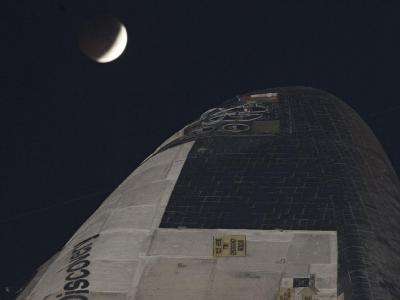
Discovery and the Lunar Eclipse

Enlarge

Image Credit: NASA/Kim Shiflett

NASA said Thursday it has found four more small cracks on the metal supports of the shuttle Discovery's external fuel tank, as the aging shuttle undergoes X-ray testing before its final space mission next year.

Repairs would be made to the cracks in a similar fashion to the cracks discovered after the November 5 launch attempt, the National Aeronautics and Space Administration said in a statement.

The space agency said it was still too early to determine if the new cracks will delay the Discovery's February launch with six astronauts to the orbiting .

Repairs of the newly discovered will take an estimated two to three days, NASA said.

"Any further work will be evaluated thoroughly early next week after additional data is reviewed," it added.

The Discovery has been plagued with setbacks since its initial launch attempt last month. It was moved from its launch pad at the Kennedy Space Center in Florida to the Vehicle Assembly Building on December 22 for evaluation and repairs.

Engineers are trying to figure out why a pair of "stringers" -- 21-foot-long (6.5 meter) U-shaped aluminum brackets -- cracked during the countdown for the shuttle's last voyage into space.

Discovery's final mission has been delayed until a launch window from February 3-10. If the launch cannot occur at that time another window will open from February 27 to March 3.

"The next available launch date is Thursday, February 3 at the opening of a window that extends through February 10," said Thursday.

The current preferred launch time on February 3 is 1:37 am (0637 GMT), the agency added.

Another shuttle, Endeavour, is set to take off in April in what will be the last official shuttle launch scheduled for the US program.

A third shuttle launch could take place in the summer before the entire fleet is retired for good.

(c) 2010 AFP

Filter


Move the slider to adjust rank threshold, so that you can hide some of the comments.


Display comments: newest first

Quantum_Conundrum
Dec 31, 2010

Rank: 1 / 5 (3)
How about retire the thing right now, instead of risking 6 more people's lives for no good reason?

Our government and space program needs to seriously evaluate what our goals are supposed to be for manned spaceflight.

I don't like the supposed planning of a manned mission to an asteroid, because there is absolutely no reason to go to an asteroid other than to establish a long term mining operation to construct a space refinery. Since it doesn't look like our government is anywhere near doing that, it's pointless to go.

In 15 years or so, the computer technology and nanotechnologies will be so much better than now, which may give rise to improvements in energy, materials, manufactuing, and recycling techniques we can't imagine now. It would be a shame to spend hundreds of billions, even trillions, on existing technologies for a large manned mission, when a few decades from now technologies will be so much better.
HaveYouConsidered
Dec 31, 2010

Rank: 3.7 / 5 (3)
Manned missions are more about national pride than rationality or scientific yield. Our space investment would go 10x further if we focus on unmanned robotic/AI mission platforms vs. manned missions, which at this point seem "so last century." Such R&D emphasis would yield better payoffs for industry and society also vs. yet another flying tin can with humans inside, trying not to hate each other during a long-term mission.
Recovering_Human
Dec 31, 2010

Rank: not rated yet
Manned missions are more about national pride than rationality or scientific yield. Our space investment would go 10x further if we focus on unmanned robotic/AI mission platforms vs. manned missions, which at this point seem "so last century." Such R&D emphasis would yield better payoffs for industry and society also vs. yet another flying tin can with humans inside, trying not to hate each other during a long-term mission.


Absolutely true, especially given how far robotics has advanced and will advance in the coming years.
Shootist
Jan 01, 2011

Rank: not rated yet
NASA costs a couple of Billion a year, whether Shuttle launches or not.

Give Near Earth Orbit to the USAF and Space to the Navy. We really need a Space Navy (apologies to the crew of the George Hammond).
TheSpiceIsLife
Jan 02, 2011

Rank: not rated yet
There is no way I would get in one of those shuttles.
Quantum_Conundrum
Jan 02, 2011

Rank: 1 / 5 (1)
We really need a Space Navy (apologies to the crew of the George Hammond).


Well, it wouldn't hurt to put a few nuclear powered COIL lasers, or else solar powered w/ charged capacitors, in geosynchronous orbit off the east and westen coast of the U.S. We put a few right over the top of Iran and N. Korea too. They launch a missile,w e shoot it down immediately. We could fry their aircraft and other units too if needed.

In combination with our aircraft and ship mounted lasers and conventional AA systems, along with our recently invented and now deployable rail guns, this would give any sane dictator quite a bit of pause before they should try to launch any attack against us or our allies.
Rank 5 /5 (5 votes)
Relevant PhysicsForums posts
  • revamping general concept and cosmological principle
    created20 hours ago
  • Transiting Exoplanet Light Curve
    createdMay 25, 2012
  • Math behind Theoretical Physics
    createdMay 24, 2012
  • Do we know whats at the center of galaxies yet?
    createdMay 23, 2012
  • Structure of the Milky Way?
    createdMay 20, 2012
  • What would it take to terraform Pluto and Charon?
    createdMay 19, 2012
  • More from Physics Forums - General Astronomy

More news stories

Astronomers seize last chance in lifetime for Venus Transit

Astronomers are gearing for one the rarest events in the Solar System: an alignment of Earth, Venus and the Sun that will not be seen for another 105 years.

Space & Earth / Astronomy

created 1 hour ago | popularity 5 / 5 (1) | comments 0

Australia hails surprise super-telescope decision

Australia has hailed a surprise decision giving it a role in a radio telescope project aimed at revolutionising astronomy, vowing to draw on its decades of experience in space science.

Space & Earth / Astronomy

created 1 hour ago | popularity not rated yet | comments 0

SpaceX capsule has 'new car' smell, astronauts say

SpaceX's Dragon cargo vessel smells like a new car, said astronauts at the International Space Station after opening the hatches Saturday following the spacecraft's landmark mission to the orbiting lab.

Space & Earth / Space Exploration

created 1 hour ago | popularity not rated yet | comments 0

Astronauts enter world's 1st private supply ship

(AP) -- Space station astronauts floated into the Dragon on Saturday, a day after its heralded arrival as the world's first commercial supply ship.

Space & Earth / Space Exploration

created 1 hour ago | popularity 5 / 5 (2) | comments 0

Dragon arrives at space station in historic 1st (Update 2)

The privately bankrolled Dragon capsule made a historic arrival at the International Space Station on Friday, triumphantly captured by astronauts wielding a giant robot arm.

Space & Earth / Space Exploration

created 23 hours ago | popularity 5 / 5 (8) | comments 16


Transvaginal mesh op restores pelvic organ prolapse at price

(HealthDay) -- Transvaginal mesh (TVM) procedures are effective for anatomical restoration of pelvic organ prolapse (POP), but patients report a worsening of sexual function following surgery, according to ...

Family history of Alzheimer's affects functional connectivity

(HealthDay) -- Cognitively normal individuals with a family history of late-onset Alzheimer's disease (AD) may display lower resting state functional connectivity in the default mode network (DMN) of the brain, ...

SpotterRF debuts Radar Backpack Kit (w/ Video)

(Phys.org) -- SpotterRF has announced a special radar backpack kit designed to enhance situational awareness for soldiers on the ground. The company says its special radar is designed for warfighters as part ...

Travel to high altitudes tied to Crohn's, colitis flare-ups

(HealthDay) -- People with inflammatory bowel disease, which includes Crohn's disease and colitis, may be at increased risk for flare-ups when they fly or travel to high altitudes for skiing or mountain climbing, ...

Thousands of shellfish found dead in Peru

Thousands of crustaceans were found dead off the coast of Lima following the mystery mass death of dolphins and pelicans, the Peruvian Navy said Friday.

Oldest Jewish archaeological evidence on the Iberian Peninsula

German archaeologists of the Friedrich Schiller University Jena found one of the oldest archaeological evidence so far of Jewish Culture on the Iberian Peninsula at an excavation site in the south of Portugal, ...