World's smallest battery: Charging makes nano-sized electrodes swell, elongate and spiral
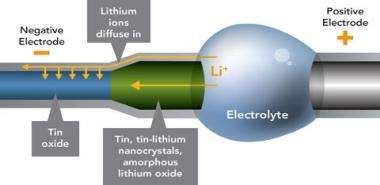
(PhysOrg.com) -- New high resolution images of electrode wires made from materials used in rechargeable lithium ion batteries shows them contorting as they become charged with electricity. The thin, nano-sized wires writhe and fatten as lithium ions flow in during charging, according to a paper in this week's issue of the journal Science. The work suggests how rechargeable batteries eventually give out and might offer insights for building better batteries.
Battery developers know that recharging and using lithium batteries over and over damages the electrode materials, but these images at nanometer scale offer a real-life glimpse into how. Thin wires of tin oxide, which serve as the negative electrode, fatten by a third and stretch twice as long due to lithium ions coursing in. In addition, the lithium ions change the tin oxide from a neatly arranged crystal to an amorphous glassy material.
"Nanowires of tin oxide were able to withstand the deformations associated with electrical flow better than bulk tin oxide, which is a brittle ceramic," said Chongmin Wang, a materials scientist at the Department of Energy's Pacific Northwest National Laboratory. "It reminds me of making a rope from steel -- you wind together thinner wires rather than making one thick rope."
In one of the videos, shown below, the nanowire appears like a straw, while the lithium ions seem like a beverage being sucked up through it. Repeated shape changes could damage the electrode materials by introducing tiny defects that accumulate over time.
Chasing Electrons
In previous work at DOE's Environmental Molecular Sciences Laboratory on the PNNL campus, Wang, PNNL chemist Wu Xu and other colleagues succeeded in taking a snapshot of a larger nanowire of about one micrometer -- or one-hundredth the width of a human hair -- that had been partially charged. But the experimental set-up didn't show charging in action.
To view the dynamics of an electrode being charged, Wang and Xu teamed up with Jianyu Huang at DOE's Center for Integrated Nanotechnologies at Sandia National Laboratories in New Mexico and others. The team used a specially outfitted transmission electron microscope to set up a miniature battery. This instrument allowed them to image smaller wires of about 200 nanometers in diameter (about a fifth the width of the previous nanowires) while charging it.
Rechargeable lithium ion batteries work because lithium ions love electrons. Positively charged lithium ions normally hang out in the positive electrode, where a metal oxide shares its electrons with lithium. But charging a battery pumps free electrons into the negative electrode, which sits across a lake of electrolytes through which lithium ions can swim but electrons can't. The lithium desires the electrons on the negative side of the lake more than the electrons it shares with the metal oxide on the positive side. So lithium ions flow from the positive to the negative electrode, pairing up with free electrons there.
But electrons are fickle. Using a battery in a device allows the electrons to slip out of the negative electrode, leaving the lithium ions behind. So without free electron companions, the lithium ions return to the positive electrode and the metal oxide's embrace.
Wang's miniature battery included a positive electrode of lithium cobalt oxide and a negative electrode made from thin nanowires of tin oxide. Between the two electrodes, an electrolyte provided a conduit for lithium ions and a barrier for electrons. The electrolyte was specially designed to withstand the conditions in the microscope.
When the team charged the miniature battery at a constant voltage, lithium ions wicked up through the tin oxide wire, drawn by the electrons at the negative electrode. The wire fattened and lengthened by about 250 percent in total volume, and twisted like a snake.
In addition, the microscopy showed that the wire started out in a crystalline form. But the lithium ions changed the tin oxide to a material like glass, in which atoms are arranged more randomly than in a crystal. The researchers concluded the amount of deformation occurring during charging and use might wear down battery materials after a while. Even so, the tin oxide appeared to fare better as a nanowire than in its larger, bulk form.
"We think this work will stimulate new thinking for energy storage in general," said Wang. "This is just the beginning, and we hope with continued work it will show us how to design a better battery."
Future work will include imaging what happens when such a miniature battery is repeatedly charged and discharged. When a battery gets used, the lithium ions must run back through the tin oxide wire and across the electrolyte to the positive electrode. How much structural damage the receding lithium leaves in its wake will help researchers understand why rechargeable batteries stop working after being recharged so many times.
The researchers would also like to develop a fully functioning nano-sized rechargeable battery.
More information: Jian Yu Huang, Li Zhong, Chong Min Wang, John P. Sullivan, Wu Xu, Li Qiang Zhang, Scott X. Mao, Nicholas S. Hudak, Xiao Hua Liu, Arunkumar Subramanian, Hong You Fan, Liang Qi, Akihiro Kushima, Ju Li6, In situ observation of the electrochemical lithiation of a single SnO2 nanowire electrode, Dec. 10, 2010, Science, DOI:10.1126/science.1195628
Provided by Pacific Northwest National Laboratory


