Choose a movie's plot -- while you watch it
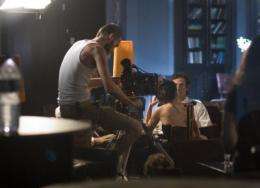
This image is from on the set of Turbulence. Credit: AFTAU
Will Rona and Sol kiss and seal their fate as a couple forever, or will Sol answer the ringing phone and change the course of history? A new movie format developed by Tel Aviv University lets the viewer decide.
Utilizing complicated video coding procedures, the new format provides smooth interaction and transition between scenes as audience members watch ― and determine the plot of ― Turbulence, created by Prof. Nitzan Ben Shaul of Tel Aviv University's Department of Film and Television. Made with his unique scene-sequencing technique, Turbulence recently won a prize at the Berkeley Video and Film Festival for its technological innovation.
"The film gives people the suspense and thrill of multiple outcomes like those of the films Sliding Doors or Run Lola Run, but it also gives them the power to really choose and influence at a number of key points how the plot of the movie will proceed," says Prof. Ben Shaul. Curious viewers can backtrack, too ― they can go back to a narrative crossroads to see what might have been, never seeing the same ending twice.
A happy American ending or tragic European one?
Using Prof. Ben Shaul's innovative format, the viewer watches the film on a regular or a touch-screen monitor, and an iridescent glow appears on certain "action items" at pivotal plot moments. The viewer can choose whether or not to interact. Should Sol send the text message? If the viewer thinks so, he clicks or touches the screen and activates the cell phone held by the actor.
Turbulence comes with an attractive plot, however it's played out. Three Israeli friends, Edi, Sol and Rona, meet by chance in Manhattan. Twenty years in the past, a protest over the Lebanon War led to an arrest, and the three friends went separate ways. Now, in present-day New York, they say goodbye to the past and two of the characters rekindle a love affair.
How will it end? You decide. Without any viewer interactions, it lasts 83 minutes; with interactions it varies from one hour to two. Whatever choice the viewer makes, Prof. Ben Shaul says, the end leads to closure and viewer satisfaction.
"Sliding Doors and Run Lola Run inspired me. They make you think about options in life, but they don't let you experience what responsibility feels like at crucial decision points," says Prof. Ben Shaul. "In our film you decide where the character should go, and you can decide to return to the point where the plot flipped. It's gripping."
Fit for an iPad
Funded by the Tel Aviv University Technology and Science Committee, the movie is perfect for new touch-screen technologies like iPads or personal airplane movie players. But the movie can also be seen in groups. An individual can be chosen to make the choices, or majority vote can rule.
"It develops optional thinking and can change the way people consume media and advertisements," says Prof. Ben Shaul, who received his Ph.D. from the Cinema Studies Department at New York University.
He hopes to inspire a whole new paradigm of filmmaking and is currently writing a book with the working title What If: Optional Thinking and Narrative Movies.
Provided by
Tel Aviv University
-
From lemons to lemonade: Reaction uses carbon dioxide to make carbon-based semiconductor,
28 comments
-
Thioridazine kills cancer stem cells in human while avoiding toxic side-effects of conventional cancer treatments,
3 comments
-
SpaceX private rocket blasts off for space station (Update),
41 comments
-
Climate scientists say they have solved riddle of rising sea,
30 comments
-
Scotland passes turbine test to harness tidal power,
40 comments
-
magnets or EMF in car bumpers to protect from fender bender
2 hours ago
-
length of wire in a coil of known dimensions?
19 hours ago
-
India Engineering Powerhouse
May 25, 2012
-
electromagnet core dereference between hard and soft iron
May 25, 2012
-
Measuring water pressure in an open tank
May 24, 2012
-
Question from a non-engineer: Pulley Systems
May 24, 2012
- More from Physics Forums - General Engineering
More news stories
Everyone knows it's windy . . .
... And now they have the data to prove it. The middle of Lake Michigan is a vast, untapped reservoir of wind energy. The next step will be to find out if it can be harvested economically without harming ...
Technology / Energy & Green Tech
23 hours ago |
not rated yet |
3
Apple CEO Cook gives up $75M in stock dividends
(AP) -- Apple CEO Tim Cook is giving up $75 million in dividends on restricted stock that the company is awarding to all of its employees.
20 hours ago |
1.8 / 5 (4) |
2
Yahoo kills 'Livestand' just 6 months after debut
(AP) -- Yahoo is killing a tablet magazine called Livestand just six months its debut on the iPad.
14 hours ago |
not rated yet |
1
Yahoo! ditches digital newsstand for iPads
Yahoo! shuttered its fledgling digital newsstand for iPads on Friday in what it said was the start of a product purge intended to make the floundering Internet pioneer more nimble.
15 hours ago |
not rated yet |
0
Facebook IPO debacle raises investor dander
The spate of complaints and investigations over the Facebook stock offering suggests big institutions had an edge over small investors, raising questions about the process.
16 hours ago |
not rated yet |
0
Landmark calculation clears the way to answering how matter is formed
(Phys.org) -- An international collaboration of scientists, including Thomas Blum, associate professor of physics, is reporting in landmark detail the decay process of a subatomic particle called a kaon ...
Dragon arrives at space station in historic 1st (Update 2)
The privately bankrolled Dragon capsule made a historic arrival at the International Space Station on Friday, triumphantly captured by astronauts wielding a giant robot arm.
Of mice and mental models: Neuroscientific implications of risk-optimized behavior in the mouse
(Medical Xpress) -- Regardless of an organism’s biological complexity, every encephalized animal continuously makes under-informed behavioral choices that can have serious consequences. Despite its ubiquity, ...
Aliens don't want to eat us, says former SETI director
Alien life probably isnt interested in having us for dinner, enslaving us or laying eggs in our bellies, according to a recent statement by former SETI director Jill Tarter.
Researchers demonstrate possible primitive mechanism of chemical info self-replication
(Phys.org) -- When scientists think about the replication of information in chemistry, they usually have in mind something akin to what happens in living organisms when DNA gets copied: a double-stranded molecule ...
Oldest Jewish archaeological evidence on the Iberian Peninsula
German archaeologists of the Friedrich Schiller University Jena found one of the oldest archaeological evidence so far of Jewish Culture on the Iberian Peninsula at an excavation site in the south of Portugal, ...
Dec 13, 2010
Rank: not rated yet