New method for making tiny catalysts holds promise for air quality
December 15, 2010

New method for making tiny catalysts holds promise for air quality

Enlarge

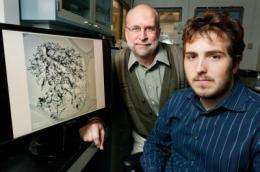
Civil and environmental engineering professor Mark Rood (left) and graduate student John Atkinson developed a novel method of producing porous carbon spheres with iron dispersed throughout them for catalytic and air quality applications. Credit: L. Brian Stauffer

Fortified with iron: It's not just for breakfast cereal anymore. University of Illinois researchers have demonstrated a simpler method of adding iron to tiny carbon spheres to create catalytic materials that have the potential to remove contaminants from gas or liquid.

Civil and environmental engineering professor Mark Rood, graduate student John Atkinson and their team described their technique in the journal .

Carbon structures can be a support base for catalysts, such as iron and other metals. Iron is a readily available, low-cost with possible catalytic applications for fuel cells and environmental applications for adsorbing harmful chemicals, such as arsenic or carbon monoxide. Researchers produce a carbon matrix that has many or tunnels, like a sponge. The large surface area created by the pores provides sites to disperse tiny iron particles throughout the matrix.

A common source of carbon is coal. Typically, scientists modify coal-based materials into highly porous activated carbon and then add a catalyst. The multi-step process takes time and enormous amounts of energy. In addition, materials made with coal are plagued by ash, which can contain traces of other metals that interfere with the reactivity of the carbon-based catalyst.

The Illinois team's ash-free, inexpensive process takes its carbon from sugar rather than coal.

In one continuous process, it produces tiny, micrometer-sized spheres of porous, spongy carbon embedded with iron – all in the span of a few seconds.

"That's what really sets this apart from other techniques. Some people have carbonized and impregnated with iron, but they have no surface area. Other people have surface area but weren't able to load it with iron," Atkinson said. "Our technique provides both the carbon surface and the iron nanoparticles."

The researchers built upon a technique called ultrasonic spray pyrolysis (USP), developed in U. of I. chemistry professor Kenneth Suslick's lab in 2005. Suslick used a household humidifier to make fine mist from a carbon-rich solution, then directed the mist through an extremely hot furnace, which evaporated the water from each droplet and left tiny, highly porous carbon spheres.

Atkinson used USP to make his carbon spheres, but added an iron-containing salt to a carbon-rich sugar solution. When the mist is piped into the furnace, the heat stimulates a reaction between the solution ingredients that creates carbon spheres with iron particles dispersed throughout.

"We were able to take advantage of Dr. Suslick's USP technique, and we are building upon it by simultaneously impregnating the porous carbons with metal nanoparticles," Atkinson said. "It's simple because it's continuous. We can isolate the carbon, add pores, and impregnate iron into the carbon spheres in a single step."

Another advantage of the USP technique is the ability to create materials to address particular needs. By fabricating the material from scratch, rather than trying to modify off-the-shelf products, scientists and engineers can develop materials for specific problem-solving scenarios.

"Right now, you take coal out of the ground and modify it. It's difficult to tailor it to solve a particular air quality problem," Rood said. "We can readily change this new material by how it's activated to tailor its surface area and the amount of impregnated iron. This method is simple, flexible and tailorable."

Next, the researchers will explore applications for the material. Rood and Atkinson have received two grants from the National Science Foundation to develop the carbon-iron spheres to remove nitric oxide, mercury, and dioxin from gas streams – bioaccumulating pollutants that have caused concern as emissions from combustion sources.

Currently, the three pollutants can be dealt with separately by carbon-based adsorbents and catalysts, but the Illinois team and collaborators in Taiwan hope to harness carbon's adsorption properties and iron's reactivity to remove all three pollutants from gas streams simultaneously.

"We're looking at taking advantage of their porosity and, ideally, their catalytic applications as well," Atkinson said. "Carbon is a very versatile material. What's in my mind is a multi-pollutant control where you can use the porosity and the catalyst to tackle two problems at once."

More information: The paper, "Synthesis and Characterization of Iron-impregnated Porous Carbon Spheres Prepared by Ultrasonic Spray Pyrolysis," is published in the journal Carbon.

Provided by University of Illinois at Urbana-Champaign search and more info website

4.3 /5 (6 votes)  

Filter


Move the slider to adjust rank threshold, so that you can hide some of the comments.


Display comments: newest first

mjesfahani
Dec 16, 2010

Rank: not rated yet
I wish you make this method work in Tehran, because air is very polluted.
Modernmystic
Dec 16, 2010

Rank: not rated yet
Air has been crystal clear where I live for at least the last 37 years...

In fact it's been clear even when I've lived in the "big city".
Jimee
Dec 16, 2010

Rank: not rated yet
Here in the west we are not so lucky. Lots of times the air looks clear, but the vistas visible when I was a child 50 years ago are obscured all the time now. Long live alternative energy.
Rank 4.3 /5 (6 votes)
Relevant PhysicsForums posts
  • Density question
    createdMay 24, 2012
  • Mass transport originating from a point source at a solid gas interface
    createdMay 22, 2012
  • Ammonia dispersion in Air
    createdMay 22, 2012
  • Multi Choice Help
    createdMay 21, 2012
  • index of refraction and thickness of materials
    createdMay 18, 2012
  • Solar battery maintainer for car
    createdMay 17, 2012
  • More from Physics Forums - Materials & Chemical Engineering

More news stories

Synthetic nano-waste does not disappear

(Phys.org) -- Tiny particles of cerium oxide do not burn or change in the heat of a waste incineration plant. They remain intact on combustion residues or in the incineration system, as a new study by Swiss ...

Nanotechnology / Bio & Medicine

created 23 hours ago | popularity 5 / 5 (1) | comments 1 | with audio podcast

Dopant gives graphene solar cells highest efficiency yet

(Phys.org) -- By taking advantage of graphene’s favorable electrical and optical properties, and then adding an organic dopant, researchers have achieved the highest power conversion efficiency yet for ...

Nanotechnology / Nanophysics

created May 21, 2012 | popularity 5 / 5 (10) | comments 14 | with audio podcast feature

Nanotechnology for solar energy conversion systems

EU researchers extensively characterised the self-organisation of nanotubes and developed novel compositions particularly appropriate to solar energy conversion applications.

Nanotechnology / Nanomaterials

created 22 hours ago | popularity not rated yet | comments 0

Nanomedicine: Quantum dots appear safe in pioneering study on primates

A pioneering study to gauge the toxicity of quantum dots in primates has found the tiny crystals to be safe over a one-year period, a hopeful outcome for doctors and scientists seeking new ways to battle diseases ...

Nanotechnology / Bio & Medicine

created May 20, 2012 | popularity 4.3 / 5 (3) | comments 8 | with audio podcast

Nano-structured polymer-based materials from scrap

EU researchers developed polymer blends and processing techniques facilitating recovery of scrap from industrial processes. Advances in this area have the potential to decrease costs and waste while protecting ...

Nanotechnology / Nanomaterials

created 23 hours ago | popularity not rated yet | comments 0


Landmark calculation clears the way to answering how matter is formed

(Phys.org) -- An international collaboration of scientists, including Thomas Blum, associate professor of physics, is reporting in landmark detail the decay process of a subatomic particle called a kaon – ...

Dragon arrives at space station in historic 1st (Update 2)

The privately bankrolled Dragon capsule made a historic arrival at the International Space Station on Friday, triumphantly captured by astronauts wielding a giant robot arm.

Of mice and mental models: Neuroscientific implications of risk-optimized behavior in the mouse

(Medical Xpress) -- Regardless of an organism’s biological complexity, every encephalized animal continuously makes under-informed behavioral choices that can have serious consequences. Despite its ubiquity, ...

Aliens don't want to eat us, says former SETI director

Alien life probably isn’t interested in having us for dinner, enslaving us or laying eggs in our bellies, according to a recent statement by former SETI director Jill Tarter.

Researchers demonstrate possible primitive mechanism of chemical info self-replication

(Phys.org) -- When scientists think about the replication of information in chemistry, they usually have in mind something akin to what happens in living organisms when DNA gets copied: a double-stranded molecule ...

Oldest Jewish archaeological evidence on the Iberian Peninsula

German archaeologists of the Friedrich Schiller University Jena found one of the oldest archaeological evidence so far of Jewish Culture on the Iberian Peninsula at an excavation site in the south of Portugal, ...