Magnetic switching under pressure
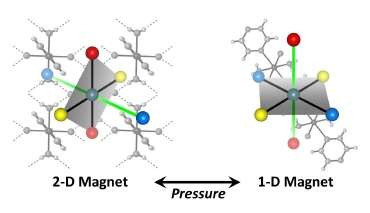
A schematic representation of the pressure-induced magnetic switching effect. The colored images highlight the direction of the magnetic orbital (grey plane) for the copper centers (green balls: copper, blue: nitrogen, red: oxygen/water, yellow: fluoride).
(PhysOrg.com) -- A materials properties are a critical factor in the way that material can be used for practical applications. Magnetism is one such property, and magnetic switches are key components for advances in data storage and for displays in computers and cell phones. These properties are normally adjusted (or "tuned") by changing the "recipe" during preparation.
Now scientists at the U.S. Department of Energys (DOEs) Argonne National Laboratory, along with a collaborator from Eastern Washington University, have harnessed the power of extreme high pressure and discovered a novel approach to predictably tune the switching of a promising new family of next-generation magnetic materials. Their results were published in the online version of Angewandte Chemie International Edition on September 10, 2010.
The magnetic materials the team studied are made from copper ions and simple building blocks, including water and fluoride. Their simple structures are held together by strong hydrogen bonds, making very robust molecular networks. Each copper ion, which sits at the corner of a molecular cube, contains one unpaired electron. These spins are disordered at normal temperatures, but begin to align in opposite directions at low temperatures, creating the magnetic state called antiferromagnetism.
Using state-of-the-art high-pressure equipment and the high-energy, highly focused x-ray beams from the X-ray Science Division 1-BM beamline at the Argonne Advanced Photon Source, the scientists observed a series of structural transitions as they exerted pressure on the material. These rearrangements abruptly reoriented the magnetic spins of the material, creating a reversible magnetic switch effect.
High-pressure science has traditionally been the domain of Earth scientists and, until now, has not been routinely used to study molecular systems. Such studies promise to greatly improve our understanding of the often complex way materials functional properties are related to their molecular structuresa key step in realizing the diverse potential of molecular materials.
Molecule-based materials are much softer than traditional solid-state materials, like oxides and minerals, said Argonne scientist Gregory Halder. As such, we can expect to induce dramatic changes to their structures and functional properties at relatively low, industrially relevant pressures.
Next up for this team of researchers: Studying a targeted series of molecular network materials under pressure to understand the broader implications of this new phenomenon.
More information: Gregory J. Halder, Karena W. Chapman, John A. Schlueter, and Jamie L. Manson, Pressure-Induced Sequential Orbital Reorientation in a Magnetic Framework Material, Angew. Chem. Int. Ed. 49, (2010). (Published online September10, 2010). DOI:10.1002/anie.20100
Provided by
Argonne National Laboratory
-
From lemons to lemonade: Reaction uses carbon dioxide to make carbon-based semiconductor,
28 comments
-
Thioridazine kills cancer stem cells in human while avoiding toxic side-effects of conventional cancer treatments,
3 comments
-
SpaceX private rocket blasts off for space station (Update),
41 comments
-
Climate scientists say they have solved riddle of rising sea,
30 comments
-
Scotland passes turbine test to harness tidal power,
40 comments
-
Water under pressure and temperature effects
9 hours ago
-
Flow, different liquid, pressure
10 hours ago
-
Dimensions and Degrees of Freedom
11 hours ago
-
Rotational Inertia of a disc
11 hours ago
-
How does B=μH really work?
12 hours ago
-
I need help with understanding of Inertia of a slender rod and plate?
14 hours ago
- More from Physics Forums - General Physics
More news stories
Landmark calculation clears the way to answering how matter is formed
(Phys.org) -- An international collaboration of scientists, including Thomas Blum, associate professor of physics, is reporting in landmark detail the decay process of a subatomic particle called a kaon ...
23 hours ago |
4.8 / 5 (12) |
29
|
Is a classical electrodynamics law incompatible with special relativity?
(Phys.org) -- The laws of classical electromagnetism that were developed in the 19th century are the same laws that scientists use today. They include Maxwell’s four equations along with the Lorentz la ...
Lying in wait for WIMPs: Researchers seek to dramatically increase sensitivity of Large Underground Xenon detector
Although it's invisible, dark matter accounts for at least 80 percent of the matter in the universe. No one knows what it is, but most scientists would bet on weakly interacting massive particles, or WIMPs.
May 23, 2012 |
4 / 5 (5) |
14
|
Hall effect at the speed of light: How can you demonstrate relativistic effects with your mobile phone?
The relativistic Hall effect describing objects rotating at speeds comparable with the speed of light has been reported.
May 21, 2012 |
4.3 / 5 (3) |
8
Cloak of invisibility: Engineers use plasmonics to create an invisible photodetector
A team of engineers at Stanford and the University of Pennsylvania has for the first time used "plasmonic cloaking" to create a device that can see without being seen - an invisible machine that detects light. It is the first ...
May 21, 2012 |
4.8 / 5 (16) |
7
|
Of mice and mental models: Neuroscientific implications of risk-optimized behavior in the mouse
(Medical Xpress) -- Regardless of an organism’s biological complexity, every encephalized animal continuously makes under-informed behavioral choices that can have serious consequences. Despite its ubiquity, ...
Dragon arrives at space station in historic 1st (Update 2)
The privately bankrolled Dragon capsule made a historic arrival at the International Space Station on Friday, triumphantly captured by astronauts wielding a giant robot arm.
High-speed method to aid search for solar energy storage catalysts
Eons ago, nature solved the problem of converting solar energy to fuels by inventing the process of photosynthesis.
It's in the genes: Research pinpoints how plants know when to flower
Scientists believe they've pinpointed the last crucial piece of the 80-year-old puzzle of how plants "know" when to flower.
Researchers solve structure of human protein critical for silencing genes
In a study published in the journal Cell on May 24, Cold Spring Harbor Laboratory (CSHL) scientists describe the three-dimensional atomic structure of a human protein bound to a piece of RNA that "guides" the pr ...
MIT researchers devise new means to synchronize a group of robots (w/ Video)
(Phys.org) -- For several years, roboticists have been working out ways to get a group of robots to perform synchronized activities as demonstrated most often in dance routines. Its not just about trying ...
Dec 03, 2010
Rank: not rated yet