First measurement of magnetic field in Earth's core
December 16, 2010 By Robert Sanders

First measurement of magnetic field in Earth's core

Enlarge

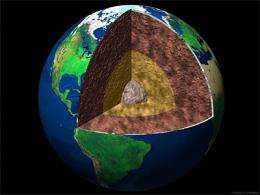
A cross-section of the earth's interior shows the outer crust, the hot gooey mantle, the liquid outer core and the solid, frozen inner core (gray). (Calvin J. Hamilton graphic)

(PhysOrg.com) -- A University of California, Berkeley, geophysicist has made the first-ever measurement of the strength of the magnetic field inside Earth's core, 1,800 miles underground.

The magnetic field strength is 25 Gauss, or 50 times stronger than the magnetic field at the surface that makes compass needles align north-south. Though this number is in the middle of the range geophysicists predict, it puts constraints on the identity of the heat sources in the core that keep the internal dynamo running to maintain this magnetic field.

"This is the first really good number we've had based on observations, not inference," said author Bruce A. Buffett, professor of and at UC Berkeley. "The result is not controversial, but it does rule out a very weak magnetic field and argues against a very strong field."

The results are published in the Dec. 16 issue of the journal Nature.

A strong magnetic field inside the outer core means there is a lot of convection and thus a lot of heat being produced, which scientists would need to account for, Buffett said. The presumed sources of energy are the residual heat from 4 billion years ago when the planet was hot and molten, release of gravitational energy as heavy elements sink to the bottom of the liquid core, and radioactive decay of long-lived elements such as potassium, uranium and thorium.

A weak field – 5 Gauss, for example – would imply that little heat is being supplied by radioactive decay, while a strong field, on the order of 100 Gauss, would imply a large contribution from .

"A measurement of the magnetic field tells us what the energy requirements are and what the sources of heat are," Buffett said.

About 60 percent of the power generated inside the earth likely comes from the exclusion of light elements from the solid inner core as it freezes and grows, he said. This constantly builds up crud in the outer core.

The Earth's magnetic field is produced in the outer two-thirds of the planet's iron/nickel core. This outer core, about 1,400 miles thick, is liquid, while the inner core is a frozen iron and nickel wrecking ball with a radius of about 800 miles – roughly the size of the moon. The core is surrounded by a hot, gooey mantle and a rigid surface crust.

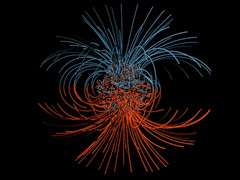
The cooling Earth originally captured its magnetic field from the planetary disk in which the solar system formed. That field would have disappeared within 10,000 years if not for the planet's internal dynamo, which regenerates the field thanks to heat produced inside the planet. The heat makes the liquid outer core boil, or "convect," and as the conducting metals rise and then sink through the existing magnetic field, they create electrical currents that maintain the magnetic field. This roiling dynamo produces a slowly shifting magnetic field at the surface.
First measurement of magnetic field in Earth's core

Supercomputer model of the magnetic field lines in Earth's core. (Gary Glatzmaier)

"You get changes in the surface magnetic field that look a lot like gyres and flows in the oceans and the atmosphere, but these are being driven by fluid flow in the outer core," Buffett said.

Buffett is a theoretician who uses observations to improve computer models of the earth's internal . Now at work on a second generation model, he admits that a lack of information about conditions in the earth's interior has been a big hindrance to making accurate models.

He realized, however, that the tug of the moon on the tilt of the earth's spin axis could provide information about the magnetic field inside. This tug would make the inner core precess – that is, make the spin axis slowly rotate in the opposite direction – which would produce magnetic changes in the outer core that damp the precession. Radio observations of distant quasars – extremely bright, active galaxies – provide very precise measurements of the changes in the earth's rotation axis needed to calculate this damping.

"The moon is continually forcing the rotation axis of the core to precess, and we're looking at the response of the fluid outer core to the precession of the inner core," he said.

By calculating the effect of the moon on the spinning inner core, Buffett discovered that the precession makes the slightly out-of-round inner core generate shear waves in the liquid outer core. These waves of molten iron and nickel move within a tight cone only 30 to 40 meters thick, interacting with the magnetic field to produce an electric current that heats the liquid. This serves to damp the precession of the rotation axis. The damping causes the precession to lag behind the moon as it orbits the earth. A measurement of the lag allowed Buffett to calculate the magnitude of the damping and thus of the inside the outer core.

Buffett noted that the calculated field – 25 Gauss – is an average over the entire outer core. The field is expected to vary with position.

"I still find it remarkable that we can look to distant quasars to get insights into the deep interior of our planet," Buffett said.

Provided by University of California - Berkeley search and more info website

4.9 /5 (19 votes)  

Filter


Move the slider to adjust rank threshold, so that you can hide some of the comments.


Display comments: newest first

vtel57
Dec 16, 2010

Rank: not rated yet
That's very interesting. I remember a Nova episode from last season on PBS with the basic premise being that the internal dynamo that sustains the earth's magnetic field may have shut down. It's nice to see confirmation that this isn't so.
barakn
Dec 16, 2010

Rank: 4.7 / 5 (3)
I think you may be misremembering the Nova episode. Generally the worry is that the dipole moment of the magnetic field is weakening in favor of higher order multipole moments. The dynamo doesn't shut down, but sometimes becomes disordered.
Nik_2213
Dec 16, 2010

Rank: not rated yet
Amazing !!

Uh, this may imply that truly terrestial planets, ie rocky, Earth mass and plate tectonics, need a big moon to keep the core stirred and the geo-dynamo humming...
lebooo
Dec 16, 2010

Rank: not rated yet
@Nik

if this were true, perhaps it could help explain why mars does not have a strong magnetic field?
vtel57
Dec 16, 2010

Rank: 5 / 5 (1)
I think you may be misremembering the Nova episode.


You may be correct, barakn. The episode I was speaking of is this one --> http://www.pbs.or...agnetic/

Regards,

~Eric
am_Unition
Dec 17, 2010

Rank: not rated yet
if this were true, perhaps it could help explain why mars does not have a strong magnetic field?


@lebooo

Phobos and Deimos are tiny. Probably captured asteroids.

And what about Mercury's magnetic field?

Are Venus's complete lack of a B-field and retrograde rotation related?

This article was great. My intuition (or whatever) tells me that some day we'll discover solar coupling into the magnetosphere also feeds the geodynamo, and similar processes on other planets.
kevinrtrs
Dec 17, 2010

Rank: 1 / 5 (5)
The cooling Earth originally captured its magnetic field from the planetary disk in which the solar system formed. That field would have disappeared within 10,000 years if not for the planet's internal dynamo, which regenerates the field thanks to heat produced inside the planet

The first story is patent guesswork - no one knows exactly how the earth got it's magnetic field.

The second story [dynamo theory] is a requirement forced onto the naturalists to explain why earth STILL has a magnetic field after 4 billion years, instead of it being dead and gone.

Currently the earth's magnetic field is decaying at a rate that is pointing to an early demise for life on earth. Naturalists want to point out that the field is changing polarity as the reason for the decay but that doesn't hold up - we should be seeing how North is shifting at the same rate as the field is decaying - and it's NOT.

The earth's magnetic field is only about 6 k years old.
Ratfish
Dec 19, 2010

Rank: not rated yet
I would have expected it to be so much higher in the core given that an MRI can be 30,000G.
MarcoB
Dec 20, 2010

Rank: not rated yet
I know there are some clever guys on here, can anyone tell me why no one ever thought of building a huge magnetic motor at the north and south pole to harness the earths magnetic field? Or maybe even small trickle charging stations that convert the magnetic field into electricity anywhere on the surface? I can imagine the field is weak on the equator, but gets stronger as you get closer to the poles, hence the northern lights.
barakn
Dec 20, 2010

Rank: 5 / 5 (1)
In order to produce an electric current, a wire loop would have to have a changing magnetic flux through the area it encompasses. The Earth's magnetic field is more or less static, so it would be a terrible power source.
Rank 4.9 /5 (19 votes)
Relevant PhysicsForums posts

More news stories

Dragon arrives at space station in historic 1st (Update 2)

The privately bankrolled Dragon capsule made a historic arrival at the International Space Station on Friday, triumphantly captured by astronauts wielding a giant robot arm.

Space & Earth / Space Exploration

created 21 hours ago | popularity 5 / 5 (8) | comments 13

Dragon makes history with space station docking

The private company SpaceX made history Friday with the docking of its Dragon capsule to the International Space Station, the most impressive feat yet in turning routine spaceflight over to the commercial ...

Space & Earth / Space Exploration

created 14 hours ago | popularity 4.8 / 5 (6) | comments 0

Aliens don't want to eat us, says former SETI director

Alien life probably isn’t interested in having us for dinner, enslaving us or laying eggs in our bellies, according to a recent statement by former SETI director Jill Tarter.

Space & Earth / Space Exploration

created 22 hours ago | popularity 4.8 / 5 (10) | comments 26

SKA super telescope to be built in Australia, South Africa (Update 2)

A long-running joust to host a radio telescope that would give mankind its farthest peek into the Universe ended on Friday with a Solomon-like judgement to split the site between Australia and South Africa.

Space & Earth / Astronomy

created 22 hours ago | popularity 5 / 5 (5) | comments 2

NASA sees Hurricane Bud threaten western Mexico's coast

NASA satellites are providing rainfall, temperature, pressure, visible and infrared data to forecasters as Hurricane Bud is expected to make a quick landfall in western Mexico this weekend before turning back ...

Space & Earth / Earth Sciences

created 16 hours ago | popularity not rated yet | comments 0


Of mice and mental models: Neuroscientific implications of risk-optimized behavior in the mouse

(Medical Xpress) -- Regardless of an organism’s biological complexity, every encephalized animal continuously makes under-informed behavioral choices that can have serious consequences. Despite its ubiquity, ...

Landmark calculation clears the way to answering how matter is formed

(Phys.org) -- An international collaboration of scientists, including Thomas Blum, associate professor of physics, is reporting in landmark detail the decay process of a subatomic particle called a kaon – ...

High-speed method to aid search for solar energy storage catalysts

Eons ago, nature solved the problem of converting solar energy to fuels by inventing the process of photosynthesis.

It's in the genes: Research pinpoints how plants know when to flower

Scientists believe they've pinpointed the last crucial piece of the 80-year-old puzzle of how plants "know" when to flower.

Researchers solve structure of human protein critical for silencing genes

In a study published in the journal Cell on May 24, Cold Spring Harbor Laboratory (CSHL) scientists describe the three-dimensional atomic structure of a human protein bound to a piece of RNA that "guides" the pr ...

MIT researchers devise new means to synchronize a group of robots (w/ Video)

(Phys.org) -- For several years, roboticists have been working out ways to get a group of robots to perform synchronized activities as demonstrated most often in dance routines. It’s not just about trying ...