New lemur: big feet, long tongue and the size of squirrel
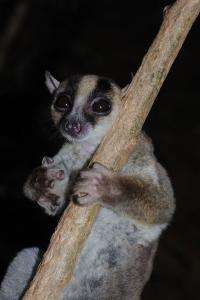
(PhysOrg.com) -- A species of fork-marked lemur believed to be new to science was discovered in the dry forests of Madagascar. It will be shown for the first time exclusively on BBC's "Decade of Discovery" special program this Tuesday, Conservation International and BBC's Natural History Unit announced today. There are currently four species of the genus Phaner and this one should be the fifth.
Dr Russ Mittermeier, world renowned primate expert and President of Conservation International, first spotted the animal in 1995 during an expedition to Daraina, a protected area in the northeast of Madagascar.
"I went to this area for the first time to see the spectacular Tattersall's sifaka (Propithecus tattersali), a large diurnal species that itself had just been described in 1988. I was surprised to all see a fork-marked lemur there, since this animal had not yet been recorded from the region. I immediately knew that it was likely a new species to science, but didn't have the time to follow up until now," he said.
In October this year, Mittermeier led an expedition of scientists, including geneticist Ed Louis from the Omaha Zoo, and a film crew from the BBC's Natural History Unit to the same area, where they managed to track down the fork-marked lemur.
The team set out just after sunset when the Phaner are most vocal and heard one calling close to camp at the top of a tree. The Phaner was difficult to catch as it moved quickly through the treetops so the team ran through the dense forest following the calls. Eventually, they caught sight of the animal in torchlight but had to wait until it moved into an open area to get a clean shot with a tranquiliser gun. Once a dart had found its target, one of the trackers quickly shinned up the tree to retrieve it.
The adult male lemur was kept safe and sedated overnight so the team could examine it in detail and take samples in daylight. The animal was measured (it is about the size of a squirrel), blood samples were taken for genetic analyses to confirm if it is indeed a new species, and a microchip was slipped in under its skin for the purpose of identification and monitoring. It was then returned to its forest home.
"This is yet another remarkable discovery from the island of Madagascar, the world's highest priority biodiversity hotspot and one of the most extraordinary places in our planet," Mittermeier said. "It is particularly remarkable that we continue to find new species of lemurs and many other plants and animals in this heavily impacted country, which has already lost 90 percent or more of its original vegetation."
Since it has very restricted range, it is likely that this will turn out to be an endangered or critically endangered species, even though it has been not been formally described yet.
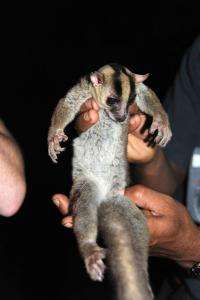
Like the other four species of the genus Phaner, this potentially new species has:
• a black, Y-shaped line that starts above each eye and joins together as a single line on the top of the head, creating the fork that gives these animals their common name
• large hands and feet for gripping onto trees
• a loud, high-pitched night-time call which helped the team track it down
• an unusual head-bobbing behavior that shows up in the beam of the flashlight at night and is unique to this species
• a diet consisting of a high proportion of gumexuded by trees and flower nectar
• a long tongue for slurping up nectar and recumbent incisors, which form a toothcomb specialized as a scraping tool to bite into the bark
"This fifth species has a somewhat different color pattern, but the main differences from the other four will likely be genetic", Mittermeier said. Since the discovery was filmed, Louis and his team have been carrying out genetic analyses to confirm if this is in fact a new species. Mittermeier and Louis would like it to be named after the non-governmental conservation organization Fanamby (Malagasy for "the challenge") that has been instrumental in protecting the forest of Daraina, where the lemur was found.
In the last decade, 63 new species of primates, including 42 species of lemurs, have been discovered worldwide. Louis has been responsible of a large part of the new lemur discoveries. Two lemurs have been named after Mittermeier, who has been studying primates for over 40 years. They are also shown in the program:
• a tiny mouse lemur discovered in 2006, named Microcebus mittermeieri
• a sportive lemur discovered in 2008, named Lepilemur mittermeieri
Madagascar is the only country where lemurs are found. They are forest-dwelling and are under serious threat. Since almost all of Madagascar's forests have been destroyed, there is a real sense of urgency to find and catalogue the lemurs that are left, but more importantly to save their habitat, which are the source of food and income for people.
"Protection of Madagascar's remaining natural forests should be considered one of the world's highest conservation priorities," Mittermeier said. "These forests are home to an incredible array of species that are a true global heritage, and also provide an incalculable array of benefits to local communities in the form of clean water, foods and fibers, and other ecosystem services."
Lemurs are found only on the island of Madagascar. There are just over 100 species of lemur with over 40 founds in the last decade. Scientists believe that they travelled by chance across the sea on rafts of vegetation that are occasionally washed down from rivers.
Since then lemurs have evolved in isolation from other primates like monkeys, which evolved later, and without many predators so they have differentiated into many forms. Madagascar has many different habitats and each species has its own adaptations to survive in its particular niche.
Lemurs are named after the lemurs (ghosts or spirits) of Roman mythology due to their ghostly vocalizations, reflective eyes and usual nocturnal habits. One of the reasons more new lemur species have been described recently is that scientists are realizing that animals which may look similar to our eyes are actually quite different to each other.
The mouse lemurs are a good example of these so-called "cryptic" species – in 1994 there were only 2 names species of mouse lemur, now there are 18 distinct species. Each has slightly different fur or size but some look nearly identical, at least to the human eye.
Provided by Conservation International


