New book will make you an instant physicist (maybe)
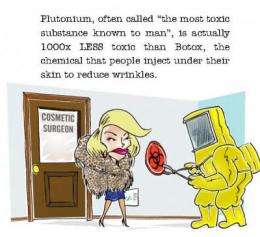
Plutonium. Credit: Joey Manfrey, illustrator, and Richard Muller, writer
Richard Muller is a guy who thinks spouting fun physics facts will make you the life of the party. And his new book, "The Instant Physicist: An Illustrated Guide," may just convince you he's right.
Who knew, for example, that liquor, by law, must be radioactive? Or that you really can get your clothes whiter than white? Or that the earth is travelling through space at a million miles per hour?
These are some of the astonishing facts Muller, a professor of physics at the University of California, Berkeley, explains with the help of witty cartoons by illustrator Joey Manfre.
"When I was a kid, I used to love 'Ripley's Believe it or Not,'" Muller said. The 2011 book's anecdotes are like Ripley's amazing tidbits, "but with a real explanation. I think this is a new approach to teaching physics. If you know ten-year-olds, giving them a copy of this book will begin to make them fascinated by science. But the book is equally liked by physics professors," he added.
The fun facts are mined from Muller's previous book, the 2008 bestseller "Physics for Future Presidents," which itself is a distillation of the lectures Muller gives in his introductory physics class of the same name. Muller credits his daughter with the inspiration for the book, after she commented that she liked best the surprising "sound bites" sprinkled throughout.
"Like the fact that alcohol is required by law to be radioactive it's something so memorable that you never forget it," he said.
Muller proposed an illustrated book of sound bites to his publisher, W. W. Norton & Company, and then called upon a designer/illustrator friend, Manfre, to try his hand at some cartoons. The collaboration was ideal, Muller said, and Norton bought the idea.
"I think there is a lot of nourishment in the cartoons," Muller said. "Joey's cartoons are not only humorous and clever, but so creative. Each one is new and original and gives a freshness to the pages that I really love."
Muller's brief introduction promises that the book will not only help the reader "pass yourself off as a physicist at your next party (assuming you would want to)," but also win arguments with friends and relatives and win money on "crazy-sounding bets."
More seriously, he wants the book to serve a purpose similar to that of "Physics for Future Presidents," which has sold more than 60,000 copies. That is, he wants to teach the lay public in as painless a way as possible about the science and technology now changing their lives.
"Whether you are a world leader or just a voting citizen, you'll improve your judgment by knowing some key facts and numbers. And what better way to learn them than through humor?" he wrote in the book's introduction.
He claims to have many more anecdotes than the 65 in the book, but don't look for a sequel just yet. His next book is "Energy for Future Presidents."
"Physics is non-partisan, and I hope to take the politics out of the argument over global warming and focus on the science," he said. "If all we can do is lower the temperature of the debate over global warming, we will make a real contribution."
Provided by
University of California - Berkeley
-
From lemons to lemonade: Reaction uses carbon dioxide to make carbon-based semiconductor,
28 comments
-
Thioridazine kills cancer stem cells in human while avoiding toxic side-effects of conventional cancer treatments,
3 comments
-
SpaceX private rocket blasts off for space station (Update),
41 comments
-
Climate scientists say they have solved riddle of rising sea,
30 comments
-
Scotland passes turbine test to harness tidal power,
40 comments
-
Interesting WWII Public INformation Leaflet
May 19, 2012
-
Treaty of the Pyrenees
May 08, 2012
- More from Physics Forums - History & Humanities
More news stories
Math predicts size of clot-forming cells
UC Davis mathematicians have helped biologists figure out why platelets, the cells that form blood clots, are the size and shape that they are. Because platelets are important both for healing wounds and in strokes and other ...
16 hours ago |
not rated yet |
0
|
Oldest Jewish archaeological evidence on the Iberian Peninsula
German archaeologists of the Friedrich Schiller University Jena found one of the oldest archaeological evidence so far of Jewish Culture on the Iberian Peninsula at an excavation site in the south of Portugal, ...
Other Sciences / Archaeology & Fossils
19 hours ago |
4.3 / 5 (4) |
12
Dinosaur with tiny arms unearthed in Argentina
Argentine experts have discovered the near-complete remains of a new species of Jurassic-era dinosaur that stood on its rear legs and had tiny arms, according to a leading paleontologist.
Other Sciences / Archaeology & Fossils
May 25, 2012 |
5 / 5 (2) |
0
Earliest musical instruments in Europe 40,000 years ago
The first modern humans in Europe were playing musical instruments and showing artistic creativity as early as 40,000 years ago, according to new research from Oxford and Tübingen universities.
Other Sciences / Archaeology & Fossils
22 hours ago |
5 / 5 (3) |
1
Talking works: UB professor develops method to analyze creative problem solving
(Phys.org) -- Talk -- if it's the right kind -- can increase creativity, leading students to create useful, new ideas that solve problems, a University at Buffalo professor has found by using a statistical tool that he invented.
Other Sciences / Social Sciences
May 25, 2012 |
not rated yet |
0
Of mice and mental models: Neuroscientific implications of risk-optimized behavior in the mouse
(Medical Xpress) -- Regardless of an organism’s biological complexity, every encephalized animal continuously makes under-informed behavioral choices that can have serious consequences. Despite its ubiquity, ...
Dragon arrives at space station in historic 1st (Update 2)
The privately bankrolled Dragon capsule made a historic arrival at the International Space Station on Friday, triumphantly captured by astronauts wielding a giant robot arm.
Landmark calculation clears the way to answering how matter is formed
(Phys.org) -- An international collaboration of scientists, including Thomas Blum, associate professor of physics, is reporting in landmark detail the decay process of a subatomic particle called a kaon ...
High-speed method to aid search for solar energy storage catalysts
Eons ago, nature solved the problem of converting solar energy to fuels by inventing the process of photosynthesis.
It's in the genes: Research pinpoints how plants know when to flower
Scientists believe they've pinpointed the last crucial piece of the 80-year-old puzzle of how plants "know" when to flower.
Researchers solve structure of human protein critical for silencing genes
In a study published in the journal Cell on May 24, Cold Spring Harbor Laboratory (CSHL) scientists describe the three-dimensional atomic structure of a human protein bound to a piece of RNA that "guides" the pr ...