New model will open immune cell's secrets
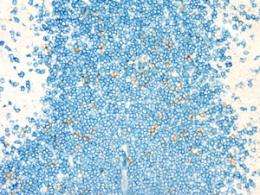
(PhysOrg.com) -- Five decades after the discovery of a rare but potentially pivotal immune cell, scientists at Washington University School of Medicine in St. Louis have found a way to eliminate it in mice.
The finding, which appears in the journal Immunity, will enable more detailed investigations of the important roles the plasmacytoid dendritic cell (pDC) plays in fighting viruses and causing autoimmune diseases like psoriasis and lupus.
“What we’ve learned so far suggests that these cells have significant influence in the immune system, but until now we haven’t had a good way to definitively assess those influences,” says senior author Marco Colonna, MD, professor of medicine and of pathology and immunology. “By allowing us to compare how the immune system responds with and without pDCs, these mice are going to be very useful.”
According to Colonna, the mice also will aid studies of autoimmune diseases and tumors that result from some skin infections, such as those caused by papilloma virus.
Scientists first identified pDCs in the 1950s in studies of lymph node tissue. They resemble plasma cells, which produce antibodies. But in 2000, Colonna showed that pDCs do not make antibodies. Instead, they produce interferon-alpha and interferon-beta, two immune compounds that block replication of viruses. Research has revealed that pDCs frequently are present when some autoimmune conditions, including psoriasis and lupus flare up. They also appear to be active when viral infections cause the skin to form tumors.
To eliminate the cells, Melissa Swiecki, PhD, a postdoctoral research associate, took advantage of a difference between mice and humans: Human cells have a receptor that makes them vulnerable to a toxin made by the diphtheria bacterium, but mouse cells lack that receptor. Swiecki and her collaborators genetically engineered mice so that only pDCs make the diphtheria toxin receptor. They showed this change made it possible to selectively kill the cells in a day with an injection of the toxin.
To demonstrate the new model’s usefulness, scientists infected mice lacking pDCs with two viruses. In one test, they gave the mice murine cytomegalovirus, which is similar to human cytomegalovirus, a herpes virus that infects 50 percent to 80 percent of human adults. In another, they gave the mice vesicular stomatitis virus, which infects the central nervous system and belongs to the same family as the rabies virus.
With the pDC eliminated, low and moderate doses of virus were more likely to cause prolonged infections, indicating the cells have a role in the early response to infection. At higher doses of virus, there was relatively little difference in the way the mice responded. Scientists speculate that this may be an indicator that the pDC's rareness limits its infection-fighting ability to mild and moderate infection.
In other respects, the effects of pDC elimination varied. In murine cytomegalovirus infections, levels of natural killer cells targeting the virus increased when pDCs were eliminated. According to the researchers, this rise compensates for the loss of virus-fighting interferon that pDCs normally produce.
During vesicular stomatitis virus infections, pDC loss reduced levels of CD8 T cells, immune cells custom-made to seek out and kill virus-infected cells. It's not clear yet if this results from reduced levels of the interferon normally made by pDCs, which is known to help CD8 cells survive. Another possible explanation is that the loss of the pDCs allows virus levels to rise, increasing activation of CD8 cells and exhausting them.
Colonna says, “There’s a need to calibrate the responses from the different branches of the immune system to make them as effective as possible, and our data suggest pDCs may help guide this calibration process.”
Researchers plan additional studies of the role of these cells in other viral infections, autoimmune conditions and skin tumors.
More information: Swiecki M, et al. Plasmacytoid dendritic cell ablation impacts early interferon responses and antiviral NK and CD8+ T cell accrual. Immunology, Dec. 22, 2010
Provided by Washington University School of Medicine in St. Louis


