Icicle shape stranger than thought (w/ Video)
December 21, 2010 By Devin Powell

Icicle Shape Stranger Than Thought

Enlarge

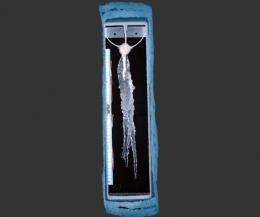
An icicle growing with multiple tips. Credit: Stephen W. Morris

Look out your window at the icicles beginning to grow on the edges of roofs and car bumpers, and you might think that all icicles are shaped the same -- long, straight and pointy.

But Canadian scientists have found that subtle differences in wind and water can produce icicles with strange shapes. Using an indoor icicle-making machine, the researchers have challenged a claiming that all icicles tend to grow towards the idealized cone-like they have in cartoons.

"The ideal icicle, the mathematically-minimum icicle, is elegant and beautiful," said icicle grower Stephen Morris, a physicist at the University of Toronto. "But the reality has turned out to be much more complicated."

An icicle grows because it is wet. As water runs down the surface of an icicle in a thin film, some freezes in the cold air, and the rest drips off the tip -- which isn't actually pointy but, under a magnifying glass, concave like an upside-down cup.

At the University of Arizona, Tucson, physicist Martin Short claimed last year that all icicles tend to grow towards an ideal shape and provided the physics rules needed to explain this shape.

Having grown up in the Southwest United States, Short has seen few icicles in his everyday life. He was inspired to study the winter phenomena after years of visiting Arizona caves and studying stalactites, which are also created by dripping water and grow downwards.

This video is not supported by your browser at this time.

A time lapse movie of an icicle growing from a rotating support. The total growth time is about 10 hours and the support rotates once every 4 minutes. Distilled water and gently stirred air were used. The icicle shows a nearly ideal self-similar shape

"I found that you could predict the ideal shape of stalactites," said Short. "We decided to study the shape of icicles based on the shape of stalactites."

The secret to the icicle's long and pointy form, he suggests, is the air around it. As dripping water freezes on the surface of an icicle, it releases heat into its surroundings. In still air, this warm air should rise, forming a blanket around the icicle. The tip stays colder than the base, keeping the top from growing wider as the wet tip freezes and elongates.

This effect, according to Short's calculations, should guide icicles towards a shape that tapers from wide to narrow according to a specific mathematic function.

"Most icicles should have this shape," said Short. "They want to have this specific (cone-like) form."

But Morris wasn't convinced by the seven photographs of icicles Short looked at to test this theory.

"We wanted to drive around and collect 100 icicles from roofs (to test the theory)," he said. "But that turns out to be not that easy to do."

Instead, he and Antony Szu-Han Chen built a device to grow 93 icicles under a variety of different conditions and different water sources. At the top of the device, a nozzle sprinkled water onto a growing icicle hanging from a platform that rotated rotisserie-style. The rotation, too slow to affect the shape of the icicle, helped to expose all sides of the growing icicle equally to a fan's cold breeze.

"It's like meat on a spit at a barbecue," said Morris. "We rotate it (one revolution every four minutes) to give the same treatment to all sides."

When fed by pure distilled water, the foot-and-a-half long icicles often formed points that resembled Short's predictions.

But the icicles were most cone-like not when the air was still, as theory predicted, but when the air was moving. In still air, the icicle often grew legs, forking into multiple tips.

The type of water also affected the shape. Icicles grown from tap water tended to bend and bulge.

Explaining this may require a closer look at these icicles, said Kazuto Ueno.

Instead of studying the overall shape of icicles, Ueno focuses on how the thin film of water freezes on the surface of an icicle. He works for the Canadian utility company Hydro-Québec and hopes to inspire better ways to combat icing problems on power lines and aircraft wings.

The surface of an icicle isn't always smooth. It's often covered with tiny ring-like ripples. In 2002 Ueno discovered that these ripples are always spaced the same distance apart.

This video is not supported by your browser at this time.

A time lapse movie of an icicle growing from a rotating support. The total growth time is about 10 hours and the support rotates once every 4 minutes. Tap water and still air were used. The icicle shows the growth of multiple tips and a rippling instability.

This video is not supported by your browser at this time.

A time lapse movie of an icicle growing from a rotating support. The total growth time is about 10 hours and the support rotates once every 4 minutes. Tap water and still air were used. The icicle shows a non-ideal shape and and a rippling instability.

"The distance between two peaks of ripples always measures around a centimeter scale, which is almost independent of air temperature, water flow rate and airflow," said Ueno, who developed a theory to explain this based on the surface tension of the water.

In Morris' experiments, published online to arxiv.org, these ripples appear to crawl up the sides of growing icicles as new ice is added. But, like the overall shape, the ripples are still not completely understood: Ueno's original theory predicted that they should appear to move downwards, in the same direction as the icicle's growth.

By putting theories to the test, the icicle-making machine may have raised more questions than it answered. But that's all part of the scientific process for Morris, who has spent a career exposing the complexity of objects in nature -- from sand dunes to turbulent .

"Some say you can see the world in a grain of sand," said Morris, quoting British poet William Blake. "I can also see it in an icicle."

More information: http://www.physics … icicles.html

Provided by Inside Science News Service search and more info website

4.3 /5 (8 votes)  

Filter


Move the slider to adjust rank threshold, so that you can hide some of the comments.


Display comments: newest first

Ratfish
Dec 21, 2010

Rank: 3 / 5 (4)
Kind of presumptuous for an Arizona physicist to tell Canadians about icicles. Good to see a rebuttal.
BillFox
Dec 21, 2010

Rank: 1 / 5 (1)
Good to see the trolls around still.
Ratfish
Dec 21, 2010

Rank: not rated yet
Good to see the trolls around still.


Good to see you attended your family reunion.
fmfbrestel
Dec 21, 2010

Rank: 5 / 5 (3)
Who trolls on an icicle article? You want to see trolls go read the comments on something relating to evolution, the LHC, or global warming. comments on those are about 90% troll.

Anyway, this really doesn't surprise me, hydrodynamics is inherently chaotic. Sure the idealized cone might be a strange attractor, but there are way too many factors involved.

Not sure why the ripples require new explanation, heard something on NBC durring the olympics about ice rippling on the skating rinks, and the 'ice master' (or something) was on talking about the surface tension, and how freezing at different temperatures creates different amounts of rippling, and how refreezing just the top layer tends to make more ripples, and on and on. These guys need to go talk to the maintenance crew for an NHL team.

rgwalther
Dec 22, 2010

Rank: not rated yet
Merry Christmas from Billy Goat Gruff.
El_Nose
Dec 22, 2010

Rank: not rated yet
well if no one is going to say it I will -- leave it to a Canadian to study icicles... I love it.
fmfbrestel
Dec 22, 2010

Rank: not rated yet
well, actually, the first post on this article said it....
Rank 4.3 /5 (8 votes)
Relevant PhysicsForums posts
  • Water under pressure and temperature effects
    created9 hours ago
  • Flow, different liquid, pressure
    created9 hours ago
  • Dimensions and Degrees of Freedom
    created10 hours ago
  • Rotational Inertia of a disc
    created11 hours ago
  • How does B=μH really work?
    created11 hours ago
  • I need help with understanding of Inertia of a slender rod and plate?
    created14 hours ago
  • More from Physics Forums - General Physics

More news stories

Landmark calculation clears the way to answering how matter is formed

(Phys.org) -- An international collaboration of scientists, including Thomas Blum, associate professor of physics, is reporting in landmark detail the decay process of a subatomic particle called a kaon – ...

Physics / General Physics

created 22 hours ago | popularity 4.8 / 5 (12) | comments 29 | with audio podcast

Is a classical electrodynamics law incompatible with special relativity?

(Phys.org) -- The laws of classical electromagnetism that were developed in the 19th century are the same laws that scientists use today. They include Maxwell’s four equations along with the Lorentz la ...

Physics / General Physics

created May 24, 2012 | popularity 4.7 / 5 (14) | comments 30 | with audio podcast feature

Lying in wait for WIMPs: Researchers seek to dramatically increase sensitivity of Large Underground Xenon detector

Although it's invisible, dark matter accounts for at least 80 percent of the matter in the universe. No one knows what it is, but most scientists would bet on weakly interacting massive particles, or WIMPs.

Physics / General Physics

created May 23, 2012 | popularity 4 / 5 (5) | comments 14 | with audio podcast

Hall effect at the speed of light: How can you demonstrate relativistic effects with your mobile phone?

The relativistic Hall effect describing objects rotating at speeds comparable with the speed of light has been reported.

Physics / General Physics

created May 21, 2012 | popularity 4.3 / 5 (3) | comments 8

Cloak of invisibility: Engineers use plasmonics to create an invisible photodetector

A team of engineers at Stanford and the University of Pennsylvania has for the first time used "plasmonic cloaking" to create a device that can see without being seen - an invisible machine that detects light. It is the first ...

Physics / General Physics

created May 21, 2012 | popularity 4.8 / 5 (16) | comments 7 | with audio podcast


Of mice and mental models: Neuroscientific implications of risk-optimized behavior in the mouse

(Medical Xpress) -- Regardless of an organism’s biological complexity, every encephalized animal continuously makes under-informed behavioral choices that can have serious consequences. Despite its ubiquity, ...

Dragon arrives at space station in historic 1st (Update 2)

The privately bankrolled Dragon capsule made a historic arrival at the International Space Station on Friday, triumphantly captured by astronauts wielding a giant robot arm.

High-speed method to aid search for solar energy storage catalysts

Eons ago, nature solved the problem of converting solar energy to fuels by inventing the process of photosynthesis.

It's in the genes: Research pinpoints how plants know when to flower

Scientists believe they've pinpointed the last crucial piece of the 80-year-old puzzle of how plants "know" when to flower.

Researchers solve structure of human protein critical for silencing genes

In a study published in the journal Cell on May 24, Cold Spring Harbor Laboratory (CSHL) scientists describe the three-dimensional atomic structure of a human protein bound to a piece of RNA that "guides" the pr ...

MIT researchers devise new means to synchronize a group of robots (w/ Video)

(Phys.org) -- For several years, roboticists have been working out ways to get a group of robots to perform synchronized activities as demonstrated most often in dance routines. It’s not just about trying ...